

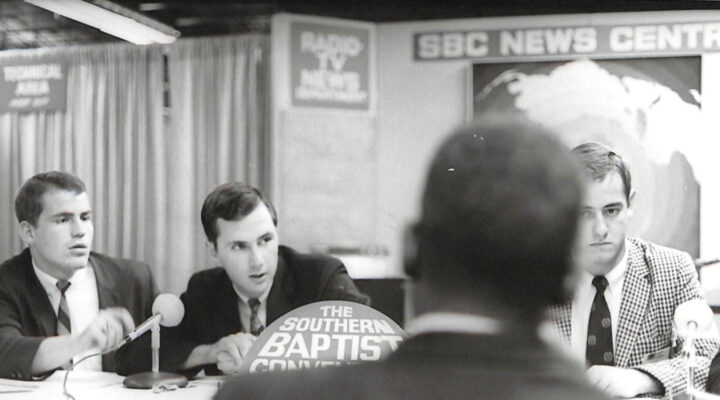
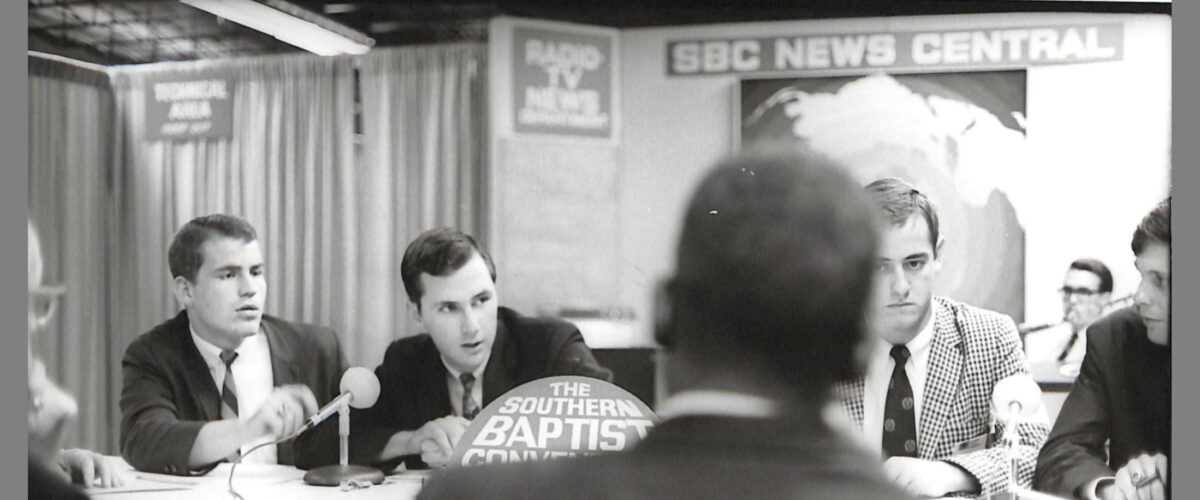
I can regularly count on late May and June as a time when news about the annual meeting of the Southern Baptist Convention begins to circulate. This year was no exception. It seems this year dealing with charges of sexual abuse in churches and purging the SBC of churches that have women in roles thought best to be inhabited by men are two indicators of the direction in which it is headed.
I am reminded of another SBC convention, 57 years ago (1968), for which the time leading up to the actual meeting was spent discussing how to respond to prominent social issues of the day like racism, poverty and the Vietnam War. Women had begun to study at the seminaries and prepare for roles in ministry. Denominational leaders were leading the way by preparing a statement on the “Crisis in Our Nation” for consideration and adoption by the messengers in attendance.
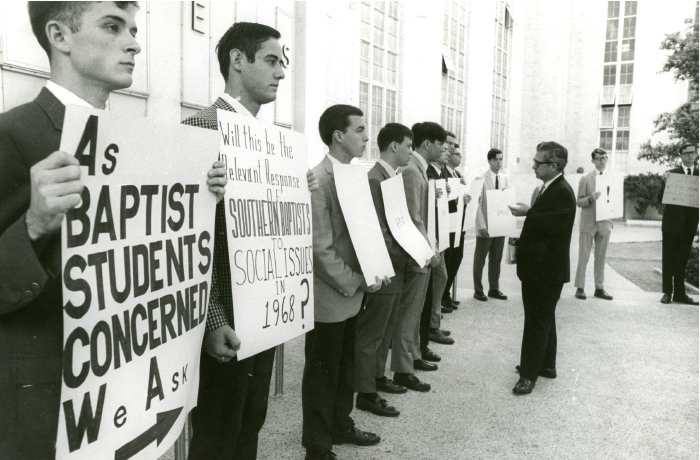
Students picketing outside convention hall in Houston 1968 (Photo: Southern Baptist Historical Library and Archives)
A group of college students active in the North Carolina Baptist Student Union were frustrated that more had not been done by the SBC to address the social issues exploding on the national scene. They believed they should go in person to the annual meeting as messengers from their local churches.
They wanted to announce their presence and the importance of moving the SBC in a more progressive direction by picketing at the convention hall and by registering as messengers to vote their consciences on the issues. News about the SBC statement encouraged them, and an organization called Baptist Students Concerned was formed.
When the students announced their plans to the staff leadership of the SBC in Nashville, they were welcomed with open arms. Leaders like Foy Valentine of the Christian Life Commission, W.C. Fields of Baptist Press and Porter Routh of the Executive Committee paved the way for them and arranged a forum and a press conference in which they could share their views with messengers and the press. Leading editors of state Baptist papers, like Chauncey Daley of the Western Recorder (Kentucky) and Marse Grant of the Biblical Recorder (North Carolina), praised them and welcomed their presence at the convention.
The meeting went well. The students did picket in front of the convention hall, and they also presented their views to the other messengers and the press. The statement on the “Crisis in Our Nation” was adopted by a significant majority. A Baptist Press summary of the convention shortly afterward said the 1968 meeting was a “turning point in the history of the nation’s largest Protestant denomination.”
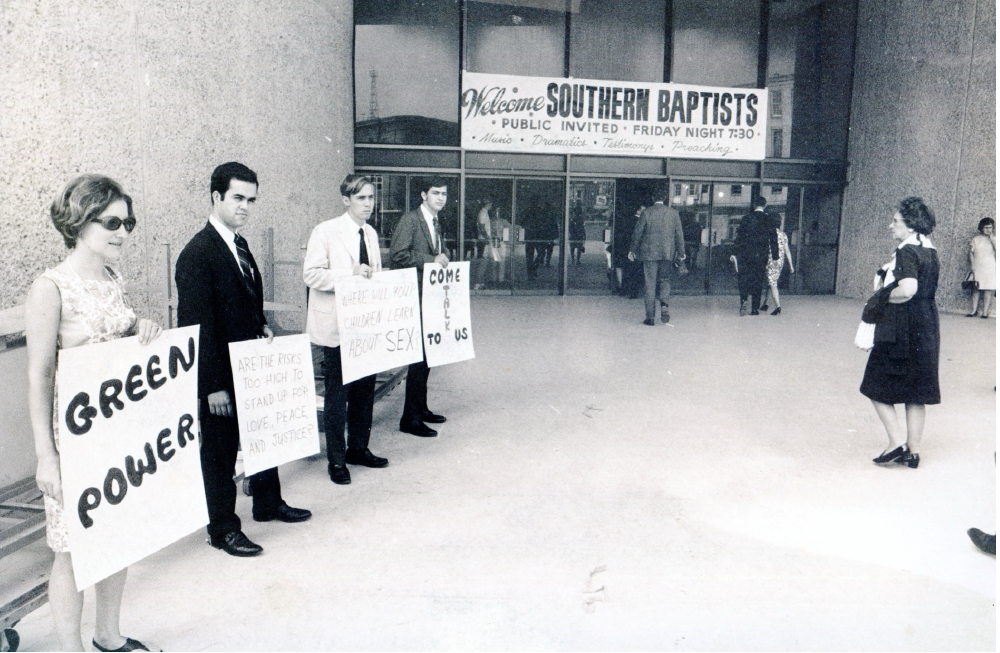
Picketing outside convention hall in New Orleans, 1969 (Photo: Southern Baptist Historical Library and Archives)
Building on the momentum of their success, plans were made to have a similar presence at the 1969 SBC annual meeting. In addition, others, including their elders, had noticed their presence mattered and responded with proposals to advance the discussion of social issues in the SBC.
Denominational leaders invited a group of students and BSU leaders to Nashville in January 1969. There was a conclave on ways students could contribute to the work of SBC churches responding more forcefully to the social issues of the day. Twenty-five pages of suggestions were accumulated.
Harper Shannon, president of the SBC Pastor’s Conference, invited two of the students to serve on a panel discussing these issues at the 1969 annual Pastor’s Conference preceding the convention meeting. A group of pastors and professors at Baptist colleges formed their own organization in parallel to that of the students. It was called the E.Y. Mullins Fellowship. They planned and hosted a pre-convention meeting, like that of the Pastor’s Conference. They also nominated a candidate to run for the office of president of the SBC in opposition to W.A. Criswell, who was running for the commonly presumed second term in office.
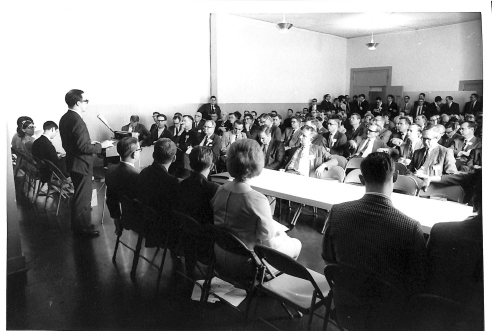
Report to leaders and messengers in Houston, 1968, arranged by Foy Valentine (Photo: Southern Baptist Historical Library and Archives)
The 1969 convention meeting had both high and low points for the students and the pastors and professors who joined them. Two students did participate in the Pastor’s Conference forum prior to the actual meeting. W.C. Fields of Baptist Press hosted another press conference for sharing of their views with the public. One of the students offered a resolution proposing that the Baptist Sunday School Board publish a series of materials on the topic of sex education for use in local churches, and that was adopted. (The materials were published in 1973.) The low point was the loss of the election for president by their friend and mentor.
Later in 1969 a movie, Dimensions of Courage, was produced by the SBC for release at the 1970 convention in honor of the 125th anniversary of the founding of the SBC. It included stories of churches addressing social issues in their own ministries and included several minutes of footage of the Baptist Students Concerned press conference in 1969.
Momentum was difficult to sustain after the 1969 meeting as the students were graduating, entering graduate schools (including a number who attended seminary), and beginning careers. No formal presence was prepared for the 1970 convention. One student attended with the support of others.
Conservative pastors, having taken note of the students’ success, determined the progressive movement needed to be reined in. At the 1970 meeting, they focused the intention not to let the convention move to the left by banning Volume 1 of the Broadman Bible Commentary. A few years later the “takeover” (or the “conservative resurgence”) began in earnest, and the results of that are well known.
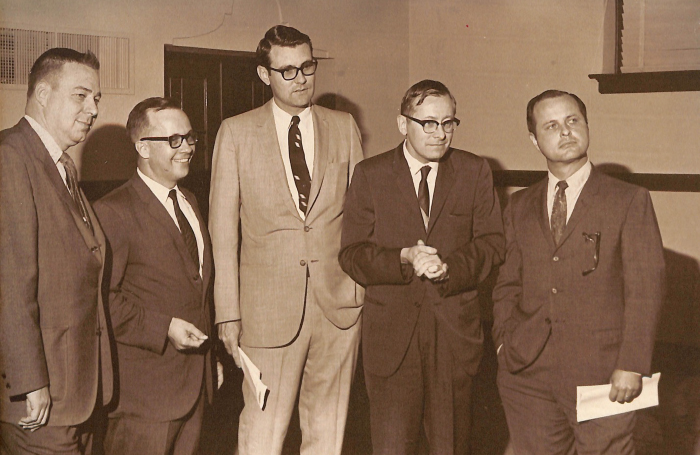
Founders of the E.Y. Mullins Fellowship (Photo: Southern Baptist Historical Library and Archives)
Steve Harmon noted in an article for BNG that there are indicators a “genuinely progressive trajectory” existed in the SBC in the 1970s. As evidence, he cited publications by Broadman Press from that period. The work of Baptist Students Concerned offers further evidence of his claim. Perhaps they can even be seen as having contributed to that trend.
One poignant suggestion by Harmon is that “things could have been otherwise than they are now in the SBC.” The students purposely stayed within the bounds of the SBC of their day. It was their honorable heritage. They were not outsiders casting aspersion. They were sons and daughters of the convention hoping for incremental change.
It was not to be. In the debate about banning the commentary in 1970, one messenger summed up the direction forward. He noted that some had said that among our ranks there is room for this opinion and that opinion and yet another. Brothers and sisters, he said, “That’s too much room.”
The story of the SBC between the storied meeting of Paige Patterson and Paul Pressler at the Café du Monde in New Orleans in 1967 and the turning point of the 1979 convention meeting should be told more carefully. We can’t undo the history, but we can be cognizant of the contributions of those who were the forebearers of the work that continues to maintain a truly Baptist witness in our troubled age.
Stuart R. Sprague is emeritus professor of religion and philosophy at Anderson University and held clinical appointment as associate professor of family medicine at the Medical University of South Carolina. He earned a bachelor of science degree in chemistry from Duke University and a master of divinity and Ph.D. from Southern Baptist Theological Seminary in Louisville, Ky. He and his wife, Sarah, are active members of Boulevard Baptist Church in Anderson, S.C.