

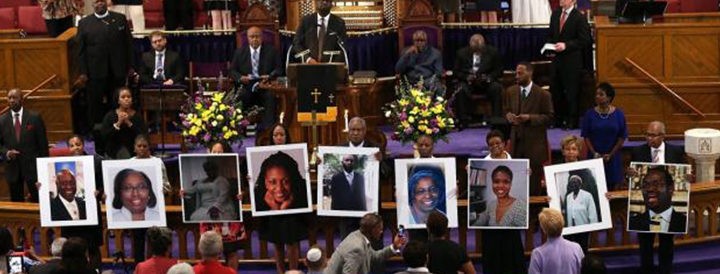

Ten years ago this month, Pastor Clementa Pinckney and eight church members of Mother Emanuel African Methodist Episcopal Church in Charleston, S.C., were murdered in a racist act by someone who believed lies about American history and its diverse people.
The shooter learned from people who knew better. The massacre was a tragedy not new to the congregation he entered on that Wednesday night.
This anniversary of a tragic racial massacre must remind us that the storyline must be interrupted.

Lovett H. Weems Jr.
One of Mother Emanuel’s early leaders, Denmark Vesey, was brought to Charleston as a slave. In the late 18th century, lotteries — while disapproved of as a form of gambling — still were commonly used for city capital projects and even church construction. Denmark Vesey, with money earned from being “hired out” as a carpenter beyond his duties for his owner, won such a lottery and purchased his freedom in 1799.
Vesey first joined Second Presbyterian Church before leaving to help start what became Mother Emanuel African Methodist Episcopal Church. Suspicions among whites about the church’s activities arose from the beginning since there was no white supervision of what happened there. The church was shut down twice in its early years despite being the second largest AME church in the country at the time.
In 1822, Vesey helped plan a revolt among slaves for their freedom. Before it could take place, word reached beyond the slave community, and Vesey and his allies were arrested. Thirty-two were deported, and 35 were executed, including Vesey. Mother Emanuel was burned to the ground.
Almost 200 years later, after much controversy, a monument to Denmark Vesey was erected — deliberately placed away from the heart of the city, apparently a compromise with those against any recognition. When the current pastor of Mother Emanuel arrived for the dedication ceremony for the monument in 2015, he had no way of knowing that he, too, would be dead within months at the hand of a gunman still loyal to the flag of the Confederacy.
At the Vesey Monument dedication, Pastor Pinckney (who also was a state senator) said Vesey never expected the furor or backlash. Vesey was a patriot, he explained, deeply invested in achieving the ideals stated in the U.S. Constitution and willing to fight to make sure that freedom was for all people. Pinckney continued his message in a spirit of reconciliation, just as he exhibited when a stranger appeared at their church’s weekly Bible Study in June. Everyone welcomed the visitor with a place made for him to sit by the pastor. Dylann Roof later would murder Pastor Pinckney and eight church members.
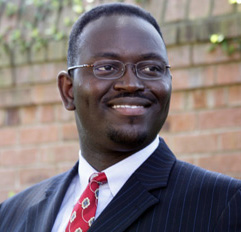
Clementa PInckney
In his eulogy for Clementa Pinckney, President Barack Obama drew from Scripture: “They were still living by faith when they died. They did not receive the things promised; they only saw them and welcomed them from a distance.” The “distance” today from those promises still appears so far away. Can 200 years make so little difference?
Pinckney embodied the love of God and neighbor Christ preached. He did it through his historic congregation as they sought to fulfill their mission from God. He also did so in the public arena where he worked for the common good. We witnessed it also in the classroom. Pinckney is one of three pastors of Mother Emanuel I have had the privilege to teach over the years. Unfortunately, his degree had to be presented posthumously to his wife and two young daughters in 2016.
This tragedy is surely not the only one that has resulted from lies about the history of our country and falsehoods perpetuated for two centuries that prepared the way for a young man to believe he had to kill Black people before his own race was destroyed. But it is the one that has profoundly deepened and shaped my sense of responsibility to call religious leadership to speak the truth and reject — and stop ignoring — the falsehoods that led to Dylann Roof’s fateful acts.
“Religious leadership must begin with the truth.”
Religious leadership must begin with the truth. We are called to counter the tales of supposed bias against those who enjoy the most historical advantages in our country and affirm the history of those who have suffered the longest. We must call into question the claims of bias against Christians, when we are overwhelmingly among those of great influence.
There is no need to argue. Seldom has that changed minds. But at this time in history, it is required of religious leaders that we avoid narratives formulated for political advantages that rarely are sufficient for making moral and ethical decisions.
Certainly, we can create opportunities for people to learn that there are more legitimate ways of thinking than one, and we can invite them to consider and explore others. We owe that to the nine faithful Christians who died in Charleston 10 years ago.
But they were not the first to suffer nor have they been the last. This anniversary of a tragic racial massacre must remind us that the storyline must be interrupted. Time alone will not end the suffering.
We are called to become active agents of defining reality with eyes of faith that look at every circumstance asking, “Does this embody love of God and love of neighbor?”
Lovett H. Weems Jr. is distinguished professor of church leadership emeritus at Wesley Theological Seminary in Washington, D.C., and senior consultant at its Lewis Center for Church Leadership. His latest book is The Right Questions for Church Leaders.
Related articles:
Saving our churches from Dylann Roof’s white Jesus | Opinion by Robert P. Jones
The Mother Emanuel Nine and the Parable of the Sower and the Soils | Opinion by George Bullard
‘God bless white America’: Why we need to overturn white racial mythologies | Opinion by Greg Garrett