

“Your church probably is not growing, and that’s OK,” Ryan Burge, a leading analyst of politics and religion, told a Cooperative Baptist Fellowship gathering June 24 in St. Louis.
But that doesn’t signal a cause for apathy or despair, he said, telling participants they can “literally change the world.”
Burge presented a spectrum of findings about American church membership and involvement during the first day of CBF’s annual General Assembly. CBF Congregational Ministries and the Center for Healthy Churches co-sponsored the pre-assembly event, attended by about 90 church leaders.
He is associate professor of political science at Eastern Illinois University in Charleston, Ill. He will become a professor at Washington University in St. Louis Aug. 1, he announced.
“A lot of things I’m going to tell you today are reflection of how I live with myself,” Burge said, noting he was bivocational pastor of First Baptist Church in Mount Vernon, Ill., more than 17 years, until the 156-year-old congregation closed in 2024.
Long slope of decline
“American religion has been declining for as long as we have data,” Burge said. “A lot of pastors have experienced the same thing I experienced. … You don’t have to hold yourself to a standard no one can meet.”
“We were never as pious as you were led to believe,” he reported. “It’s just that we get nostalgic and grind off the parts we don’t like. … We have a distorted view of the past.”
“We have a distorted view of the past.”
For example, “even in the Colonial period, less than 15% of the population were members of a church,” he said. “We’re doing better than that today.”
“We actually were fairly religious in the 1950s, but it was not the kind of religion evangelicals like these days,” he added, recalling how Mainline Protestant denominations — the kinds of Methodists and Presbyterians and others evangelicals call “liberal” — dominated.
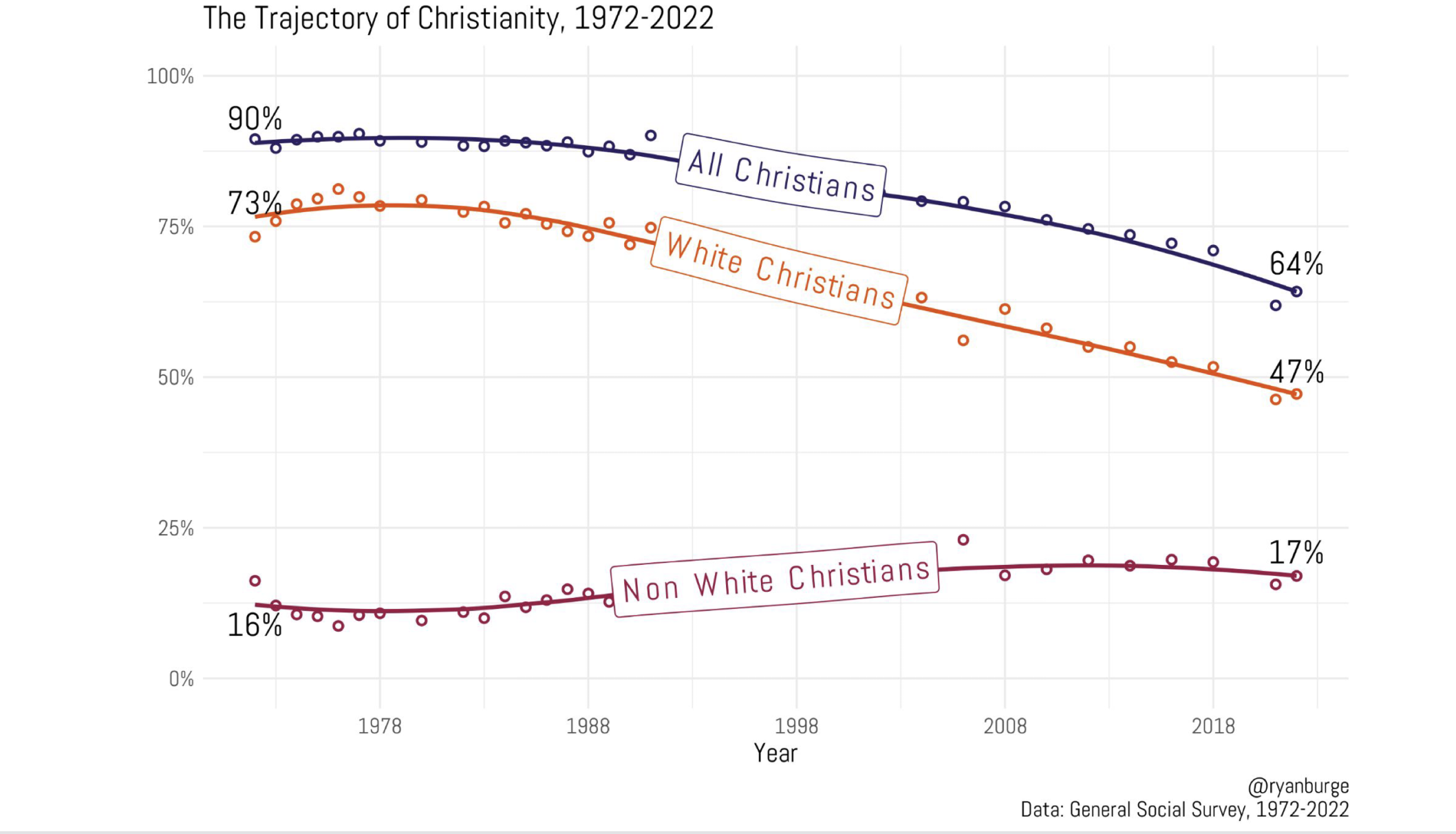
Burge presented reports that tracked U.S. religion for the 50-year period from 1972 to 1922. Across that span, the portion of Americans who said they were Christian fell from 90% to 64%.
A graph that charted the decline revealed a parallel arc that showed how the percentage of white Christians in America dropped from 73% to 47% over the same period.
“The share of American Christians who are white has dropped because share of Americans are white has dropped,” he explained, noting the percentage of Americans who are white is less now than it was 50 years ago.
“So, the decline of all Christians in America is directly attributable to the decline in (the percentage of) white Americans,” he stressed.
Citing a modest bit of good news, the overall decline “has leveled off the past five years,” he said.
The Nones
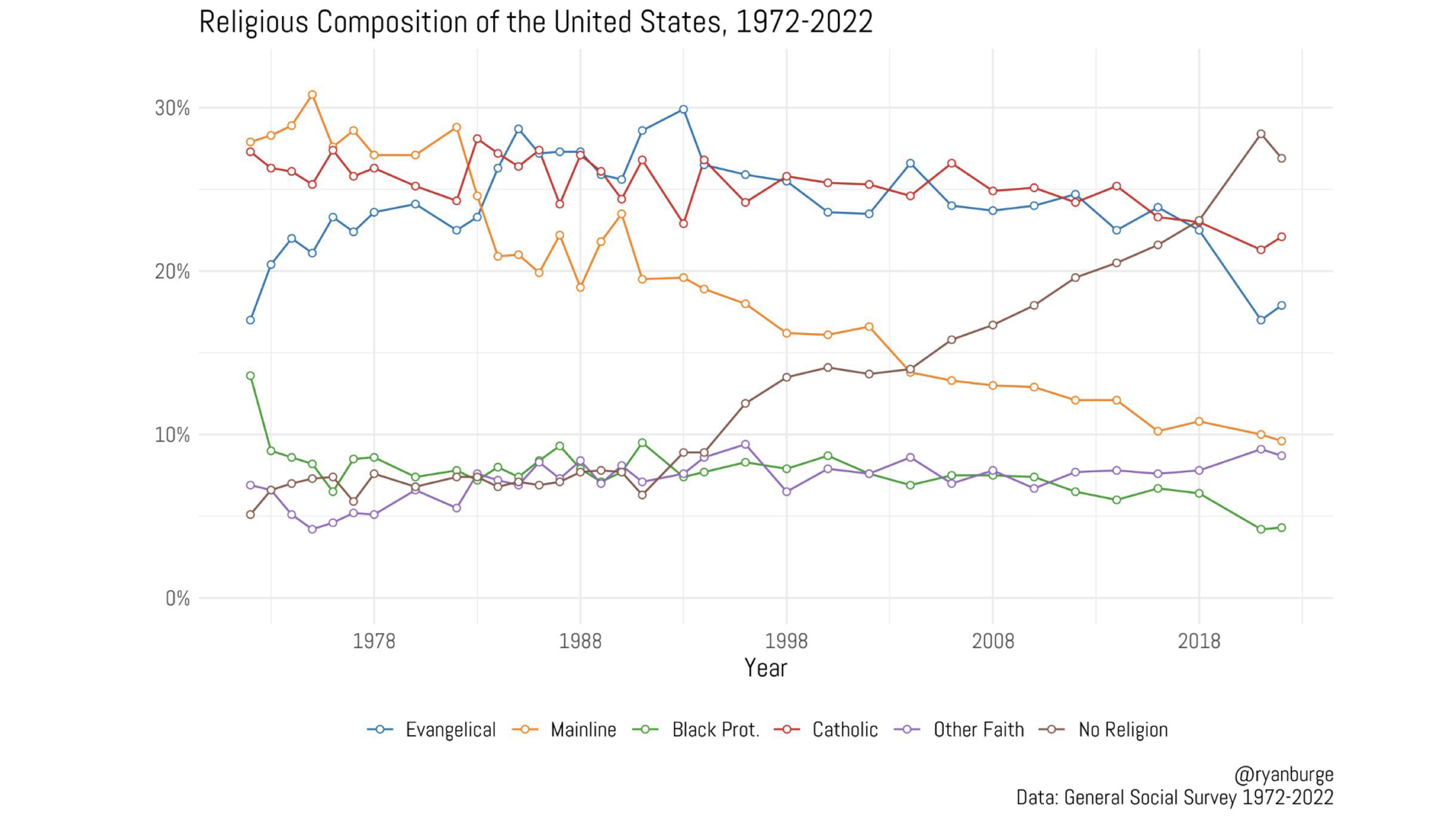
The biggest changes happened to the Mainlines and the Nones, or people who check “none” when asked to state their religious preference.
In 1972, a plurality of Americans — almost 30% — were affiliated with Mainline churches, he said. That number dropped to less than 10% by 2022. Meanwhile, nones became the largest religious classification, increasing from 5% to more than 25%.
Acknowledging “most Americans are religious by default,” Burge added: “Here’s the big problem — a lot of people will leave religion as they age. Your (faith group’s) retention rate is the most important figure no one tracks.”
“Your (faith group’s) retention rate is the most important figure no one tracks.”
A group’s retention is the percentage of adherents who are still affiliated with the same tradition in which they were raised, he said. Retention marks how well the groups do at keeping children who were raised in the faith within the fold.
Across decades and the religious spectrum, evangelicals did the best at holding their own. Their retention rate fell from 78% to 73%. Mainliners were the biggest losers, dropping from 76% to 58%. “Retention is a problem, because there are no people of childbearing age in these churches,” he said.
Retention is particularly challenging for the religious groups because “conversion is incredibly hard and incredibly rare,” Burge said. “If you don’t have kids in your church, you can’t convert yourself out of that (decline) in most cases.”
Overall, Nones were the biggest winners, with their retention rate almost doubling, from 36% to 66%. “It’s the only group where the retention rate is rising,” he said.
Burge countered a popular notion that Nones primarily are composed of atheists. “That’s a bad understanding,” he said. In 2024, Nones comprised 34% of Americans, with the breakdown revealing 7% atheists, 6% agnostics and 21% “nothing in particular.”
“The ‘nothing in particular’ are nonreligious and, in some ways, the most troubling group in America,” he said. “They have the lowest education. They’re the least politically engaged. Thirty-three percent have a high school diploma or less. Not only are they behind; they’re falling further behind every year. And, boy, is despair tough.”
Nondenoms
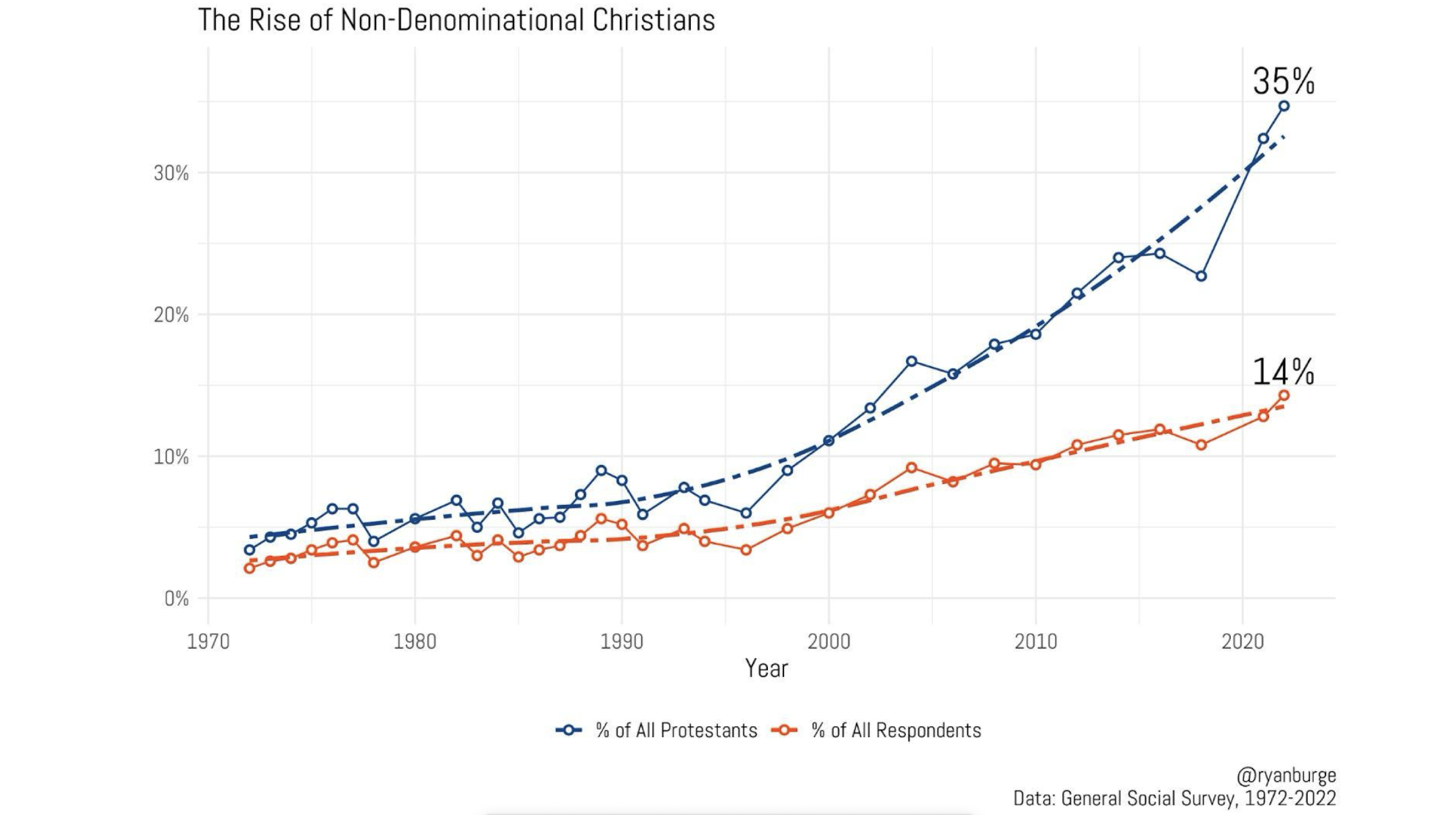
While the rise of the Nones is the biggest religious story across the past 50 years, the rise of the Nons — members of nondenominational churches — is the second-biggest, Burge reported.
Nondenominational church membership accounts for 35% of all U.S. Christians and 14% of all Americans, he said, adding, “They don’t get coverage, but that’s what evangelicalism looks like.”
The reason nondenominational congregations don’t get greater coverage is because “fiefdoms of nondenoms don’t talk to each other” but exist independently.
The share of Americans who have no religious affiliation is increasing by generation, Burge said. For example, the generations and the percent who are unaffiliated are:
- Silent Generation (born 1925-45), 19%
- Boomers (1946-64), 24%
- Gen X (1965-76), 31%
- Millennials (1977-95), 42%
- Gen Z (1996-present), 46%
Generations aside, “the strongest factor of whether you are religious or nonreligious is what your politics are,” he said. “You are almost six times more likely to be nonreligious if you are a liberal than a conservative.”
External forces
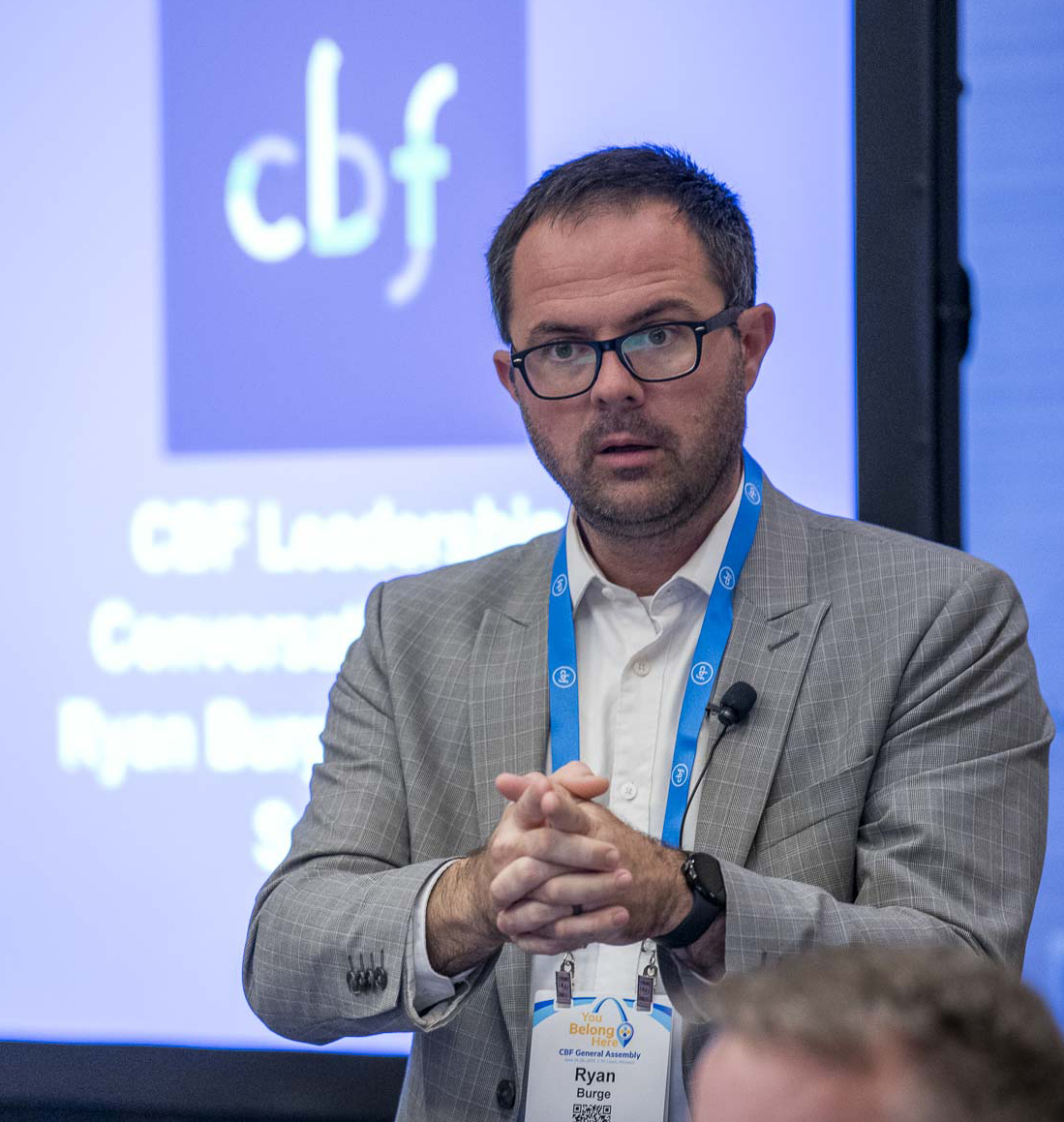
Ryan Burge (Photo: CBF communications)
Focusing on the dynamics of individual congregations that impact growth or decline, Burge stressed external dynamics drastically — and sometimes irreversibly — impact congregational affiliation or membership.
For example, the population growth or decline of the county in which a church is located strongly correlates to the growth or decline of the church, he said.
He compared the 100 fastest-growing churches in America as cited by Outreach magazine to the U.S. Census data for all counties in America. Of all U.S. counties, the 54% that declined accounted for just 7% of the fastest-growing churches. Meanwhile, the 4% of all counties that grew by 20% or more accounted for 18% of the fastest-growing churches.
Other contributors to fast-growing congregations include education of the population and optimal population density found in suburbs near urban cores. “At the end of the day, it’s hard to outrun demographics,” he said.
These factors point toward what Burge called “tailwinds” and “headwinds” that impact growth or decline. Tailwinds are local or social factors that make growth easy, and headwinds are the factors that work against growth.
“If your church is not growing, it’s not all your fault. If your church is growing, it’s not all your doing.”
“If your church is not growing, it’s not all your fault. If your church is growing, it’s not all your doing,” he observed.
Burge urged participants to help their church members “say what your church should be in 10 years; that should be your North Star. … Lead your church in a collaborative way. Have the tough conversations … and trust your people are with you.”
“God called you to be faithful, not successful,” he said. “God sees you. God honors you. God just wants you to put your shoulder to the wheel and push.”
Pastorally, he also called for church leaders to tune their hearts.
“The most important dispositional change you can make is gratitude,” he said, citing advances in medicine and science that make life safer, longer and more productive.
“Nothing has changed my life more than turning my heart toward gratitude and thanksgiving,” he insisted. “This is the greatest moment in the history of the world, and you can literally change the world” turning people toward Jesus.
Related articles:
Burge sees danger in ‘political monoculture’ of evangelicalism
Ryan Burge explains ‘casual dechurching’
Here’s what I’m learning about the ‘nones’