

I remember the yellow first. It shimmered in the early light. —draped across the pulpit, woven into the choir rail, curling like a ribbon around the sanctuary ceiling. Yellow is the royal color in Thailand, the color of loyalty to the king. And on this Sunday — “King’s Sunday,” they called it — there was no mistaking whose story we had gathered to tell.
A framed portrait of the king and queen stood beside the altar, flanked by flowers and candles. The melodies in the bulletin were hauntingly familiar. One was the Thai national anthem, set to the tune of America the Beautiful. The other was The King’s Song — a kind of royal hymn played before every public event in the country. You couldn’t go to a movie without standing for it. The lights would dim, the music would swell, and the screen would fill with reverent images: The king blessing farmers, comforting children, decorating soldiers. No one whispered. No one slouched. You stood.

Jason Edwards
It was holy — not the kind that invites you to take off your shoes, but the kind that demands stillness, deference, allegiance.
That morning, a government official preached — not about Jesus, but about the goodness of the king. His compassion. His wisdom. His divine authority to rule. I remember thinking: This is what empire worship looks like.
And then, just as quickly: Would we even recognize it if we saw it at home?
Because here’s the truth I still wrestle with. Most American Christians I know would’ve named what I witnessed that day for what it was: nationalism dressed up like liturgy. They would’ve heard the sermon and smelled the incense of state power. They’d have said, “That’s not what church is for.”
“We can recognize empire easily when it wears someone else’s crown.”
But swap the king’s portrait for the American flag. Swap The King’s Song for God Bless America. Swap the state emissary for a local politician offering a few words before the sermon. And suddenly, it’s just July Fourth Sunday. No one blinks.
We can recognize empire easily when it wears someone else’s crown. We struggle when it wears our colors.
The phrase “Christian nationalism” makes headlines and hashtags. It gets used to describe the fringe, the flag-wavers with bullhorns and homemade signs. But the deeper issue isn’t always loud. Sometimes, it’s quiet. It’s folded into hymns and habits, tucked between the Pledge of Allegiance and the opening prayer. It’s not just a movement. It’s a formation.
As Southern Baptist leader Russell Moore put it, many Christians are being catechized more by their newsfeeds than by the Beatitudes. That line has lodged itself in my imagination—not because it’s provocative, but because it’s accurate. We’ve been shaped by a story that prizes strength, certainty and control. We know how to kneel at the altar, but we’ve forgotten how to kneel without clenching a fist.
And so the real danger is not in the dramatic betrayal of the gospel, but in the slow, subtle blending of loyalties. It’s the creeping confusion between civic pride and sacred trust. It’s when our sanctuaries start to sound more like campaign rallies than places where the poor are blessed and the meek are lifted up.
“We know how to kneel at the altar, but we’ve forgotten how to kneel without clenching a fist.”
Most people aren’t trying to worship empire. They’re trying to be faithful. But when patriotism becomes liturgy, when love of country is sewn into the seams of our theology, it becomes harder to tell where one ends and the other begins. That’s what makes this so hard to name — and so urgent to address. Because if we only imagine Christian nationalism as the problem of “those people,” we’ll never see how it quietly shapes us too.
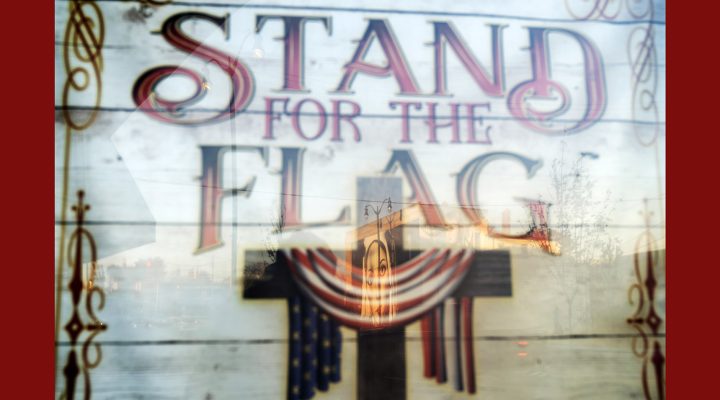
A prominent pastor friend has shared: “It’s everywhere. Even in churches that would never call it that.” And I’ve seen it. Churches filled with good-hearted people, who just never noticed their gospel came with a flag stitched to the cross. Our work, then, is not just to expose or condemn; it’s to disciple. To form hearts and imaginations that know the difference between following Jesus and pledging allegiance to something smaller.
Amanda Tyler and Baptist Joint Committee have shown that Christian nationalism is more than a theological error — it’s a civic threat. But deeper still, it is a spiritual distortion: a version of faith that bows to power instead of truth, that forgets the gospel is always good news for the poor and unsettling news for the powerful.
We’re not trying to ban flags or shame anyone who sings the national anthem with pride. This is not about scolding. It’s about asking the deeper question: What kind of people are we becoming? Are we forming citizens of the kingdom of God or defenders of an idealized nation? Are we raising disciples who know how to love their enemies or only those who share their politics? Are our churches places of sanctuary or staging grounds for cultural defense?
Brian Zahnd calls us to cruciform Christianity — a faith shaped by the Cross, not by the sword. That’s the invitation, to be a people who lay down power for love, who tell the truth even when it costs something, who believe mercy outlasts might. This doesn’t mean withdrawing from public life. It means entering it more deeply, more faithfully. Less spectacle, more substance. Less panic, more presence. It means worship that looks like Jesus — open hands, broken bread, unarmed love.
Maybe it begins with sight. With learning to recognize the ways our sanctuaries have been slowly shaped by other stories. With noticing when the rhythms of our worship owe more to national myth than to resurrection hope. And maybe it continues with a kind of holy unlearning — not shame, not outrage, but remembering.
That Jesus didn’t come waving a flag. He came carrying a cross. That his kingdom doesn’t need votes to endure. That the church is not the chaplain of the state, it’s the body of Christ. The presence of grace. The table where enemies eat together.
When we forget that — even for sincere reasons, even with the best intentions — we lose something essential. So, may we remember. May we be people who pray without pretending, who sing without dominion, who love our country without confusing it for our Christ.
Because in the end, the king’s song will fade. But the Cross still stands.
Jason G. Edwards is a pastor and writer from Liberty, Missouri, where he serves Second Baptist Church, a congregation learning to make room by the fire for everyone. Find his poetry, prose and blessings at jasongedwards.com.
Related articles:
Don’t be a Stormtrooper: Moral clarity in story and in life | Opinion by Greg Garrett
The lies my country taught me | Opinion by Richard T. Hughes
Nazi ideology wrapped in an American flag | Opinion by Stephen Shoemaker