


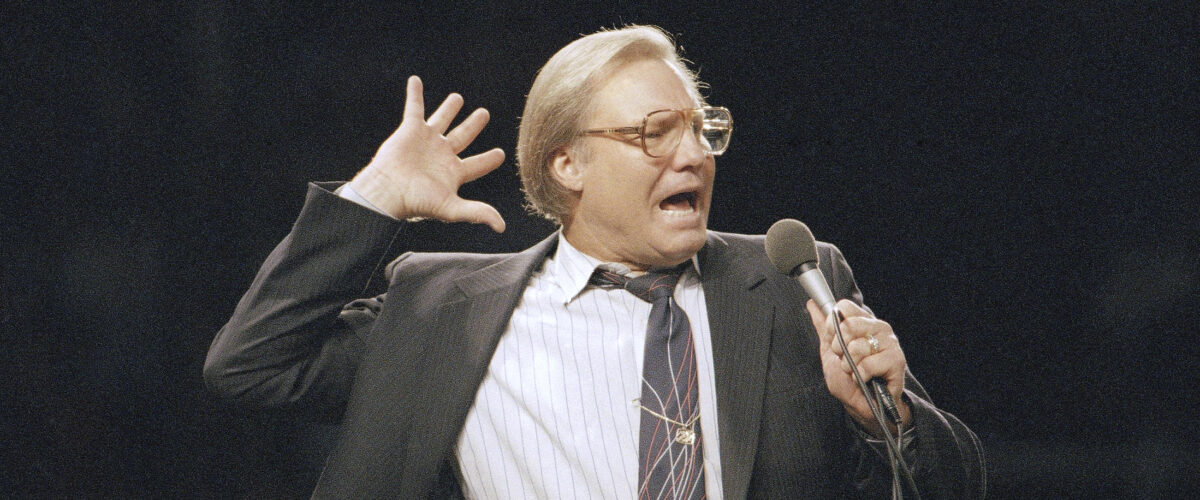
Jimmy Swaggart has died at the age 90. Swaggart was born and raised in the heart of Louisiana and ended up being rooted there to do what he and his followers would call “the Lord’s work” in Baton Rouge.
As a child, I can remember watching him every Saturday morning; yes, instead of watching cartoons like most children, you could find me front and center in my house in Orlando, tuned into the music and preaching of his weekly broadcast. My mom would even allow me to send my allowance into his ministry to buy cassette tapes and lapel pins.

Maina Mwaura
I was hooked by his folksy sound and couldn’t step away long enough to think through who the man was. Growing up, my father was Greek Orthodox, so he found my behavior not only odd but concerning.
Swaggart rose to fame from deep Southern Pentecostal roots with a family full of musicians, such as his cousins Jerry Lee Lewis and Mickey Gilley. There never was a time in life when music and preaching were apart from one another for him.
Swaggart was different from his cousins, who were performing for secular audiences. In fact, it’s been told that he turned down the lucrative contracts that were given to his cousins to preach the gospel instead.
Swaggart still appealed to the masses during the rise of American evangelicalism in the 1980s. There would be no Moral Majority without him, and although the relationship between he and Jerry Falwell was complex, they were in lockstep with one another in how they saw the world and the power evangelicals should have on America and the world.
Later in life, Swaggart’s cousin Jerry Lee Lewis also became close friends with Jerry Falwell Jr., to the extent of giving him a car.
As a child, I was immersed with both families, growing up in a conservative Southern Baptist home and church. I attended Liberty University for my undergraduate degree.
My dad, however, hated that I was immersed with Swaggart and would routinely caution my mother on buying his materials. However, like many evangelicals, I was hooked, until his fall from grace many evangelicals had to wrestle with. My mother ultimately stopped letting me watch him on TV for several reasons, one of them being having to explain to me what prostitution is.
Throughout the 1980s, Swaggart was routinely preaching against the same sinful behavior he was indulging in during his frequent visits to patronize prostitutes, in what many would call sex trafficking behavior.

Screencap of Jimmy Swaggart’s “I have sinned” sermon.
In fact, during the Jim and Tammy Faye Bakker scandal, Swaggart — along with Falwell — was a main leader who antagonized the Bakkers. This was routine for Swaggart. Years prior, he did the same thing to a lesser-known televangelist, Marvin Gorman, whom he had defrocked from the Assemblies of God due to sexual sins. Just like a modern-day soap opera plot, Gorman enlisted his family members to hide out and photograph Swaggart coming out of a hotel room with a prostitute, which led to his fall from grace.
It’s hard to imagine in today’s culture how big the news was of his fall, but just about everyone was glued to the screen in watching him tearfully repent on national TV. According to some estimates, his broadcast reached more than 3 million homes weekly. Even “America’s pastor” Billy Graham weighed in: “If it happened to evangelist Jimmy Swaggart it could happen to me; this holy man of God won thousands of souls for Christ. He is already wounded; let us not finish him, let us heal and lift our soldier.”
Swaggart took three months off from the pulpit. The Assemblies of God wanted a longer period, which he rebuffed. He had a second documented encounter with a prostitute in 1991, which seemed to have been a bad year for the ministry. Membership dwindled, TV stations stepped away, and the money dried up.
But another story unfolded that year that received less fanfare. The ministry, which was known for its foreign mission crusades, was involved in aiding the resistance side of Mozambique’s 15-year war. In fact, the government accused the missionary of funneling funds to the resistance group to topple the government.
During the later years of the televangelist’s life, you could still find him sitting at the piano and preaching from his chair to an empty sanctuary in Baton Rouge. As often time does, it keeps beating to its own rhythm and “life keeps lifing,” as Generation Z likes to say.
My life took a turn from the 9-year-old watching Swaggart on TV. Nine years ago, as I sat in my living room trying to pick up the pieces of being fired from a large evangelical church, I went down memory lane of my childhood years with my good friend Sam Dula. He asked, “You’ve talked about in the past how you always wanted to step into journalism; maybe you should interview Jimmy Swaggart.”
That one question led me to call an editor, and two weeks later my first story. Now I’m almost a thousand stories in, none of them being interviews with Swaggart. I did try almost a dozen times to get an interview with him and thought I was close a few months ago when my friend and baseball player Daryl Strawberry tried to get a connection for me.
If I had been given the chance to interview Swaggart, who by the way didn’t grant very many interviews, I’m sure the allotted time wouldn’t have scratched the surface of how many questions I had for him.
Maina Mwaura is a freelance writer based in Kennesaw, Ga. He is a graduate of Liberty University and New Orleans Baptist Theological Seminary.