



More than 100 Florida faith leaders signed a letter pleading with Gov. Ron DeSantis to pause the fast pace of executions in the state this year.
Seven men have been executed already in 2025, and two more are scheduled to die this month. The state never has executed more than eight in a single year, which it did in 1984 and 2014, according to the Death Penalty Information Center.
Following Florida are Texas and South Carolina with four executions each already this year. Alabama has executed three inmates and Oklahoma two. Five other states — Arizona, Indiana, Louisiana, Mississippi and Tennessee — have executed one inmate apiece so far in 2025.
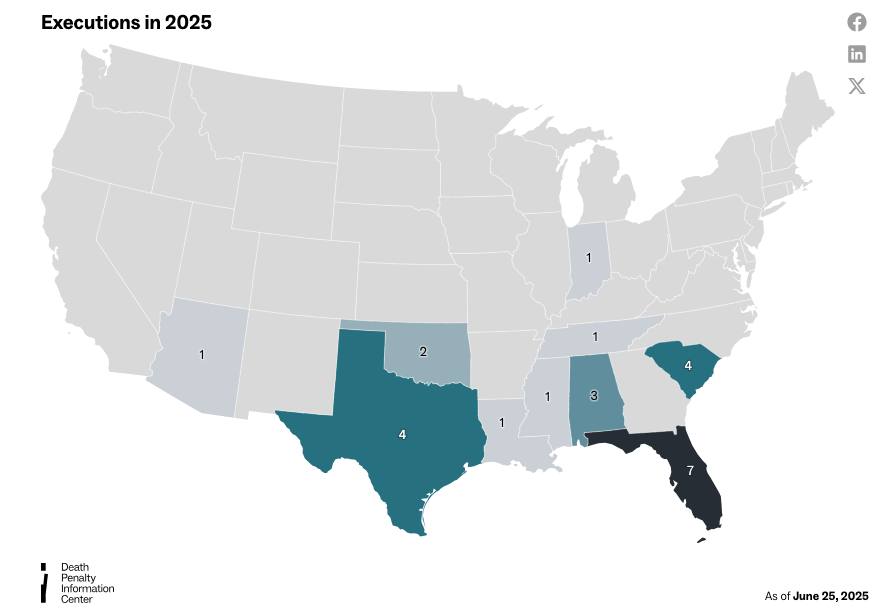
The record-breaking pace and expansion of DeSantis’ execution spree highlights the brutality of capital punishment, 110 faith leaders said in the letter delivered to the governor July 8.
“We stand together to call on you to pause the signing of death warrants and make space for dialogue around whether the people of the State of Florida are being served by the current pace of executions,” they said.
“Our shared belief in the sacred value of every human life unites us.”
Ministers involved in the effort represent numerous traditions including African Methodist Episcopal, Baptist, Catholic, Episcopal, Mennonite, Quaker and United Church of Christ.
“Though we come from different backgrounds and spiritual traditions, our shared belief in the sacred value of every human life unites us,” they wrote. “Our faiths teach us that no person is beyond redemption and that true justice must reflect both accountability and compassion.”
The state’s death penalty system is beset with racial disparities in its application and rife with wrongful convictions, the ministers said. Florida has exonerated 30 inmates from Death Row, the most of any state in the nation, according to DPI.
“We believe we cannot heal violence with more violence and executions do not bring the peace and closure victims’ families deserve,” the letter adds. “To continue executing people in our names, using a system built on injustice and error, is incompatible with the values of mercy, dignity and hope.”
Four members of the group walked the letter to DeSantis’ office after a livestreamed press conference urging the governor to consider the teachings of his Catholic faith before condemning another prisoner.
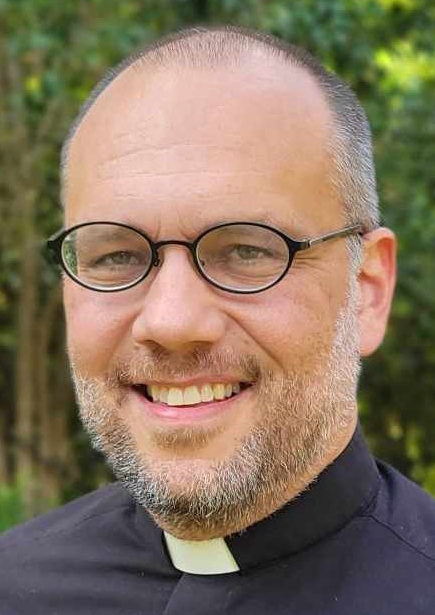
Dustin Feddon
“There is a greater and greater unity among Catholics — Catholic laypeople, Catholic deacons, Catholic priests and all the way up to our bishops and our Holy Father, Pope Leo XIV — appealing to the conscience of our state leaders, especially those who share our faith, to put a pause on the signing of these death warrants,” said Dustin Feddon, parochial vicar at Blessed Sacrament Catholic Church in Tallahassee.
Catholic deacon Andy Grosmaire asked the governor to consider the possibility of forgiveness rather than retribution in deciding prisoners’ fates.
Although difficult, that route helped him and his wife heal from the murder of their daughter in 2010, said Grosmaire, a staff member at the Co-Cathedral of St. Thomas More in Tallahassee. “Just as God has justice over our actions, he also provides mercy. And his mercy helped us through the healing so that we can live our lives on a daily basis. We couldn’t operate with hatred and vengeance in our hearts.”
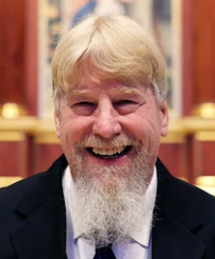
Andy Grosmaire
Florida’s record-setting pace of executions comes at a time of declining national support for capital punishment. This year, only 10 of 27 death-penalty states have conducted executions, three have moratoriums and 23 have abolished the practice altogether since the 19th century, DPI statistics show.
A December Gallup study, meanwhile, reported popular support for capital punishment at 53% of American adults, the lowest measured since the early 1970s.
Yet political aspirations and pressure from the Trump administration may be influencing the actions of conservative governors like DeSantis.
In January, Trump issued an executive order to “fully implement” the federal death penalty system, which he described as “an essential tool” for deterring crime, restoring order and responding to “evil.” The directive also claimed “capital punishment continues to enjoy broad popular support,” which is not true.
Attorney General Pam Bondi has since vowed to seek and carry out the death penalty to the fullest degree. In April, she followed through by directing federal prosecutors to seek the execution of Luigi Mangione in the 2024 killing of UnitedHealthcare CEO Brian Thompson.
The Tallahassee Democrat reported DeSantis presided over six executions in 2023 while running for the Republican presidential nomination and he is considered as a strong contender for the GOP nomination in 2028.
“Now, when the Trump administration, whose attorney general is from Florida, calls for increased use of the death penalty, Florida is executing people at an unprecedented rate,” a source explained in the newspaper report.
That was not a dynamic lost on Demetrius Minor, a minister and national manager of Conservatives Concerned, during the press briefing.
“As a Christian, I believe in redemption and I also believe in the power of transformation and the ability of even the most broken lives to be made new,” he said. “But the death penalty is not a system of redemption. It is a system of retribution, of politics and of grave error.”
Nor is capital punishment a deterrent to violent crime, he added. “It’s not about public safety, it’s about power. The governor alone decides who lives and who dies with no checks or balances. My friends, that is not justice. That’s what we call vengeance, and it is very dangerous.”
Related articles:
Trump demands death penalty be restored
Younger adults driving decreased support for death penalty
Death penalty executions on the rise worldwide
How I came to oppose the death penalty | Opinion by Stephen Reeves