

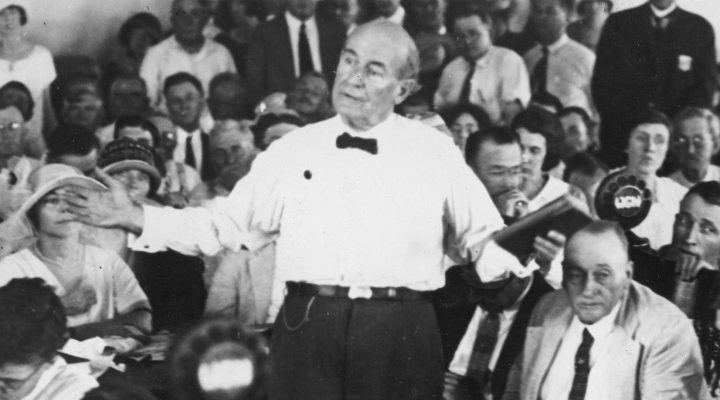
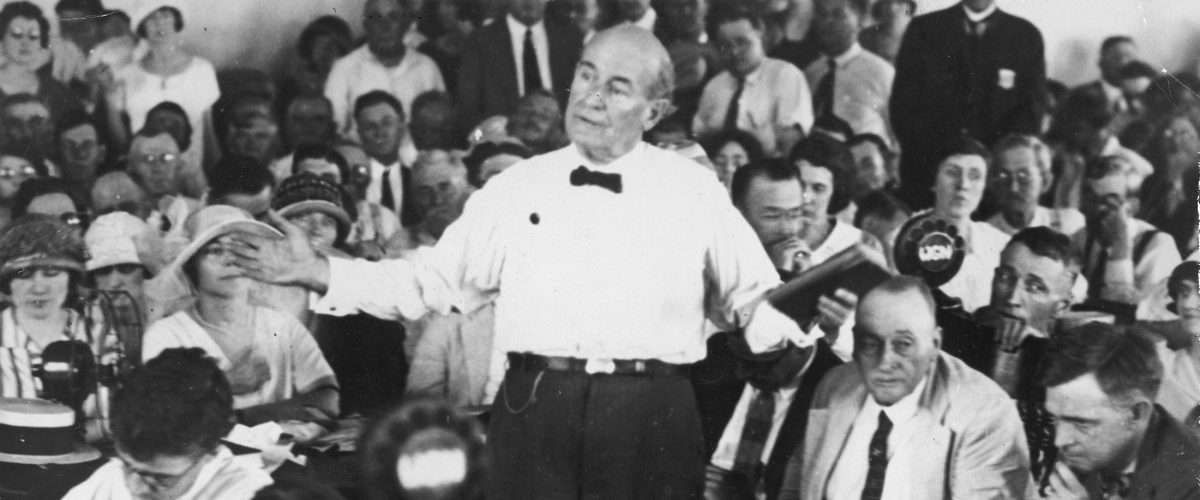
Tensions between religion and science erupted in a hot and humid courtroom in Dayton, Tenn., 100 years ago this month. Fundamentalist celebrity William Jennings Bryan squared off against agnostic attorney Clarence Darrow in the trial of high school teacher John Scopes, who challenged a new state law outlawing teaching “that man has descended from a lower order of animals.”
Fundamentalists, including many Baptists, hoped the Scopes Trial would halt the teaching of evolution and natural selection, concepts Charles Darwin highlighted in his 1859 book, On the Origin of Species. Their literalist interpretation of the Old Testament book of Genesis taught that God created the universe and all the species over six literal days in the year 4004 B.C.
The prosecution, which was organized by the World’s Christian Fundamentals Association, a group founded in 1919 to combat modernism, selected Bryan to represent their cause. He was a popular preacher and politician who led 19th-century efforts to establish a Christian America.
Fundamentalists already had succeeded in a major part of their social crusade. Prohibition, which became the law of the land in 1920 through the Eighteenth Amendment, made alcohol illegal across the country. Many of the same preachers who had condemned booze also railed against evolution for teaching that humans descended from monkeys.
The defense was organized by the American Civil Liberties Union, which was founded in 1920 and was seeking a big case to build its reputation. Working with Darrow guaranteed a lively trial that would gore many sacred cows and use media coverage to demonstrate the contrast between science and superstition.
The two-week trial delivered. It was carnivalesque, attracting hundreds — and on some days thousands — of observers and 200 journalists to a small town, according to Edward J. Larson’s Pulitzer Prize-winning account, Summer for the Gods.
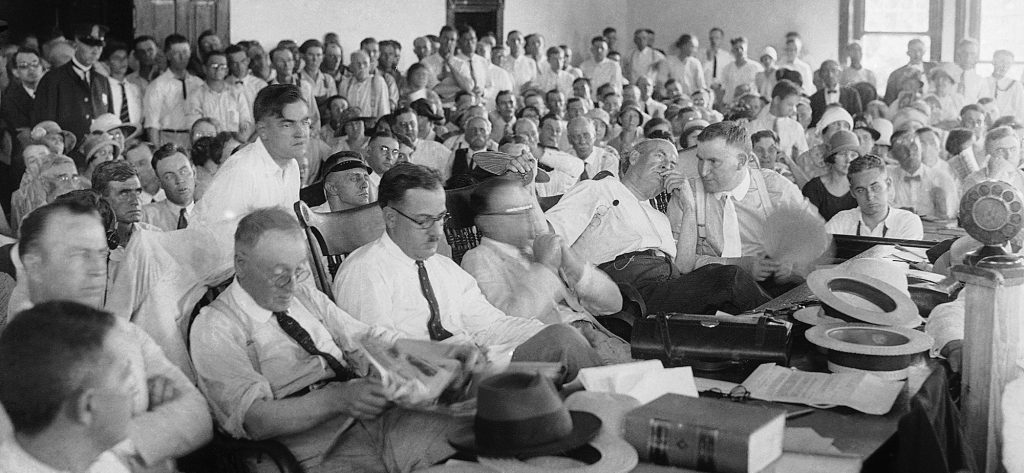
Court scene of Scopes trial, 1925. (AP Photo)
The trial was the first in American history to be broadcast nationwide via the relatively new technology of radio, and from the beginning, the proceedings demonstrated the power of media to inform — and inflame — public opinion over complex issues.
Scientific evidence was mostly barred from the trial, meaning religion would take center stage.
“I object to the Darwinian theory because I fear we shall lose the consciousness of God’s presence in our daily life,” Bryan said.
Darrow, the most celebrated defense attorney of his day, called the trial “the first case of its kind since we stopped trying people for witchcraft.”
“Nero tried to kill Christianity with persecution and law,” Darrow said. “Bryan would block enlightenment with law.”
A crucial turning point came when Bryan took the witness stand and Darrow grilled him about alleged inconsistencies in the Bible. Bryan, a powerful orator who could bring a sympathetic audience to tears, stumbled in his answers and grew flummoxed under the assault.
In the end, the fundamentalists won the case. Scopes was convicted and fined $100. Bryan announced he would launch a national tour to preach against evolution. “We must strike while the iron is hot,” he said.
But the victory celebration was short-lived. Bryan died five days after the trial ended, and with him, many of the hopes of fundamentalists, according to historian Stephen Neil: “Deprived of its major figure, fundamentalism failed in its effort to capture the denominations. It survived in the form of minority parties in the churches and in splinter bodies, but by the later 1920s it was clear that the movement had failed in its principal objectives.”
The Hundred Years’ Trial, a new book about the Scopes trial, argues it didn’t really settle much. Instead, tensions between faith and science can be seen today in arguments over vaccines and climate change.
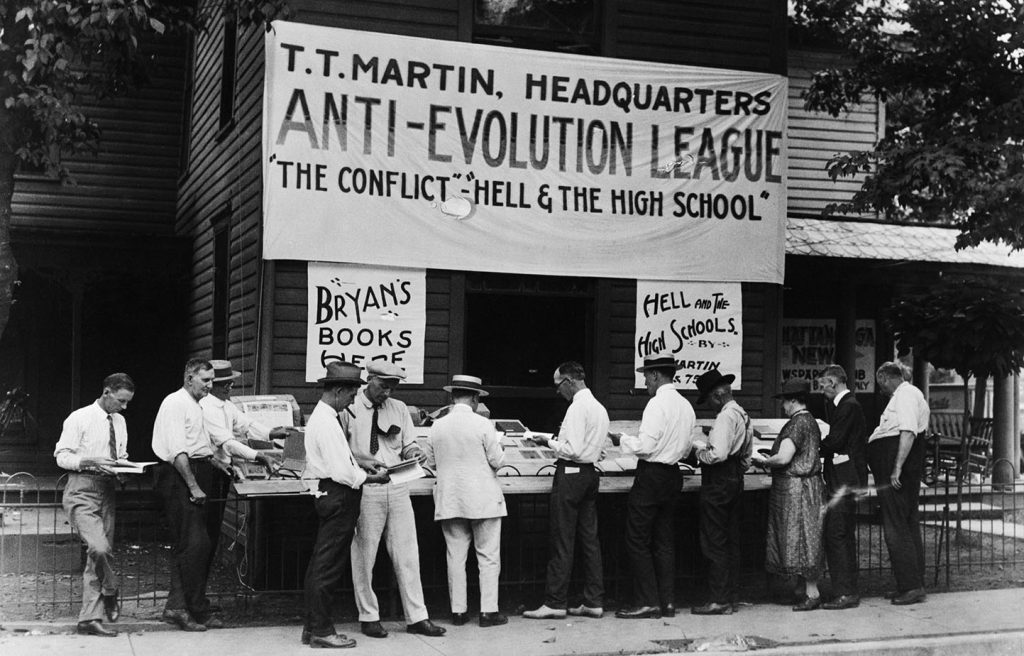
An Anti-Evolution League holds a books sales at the opening of the Scopes “Monkey” Trial in which biology teacher John T. Scopes is being prosecuted for teaching evolution in his class. (Getty Images)
“The issues at the heart of the trial — conflicts between science and religion, controversies about how to educate the public on scientific developments, and unease over the power of courts to override democratic legislation — are as pertinent now as they were a century ago,” write the father-and-son author team Alexander and Harold Gouzoules.
“Scopes and its legacy thus also provide fascinating insight into the inability of seemingly definitive legal decisions to resolve with finality continuing social, cultural and political controversies.”
The arguments from a century ago continue to resonate. Religious and political leaders regularly claim the teaching of evolution has eroded American morality with tragic results.
“We know we’re living in a completely amoral society,” said U.S. Rep. Mike Johnson, the current U.S. House Speaker, in a 2016 talk at a Shreveport church.
“People say how can a young person go into their schoolhouse and open fire on their classmates?” he asked. “Because we’ve taught a whole generation, a couple of generations of Americans, that there is no right and wrong, that it’s survival of the fittest, and you evolved from the primordial slime. Why is that life of any sacred value because there’s nobody sacred to whom it’s owed?”
Many Americans agree with Johnson, and the teaching of evolution in public schools has contributed to the growth of Christian schools and home schooling.
Last year, Gallup released its latest polling data on views on human origins. Gallup found:
- “The largest segment of Americans, 37%, are creationist purists, saying God created humans in their present form within the past 10,000 years.”
- 34% say “humans evolved, but with God’s guidance,” meaning God used evolution to create the human race and other creatures.
- “24% of U.S. adults accept the scientific theory of evolution, that humans evolved from less advanced forms of life over millions of years without God’s involvement.”
Creationists have been in the majority in Gallup’s polling on human origins since the firm began asking the question in 1982. In 1999, 47% of Americans said they were creationist purists while 40% said they were theistic evolutionists. Both percentages have declined since then as the percentage of Americans who embrace “evolution without divine intervention” has tripled.
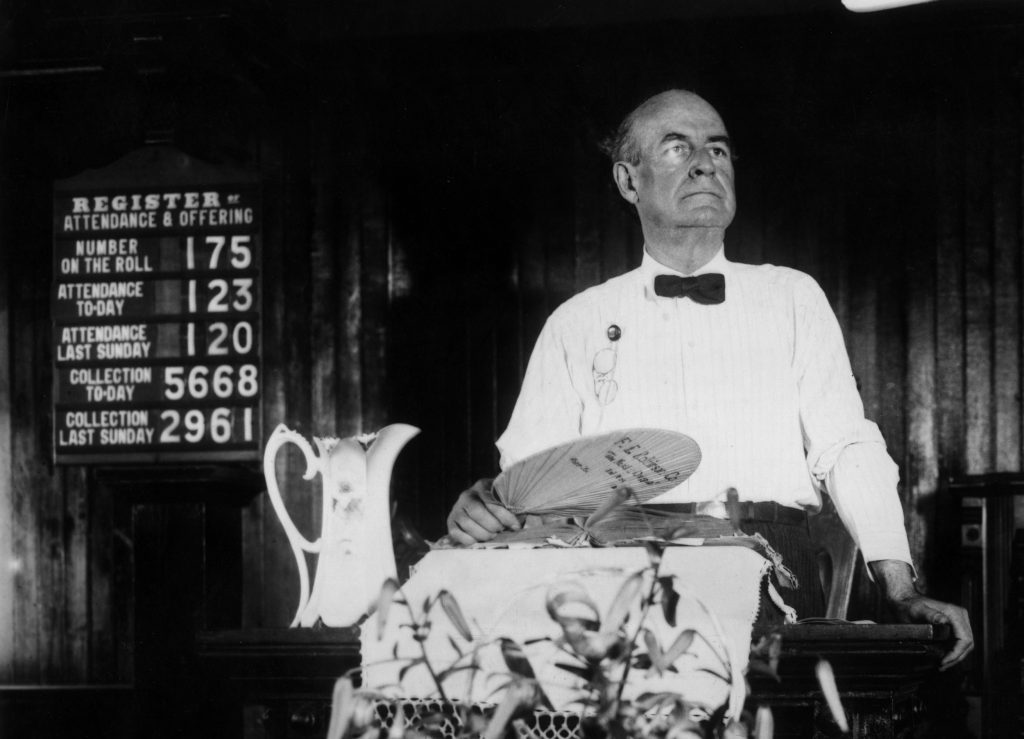
In July 1925, political leader and orator William Jennings Bryan (1860 – 1925), an anti-evolutionist, preaches from the pulpit at the Little Methodist Church during the Scopes trial in Dayton, Tenn., at which he was director of the prosecution. He died of a cerebral haemorrhage a few days after the trial. (Photo by Hulton Archive/Getty Images)
William Jennings Bryan never identified himself as a theistic evolutionist, but he did reject the fundamentalist belief that God created the world in six 24-hour days. He believed the biblical six days could have been six long ages or epochs.
When Bryan died, his supporters promised to create a college that would carry on his legacy. Bryan College was founded in Dayton, Tenn., five years later. Today it has more than 1,400 residential and online students.
The college plays a major role in annual reenactments of the trial, and this year it’s helping organize Dayton’s larger Scopes Trial Centennial Celebration, scheduled for July 10 and 11.
Today, Christian ministries keep the young earth faith alive. Answers in Genesis operates the Ark Encounter in Kentucky, which features a life-size reconstruction of Noah’s ark. The group also produces young earth curriculum.
And Focus on the Family celebrates polls showing that millions of Americans support young earth views. “We’re not alone, and not by a lot,” said Focus’s Daily Citizen. “Make no mistake: The clash of worldviews is real and escalating. The battleground is the statehouse, the classroom, the media, Hollywood and the arts, and sometimes even the church itself. It’s important we know what we believe — know how to articulate and relay God’s truth to a confused and often hostile world.”
Many Americans’ understanding of Scopes is based on the drama Inherit the Wind, which takes liberties with the facts of the case. The play debuted on Broadway in 1955 and portrayed Scopes as an anti-intellectual witch hunt that predated the McCarthy hearings into Communist subversion in America during the 1950s. A movie version was released in 1960.
Related articles:
A hundred years after the Scopes trial, not much has changed | Analysis by Alan Bean
The Scopes Trial, then and now | Opinion by Bill Leonard