

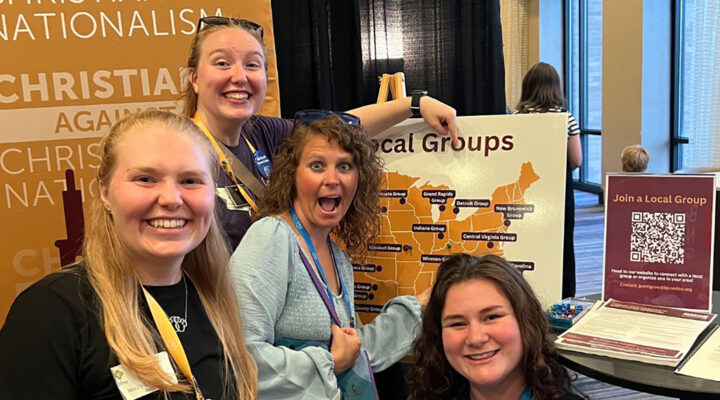
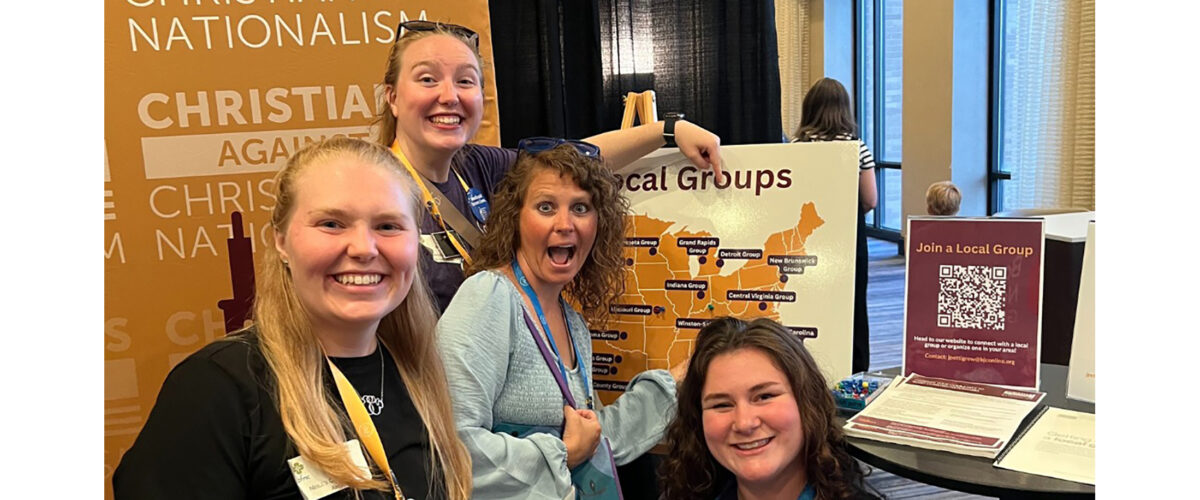
Nearly 20 groups affiliated with Christians Against Christian Nationalism have been formed in more than a dozen states to advocate for religious freedom and to resist the religious hatred and violence sweeping the nation.
And more churches or clusters of churches and community organizations are being invited to form similar groups, said Amanda Tyler, executive director of Baptist Joint Committee for Religious Liberty and lead organizer of its anti-Christian nationalism movement.
“What we hope is some of these groups that are forming now will be doing this justice work for years and decades to come,” Tyler said in a learning lab session at the Cooperative Baptist Fellowship’s General Assembly in St. Louis last month. “We’re seizing on some of the real energy people have right now and on this deep calling from their faith-rooted places that they are committed to doing this work.”

Amanda Tyler
The grassroots ecumenical movement was launched in 2019 to counter the increasingly organized infiltration of Christian nationalism into U.S. politics, culture and religion. It has provided educational podcasts and printable materials, supported advocacy, generated press coverage and created an online statement signed by more than 40,000 people.
But it became clear more intentional community organizing was needed given the continuing dominance of white Christian nationalism in churches, government and education, Tyler said. “We recognized Christian nationalism as this growing threat to the values we hold dear, and we also recognize it was becoming increasingly violent and it was time to have a coordinated effort to stand against it.”
So far, groups have been formed in the Southwest, Southeast, Northeast, Midwest and Pacific Northwest. Texas, North Carolina and Michigan each have two groups.
“These are places where volunteer leaders came to us and said, ‘We need a group here and we would like tools that you’re offering to help us get groups started,’” Tyler said, adding the groups will have their work cut out for them. “The work of these groups is not just gathering people in a group to talk about Christian nationalism. It’s working and committing to doing this work for the long term.”
The groups will provide advocacy countering the myth of the Christian nation and educate communities about the dangers of public school chaplains, requiring Ten Commandments displays in classrooms and forcing teachers to use Bible-based curriculums, she said. “It’s dreaming about what a community without Christian nationalism looks like and talking about what are the barriers to a full belonging in your community and how can we work together to overcome those.”
The local groups are more than simple chapters. One that meets at Ardmore Baptist Church in Winston-Salem, N.C., consists of up to 200 people from a broad spectrum of Protestant congregations in addition to some who claim no faith, said Dane Martin, lead organizer of the group and youth and college pastor at Ardmore Baptist. “We’re also trying to partner with others to build a coalition of nonprofits, faith-based groups and teachers unions to pursue education work and to see what Christian nationalism looks like in schools across the state and nationally.”
Christians Against Christian Nationalism has created a resource page for local groups and lists ways for others to find and join or coordinate with existing organizations.
The urgency for action is evidence in the rising use of deadly violence among those who have embraced Christian nationalism, Tyler said. “We see how many of these killers are armed not just with deadly weapons, but with a deadly ideology of Christian nationalism, and it’s up to us and our churches and in our conversations to roundly reject violence in all forms as being against the gospel, as against anything that Jesus ever stood for.”