

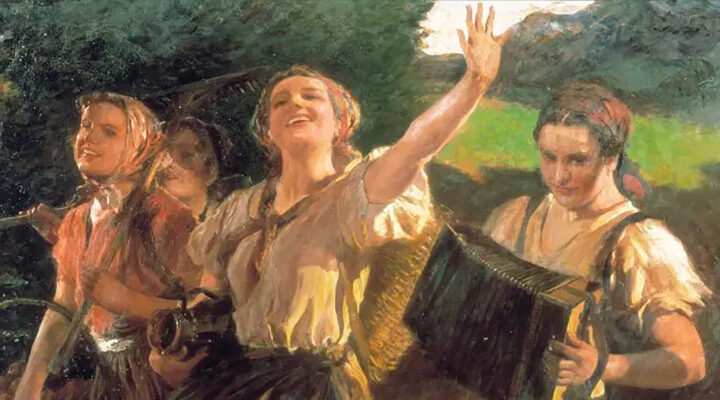
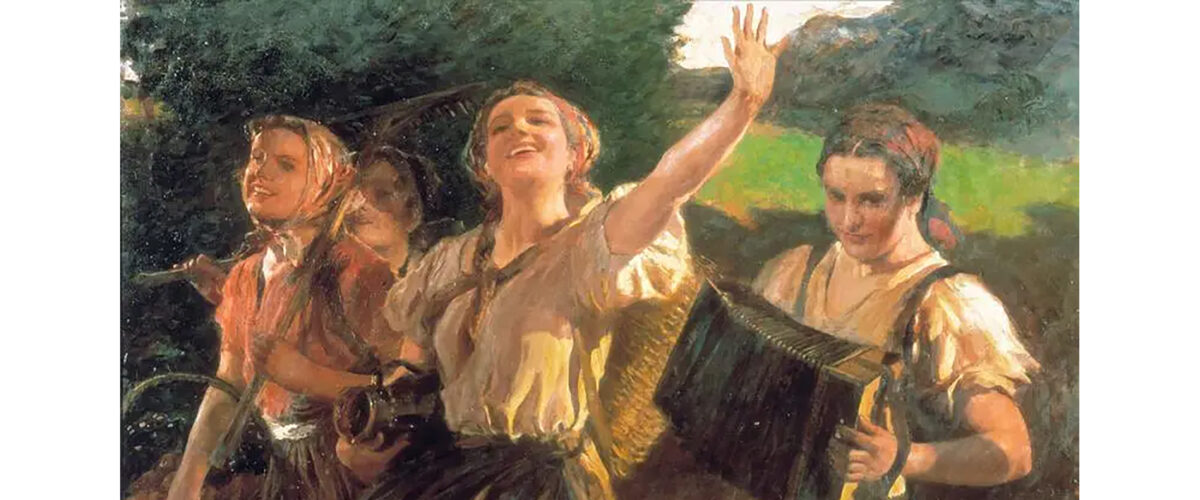
I’ve written elsewhere about the role the arts have played in both creating and confronting shared identity and ethics across time. Art is a powerful medium. It has the potential to both reflect and to shape collective memory — which is why, throughout history, fascist regimes have targeted the artistic and cultural institutions first.
If a government wants to force a collective narrative upon the masses, arts, culture and media entities are necessary.
Recently, the Kimbell Art Museum in Fort Worth presented an exhibition organized by Germany’s Neue Nationalgalerie, Berlin, called Modern Art and Politics in Germany 1910-1945. The exhibit tracks Germany’s politics from the last years of the German Empire through World War I and the short-lived liberal Weimar Republic to the rise of National Socialism and Adolf Hitler — all through the lens of visual art.
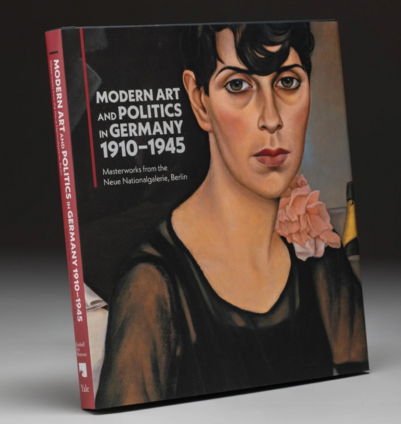 Experiencing this particular exhibit in June 2025 — six months into the second Trump administration — undoubtedly affects the experience.
In my writing about the president’s assault on democratic norms and his attempts to reshape culture and rewrite American history, I have avoided comparing his efforts to those undertaken in Germany in the 1920s and 1930s. There are more recent examples of fascist regimes to pull from. However, as I wandered through the exhibit reading about Germany’s history and seeing the artistic responses to the political realities that existed nearly a century ago, I found myself comparing our country’s present to Germany’s history and the rise of fascism there.
The comparisons are unsettling.
In case you missed it
In case you missed it, here is a brief rundown of the president’s efforts since Jan. 20 to bring arts institutions to heel and do his bidding.
He has eliminated the President’s Committee on the Arts and Humanities, which was originally created by President Ronald Reagan in 1982.
He has taken over the John F. Kennedy Center for the Performing Arts, fired the longtime president and placed himself as the board chair. By stepping into lead the Kennedy Center, Trump is fulfilling a lifelong dream of producing theater. In 1969 a then 23-year-old Trump used some of his father’s money to help produce a Broadway flop. Now, he gets a say in what the Center produces and has promised to bring back sentimental shows from the 1980s.
He’s ordered the Corporation for Public Broadcasting — which was established by Congress in 1967 — to cease funding National Public Radio and Public Broadcasting Services. He also has requested that Congress rescind the previously approved two-year allocation of $1.1 billion for public broadcasting.
“The president has set his sights on the Smithsonian Institution.”
The president has set his sights on the Smithsonian Institution, which was founded by Congress in 1846 and encompasses 21 museums, 21 libraries and the National Zoo. In an especially foreboding executive order titled “Restoring Truth and Sanity to American History,” he charges that there has been “a concerted and widespread effort to rewrite our nation’s history, replacing objective facts with a distorted narrative driven by ideology rather than truth.”
The executive order seeks to erase any mention of the country’s darkest past including chattel slavery, genocide of Native Americans and more. What this means for the National Museum of African American History and Culture, the National Museum of the American Indian and the planned American Women’s History Museum remains unclear. But most recently, after attempting unsuccessfully to fire the longtime head of the National Portrait Gallery, Trump got his wish when she decided to step down for the sake of the organization.
The president eliminated the Institute of Museum and Library Services, which was created in 1996 by combining prior government agencies — some of which had served Americans since 1937. Libraries serve as local hubs and are vital to communities large and small across the country. The IMLS serves libraries and museums in all 50 states.
He fired the head of the Library of Congress — someone who served during his first presidency and whose 10-year tenure was set to expire next year. The Library of Congress houses “a vast collection of the nation’s books and history, which it makes available to the public and lawmakers.” The move has echoes of the various book bans that have roiled communities across the country, except in this instance, it’s the country’s own understanding of its history that is at stake.
Days after firing the head Librarian of Congress, he fired the director of the U.S. Copyright Office, which is overseen by the Library of Congress. The firing of the director follows the office’s release of a report critical of the way artificial intelligence companies use copyrighted materials to “train” their AI systems “and then compete in the same market as the human-made works they were trained on.” The move follows an executive order that orders the deregulation of artificial intelligence and cryptocurrency sectors.
The president fired the Senate-confirmed head of the National Endowment for the Humanities, which has been making the humanities accessible to all Americans since 1965. He also fired 80% of the agency’s staff and rescinded all previously approved grants. These grants — which were approved in August 2024 — were to have funded projects in 43 states and the District of Columbia.
The president also rescinded all National Endowment for the Arts previously approved grants and has proposed to eliminate both the NEA and the NEH next year — something he unsuccessfully attempted during his first term. The NEA grants the administration canceled had been earmarked for projects in all 50 states and the District of Columbia and Puerto Rico.
Fascism and art
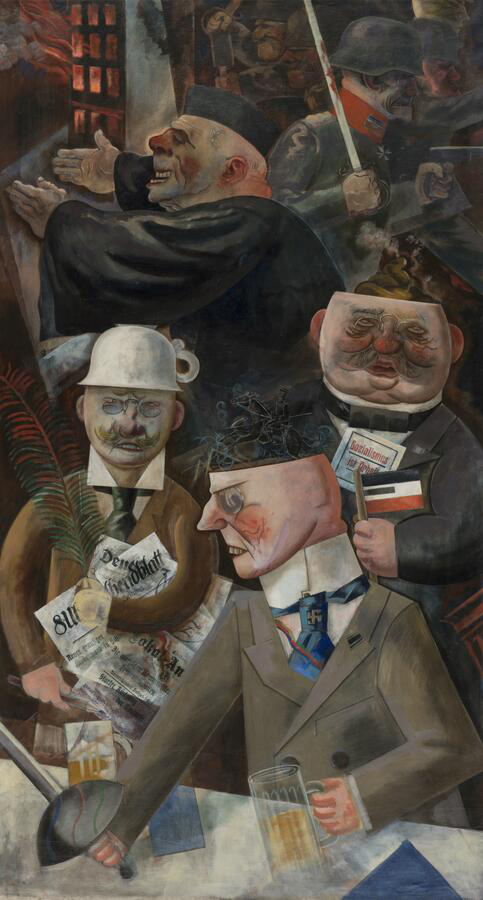
George Grosz, “Pillars of Society,” 1926, oil on canvas. Neue Nationalgalerie, Stiftung Preußischer Kulturbesitz, Berlin. © 2024 Estate of George Grosz
I won’t offer a side-by-side comparison of Nazi Germany’s assault on the country’s arts and culture sectors and what is happening under the Trump administration, but there are a few noteworthy points of contact worth mentioning.
According to the Kimball’s exhibition catalogue, in 1928, Nazi idealogues launched an effort to push back against “every form of modern art.” The Nazi movement was a reactionary one that sought to return the country to an earlier time — to make the country great again. That effort translated into the kind of art the party wanted to see. Instead of modern Expressionism and other abstraction, the Nazi party demanded “naturalistic and heroic or idealizing forms of representation.”
In 1933, after Adolf Hitler (a failed painter) was elected chancellor, he and Joseph Goebbels (a failed author) purged the country’s arts and culture institutions of their leaders and installed Nazi party loyalists in their stead.
That same year, book-burnings took place across the country. And the first iteration of the famous “Degenerate Art” exhibition took place. This exhibition would evolve over the years and was shown as a counterpoint to the Reich-approved artworks that typified “real” Germans and German art. The party’s artwork idolized “the Nordic”— meaning the “cultural circle of white peoples,” as the “heroic” and “moral.”
As Trump has decimated the major arts and culture institutions of the country, he also has pushed his own vision for national art — an “American” art.
He has established the White House Task Force on Celebrating America’s 250th Birthday which he oversees. Given his penchant for military parades, we can expect the celebration in 2026 to project the mythic vision of American exceptionalism complete with some sort of military parade.
Additionally, Trump issued executive orders to build monuments and a National Garden dedicated to “American Heroes.” Trump, of course, has put himself in charge of determining who qualifies as an American hero. He’s actually listed them out in his executive order.
And to fulfill his vision, the NEA — after canceling all previously approved funding — has posted a new call for artistic submissions. The criteria? Artists and art groups must select one of the Trump-approved “heroes” to create monuments to.
For its part, the NEH also has issued a call for grants after reneging on previously promised ones. It is looking to fund projects as part of its special initiative called “A More Perfect Union.” The grants will support projects that “promote a deeper understanding of America’s history and culture, advance civics education and knowledge of the nation’s core principles of government and preserve and provide access to the nation’s heritage.”
To be clear: Trump is manipulating agencies that use taxpayer funds for arts and humanities that are supposed to serve all Americans.
No U.S. president ever has strong-armed arts and culture institutions like he is. This gross abuse of power is straight out of the fascist handbook. And its eerily similar to what happened in Germany in the 1930s.
Who cares?
There is so much happening so quickly that it is impossible for anyone — especially everyday Americans who aren’t intimately involved in policy and government — to track the dismantling of our democratic norms in real-time.
But it’s happening.
And while everyone’s attention is pointed to other fires like the illegal deportation of asylum-seekers to third-party countries, the individuals and organizations whose artistic contributions are essential to our collective understanding of who we are as a people are being destroyed.
“What happens when there are no artists or arts organizations willing to make art that challenges this administration’s rewriting of history?”
What happens when there are no artists or arts organizations willing to make art that challenges this administration’s rewriting of history?
What happens when the American people wake up in two years to find that our collective understanding of our history has been erased from the Library of Congress, mass book burnings and the fascist enforcement of what constitutes art?
Recently, the Munk Debates — a Canadian podcast dedicated to hosting debates that are civil — invited debate between Kevin Roberts (president of the Heritage Foundation), Kellyanne Conway (senior counselor to President Trump in his first term), Ezra Klein (New York Times contributor and podcaster) and Ben Rhodes, President Barack Obama’s senior adviser and co-host of the podcast “Pod Save the World.”
I want to highlight something Ezra Klein said in his closing statement that resonates here. It has to do with the arts, media and shared moral character.
The same people who are currently gutting arts funding and dictating what kind of art gets made are the same people promoting a specific vision of moral character on the White House’s social media accounts. In his closing comments, Klein pointed to this vision of moral character that is being promoted.
He pointed to the incredibly disturbing ASMR video produced and shared by the White House in February. ASMR stands for “Autonomous Sensory Meridian Response” and is a kind of fetish video experience that stimulates viewers’ in any number of ways. The White House produced, distributed and celebrated an ASMR video that fetishized the sounds of manacles clanking — the manacles of people they deem “illegal” in America.
“The fetishization of their deportment is a depraved form of ‘art.’”
Time and again this administration has deported people who are legally in this country and going through the hoops we have set up for them to jump through in order to stay in this country. So the fetishization of their deportment is a depraved form of “art.”
Klein then noted Chat GPT has released a new feature that allows users to create or alter images so that they mimicked the artwork of filmmaker Hahayo Miyazaki. The White House produced, distributed and celebrated an image of an immigrant in tears fetishized in the image of Miyazaki’s work. In this case — unlike the ASMR video — the immigrant depicted had previous criminal convictions.
Even so, as Klein points out, there’s a difference between supporting policies and exalting in cruelty.
The Trump administration is using the arts to rewrite history and promote its moral vision for the country. We, as Americans, cannot turn away from this manipulation.
The arts remind of us who we are and who we want to be. If left to the whims of president Trump, we need only look to fascist Germany to see our future.

Mara Bim
Mara Richards Bim serves as a Clemons Fellow with BNG and is the first Justice and Advocacy Fellow at Royal Lane Baptist Church in Dallas. She is a spiritual director and a recent master of divinity degree graduate from Perkins School of Theology at SMU. She also is an award-winning theater artist and founder of the nationally acclaimed Cry Havoc Theater Company which operated in Dallas from 2014 to 2023.