

My wife, Lauren, told me a story once.
When she was 16, her mother put her on a plane to Europe.
She gave her a peck on the cheek, a few words of encouragement and a credit card.
“Have fun,” she said.
Justin Cox
Think study abroad. Think exchange student. Think host family.
She wasn’t alone. There were other high school sophomores, juniors and seniors.
There was a chaperone or two.
My wife landed in Frankfurt, Germany — a land filled with Pilsner lager and surrounded by Kölsch ale.
She drank in the culture.
Her trip was scheduled for six weeks. There was a loose itinerary, specific events and locations were recommended, but nothing was set in stone.
She visited museums and galleries. She climbed the Cathedral of Cologne. She described to me churches where skeletons, brushed with or encased in gold, hung from ceilings.
They traveled all over the country.
During breakfast in Munich, her classmates planned out their day. Being so close to the Austrian border, my music-obsessed wife wanted to hop the train over to Salzburg and visit the birthplace of Wolfgang Amadeus Mozart. Two others joined her.
The rest of her peers went an hour north, in the opposite direction.
Dachau is a bedroom community for those commuting to Munich. Residents in the area work in manufacturing. The hospitality industry is thriving. It’s a city with roots going back to the ninth century.
Dukes Otto I the Redhead, Ludwig II the Strict and Sigismund of House Wittelsbach called it home. In the 19th century, artists flocked to the area. Drawn to the beautiful landscape and Renaissance-style architecture.
But this is not what most think of when they think of Dachau.
They think of a place on the east side of the town built in the spring of 1933. A place commissioned by the chancellor of Germany, Adolf Hitler, to house his political opponents. They think of the German words, Arbeit Macht Frei — Work Will Set You Free.
They think of the 41,500 souls who died because they were led — forced — through the gates of the Nazi concentration camp there.
They think of the Holocaust.
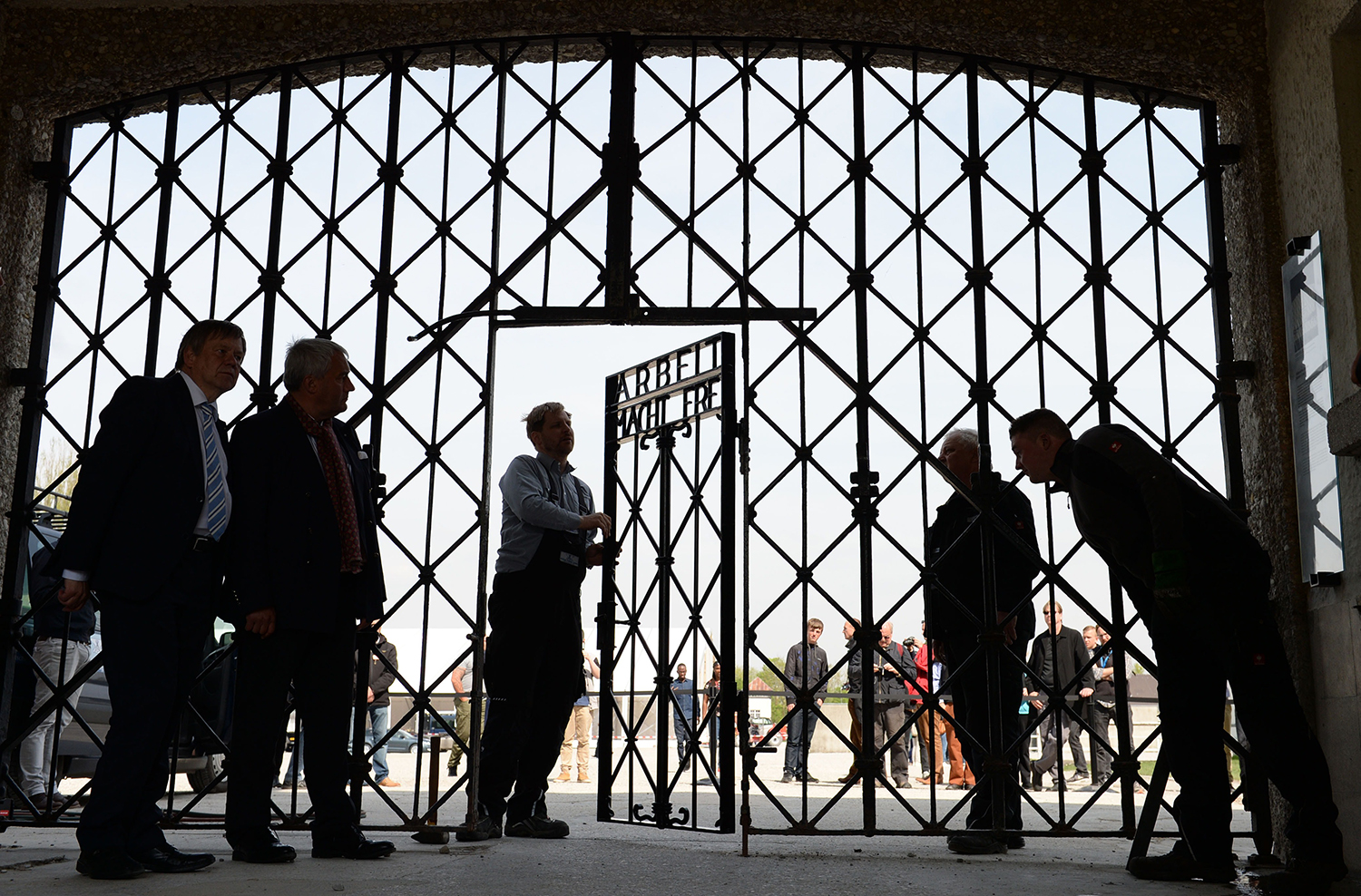
People stand beside the entrance gate with the new door with the inscription ‘Work sets you free’ (Arbeit macht frei) of former concentration camp in Dachau, southern Germany, on April 29, 2015. The old entrance gate had been stolen on November 2, 2014. Dachau was opened in 1933, less than two months after Adolf Hitler became German chancellor, to house political prisoners. More than 200,000 Jews, gays, Roma, political opponents, disabled people and prisoners of war were imprisoned at the camp. More than 41,000 people were killed, starved or died of disease before the U.S. troops liberated it. (CHRISTOF STACHE/AFP via Getty Images)
Lauren’s schoolmates joined the nearly 1 million people who visit the Dachau Concentration Camp Memorial Site each year.
At dinner, they told her about what they had seen.
They watched as a group of American tourists took photographs of each other posing behind bars. They made faces, contorted their bodies and mimicked what they thought prisoners would have done.
“They mocked a place where suffering is still felt.”
They mocked a place where suffering is still felt. A place haunted by the worst actions of humanity in recent memory. A point on the planet that captures a level of grief for all to see and remember. They made light of it. They made it a photo-op.
That’s not what you do.
You go, witness and make a promise to do your part to prevent something like that from happening again.
I thought of her story. I thought of those foolish and thoughtless individuals who took those pictures.
Then I thought of Alligator Alcatraz.
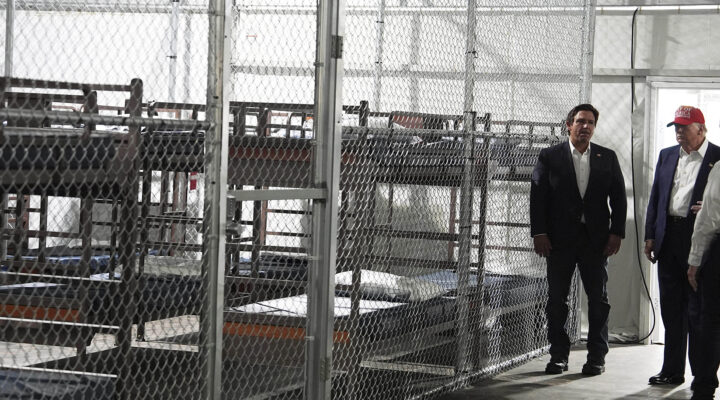
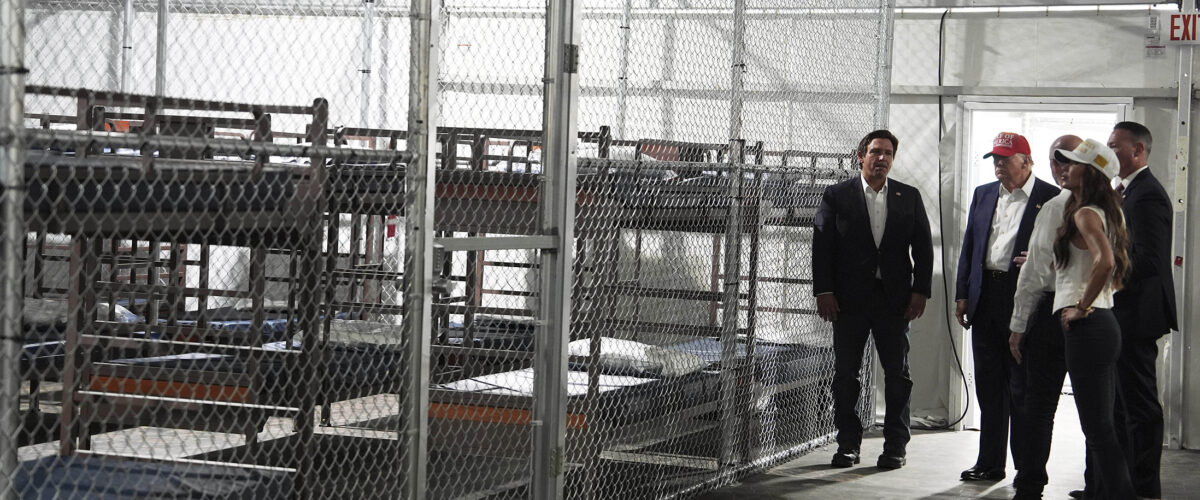
This designated detainment facility, this new “camp,” is situated on the grounds of the former Dade-Collier Training and Transition Airport in Florida’s Everglades. Pushed through and praised by Florida elected officials, Gov. Ron DeSantis and Attorney General James Uthmeier, the encampment can hold up to 5,000 detainees. According to CBS News, it will cost $450 million annually to operate. A similar center is being planned in Northern Florida at Camp Blanding.
In his Gulf of America red hat, a smiling Donald Trump visited the site recently. Quipping in a video that DeSantis and company are using, “cops in the form of alligators” to deal with the issue of immigration.
Afterward, the online retail merchant Etsy saw an uptick in alligator merchandise. Images of the reptile and the word “Alcatraz” are being plastered on T-shirts and hats. Suggested purchases include anything related to the MAGA movement. A growing number of buyers and sellers are calling for a boycott of the platform until the company removes the items in question.
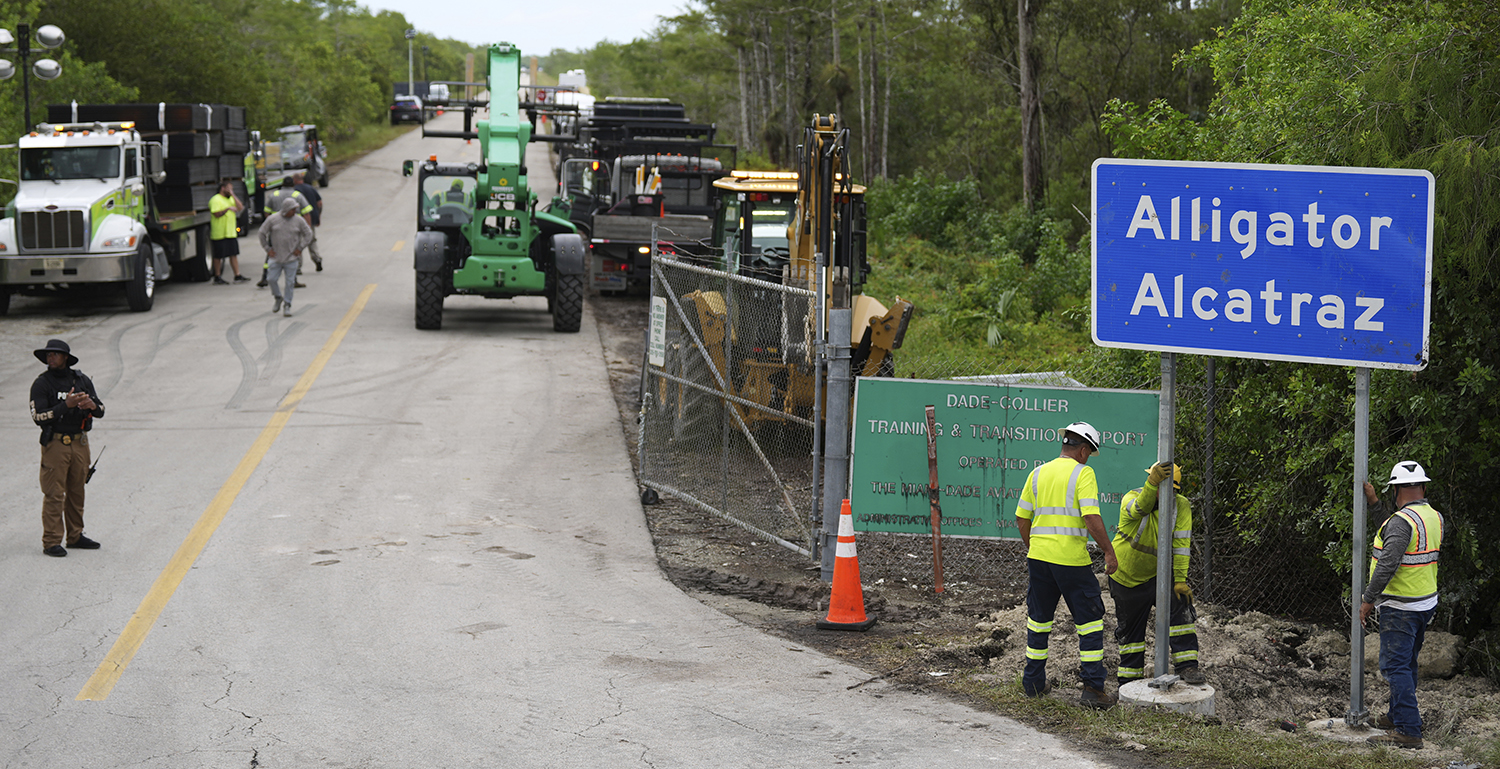
Workers install a sign reading “Alligator Alcatraz” at the entrance to a new migrant detention facility at Dade-Collier Training and Transition facility, Thursday, July 3, in Ochopee, Fla. (AP Photo/Rebecca Blackwell)
And then there’s the sign.
An eye-catching green information sign reading “Alligator Alcatraz” was erected by road workers off US Route 41. An arrow lets motorists know the destination is straight ahead.
The sign has turned into a selfie landmark.
People in favor of the site are stopping to take photos. Posting them online. Sharing them on social media.
Seeing this, I’m having a hard time not thinking about how the people on a Florida highway are the same type of people at the entrance of Dachau.
“I’m having a hard time not thinking about how the people on a Florida highway are the same type of people at the entrance of Dachau.”
We know there are places in the world where traumatic events have taken place. Some are associated with natural disasters. New Orleans after Katrina. Butte County, Calif., and wildfires. The cold and ceaseless waters of Kerr County, Texas, and Camp Mystic.
Others are human-made shrines of sorrow. La Porte du Non-Retour (The Door of No Return), located in Ouidah, Benin. A monument brings attention to the one million enslaved Africans deported from the city’s port.
The 16th Street Baptist Church in Birmingham, Ala., where children Addie Mae Collins, Carol Denise McNair, Carole Rosamond Robertson and Cynthia Dionne Wesley lost their lives.
A strip of land in Colorado, where in 1864, some 200 Cheyenne and Arapaho native people were slain by U.S. soldiers in what is known as the Sand Creek Massacre.
The remains of the 10 “relocation centers” used to incarcerate individuals and families of Japanese descent in this country from 1942 to 1946.
The National Memorial for Peace and Justice honors the lives lost of African Americans to lynching.
Finally, Alcatraz Federal Penitentiary. Its efficiency, brutality and inhumane treatment of inmates are well documented.
I believe the next in a long line will be Alligator Alcatraz — where dreamers, dissenters and the damned will be deported with equal fervor.
It will become just another unholy and revered site, filled with misery, pain and heartache.
In a future history class, students will discuss how it came to be. How certain events unfolded. They’ll debate the circumstances leading to it. They’ll look to name the watershed moment when it occurred.
Perhaps someday, my grandchildren will take a trip to what I hope is an empty building in Ochopee, Fla.
They’ll see what’s left, they’ll see that sign, and looking back with the perfect vision of hindsight, they’ll know — We were warned.
We decided to take pictures instead.
Justin Cox received his theological education from Campbell University and Wake Forest University School of Divinity and McAfee School of Theology, where he received his doctor of ministry. He is an ordained minister holding standing in the Cooperative Baptist Fellowship and American Baptist Churches USA. When not spending time with his spouse and daughters, he can be found writing and baking late into the night. His thoughts and reflections are his own.