


Pilate asked him, “So you are a king?” Jesus answered, “You say that I am a king. For this I was born, and for this I came into the world, to testify to the truth. Everyone who belongs to the truth listens to my voice.” Pilate asked him, “What is truth?” (John 18:37-38)
Whether the writer of the Gospel of John intended to paint Pontius Pilate as sincerely posing a philosophical question or as simply mocking Jesus (or both?) the exchange and the larger questions it points to remain relevant today.
What is truth? What sources of knowledge are legitimate? Is truth relative or static? Who gets to decide? Does truth even matter?
Over the past decade — and especially since 2020 — America has practically ripped itself in two over these questions and the battle for what is true. Is there any hope we can once again come to a consensus about what constitutes truth?
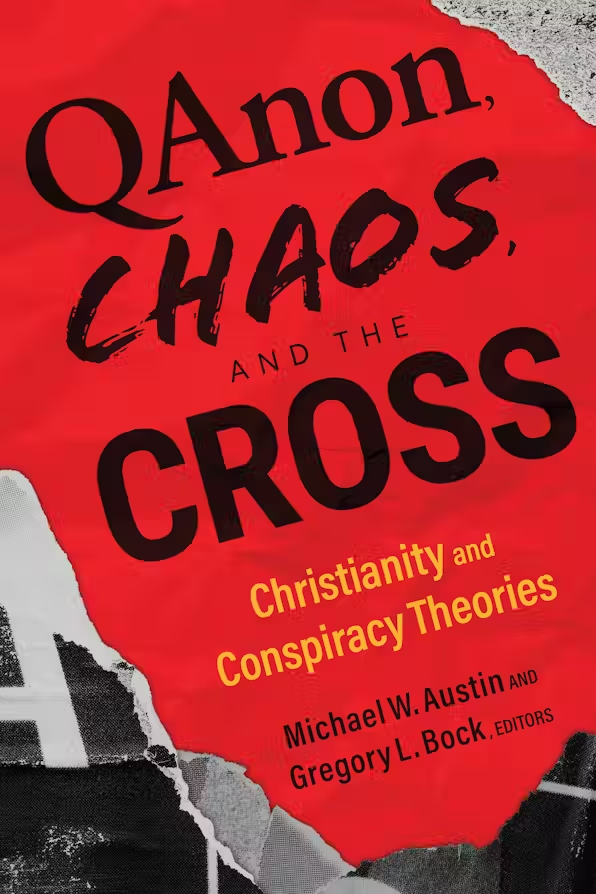 These questions were in the back of my mind as I read QAnon, Chaos and the Cross: Christianity and Conspiracy Theories, an anthology of essays edited by Michael W. Austin and Gregory L. Bock.
Two essays, in particular, have inspired my recent thinking about how we Christians face this moment we find ourselves in — a moment in which, to quote Melissa Murray of the podcast “Strict Scrutiny,” “Secretary Whale Juice, raw milk, bear carcass” is effectively ending “science-based, evidence-based health protocols and research.”
A moment in which the head of the Heritage Foundation and chief architect of Project 2025, Kevin Roberts, seriously contends that under the current administration, “This is the Golden Age of America.”
I would like to propose we re-embrace and advocate for the ethics of intellectual virtue. To do so is the most Christian of responses to the moment we’re in today.
The incorporation of new information shouldn’t be political
To be fair, while the Right and the current president have gleefully dropped any pretense of valuing knowledge and truth, the Left also has played a role in bringing us to the ethical crisis we find ourselves in today.
For example, several recent articles examine the politicization of the science behind pediatric gender medicine. A recent New York Times article following the Supreme Court’s ruling in United States v. Skrmetti upholding Tennessee’s ban on medicalized gender-affirming care for minors, notes how pediatric gender medicine became politicized and in the process created tension on how new information is received and incorporated into medical care.
“Pediatric gender medicine had become so politicized that the Left was unwilling to take in new information and change course.”
In 2013, the American Psychiatric Association published its updated Diagnostic and Statistical Manual of Mental Disorders (the DSM-5) in which the formal diagnosis of “gender identity disorder” was replaced with “gender dysphoria,” a diagnosis with looser criteria. The aim was a noble one: to make accessing treatment easier. However, shortly thereafter the U.S. saw a huge influx in the number of minors requesting and receiving medicalized care for gender dysphoria as a first-line treatment.
At the same time, European countries that had pioneered gender medicine began to react with alarm both to who was seeking gender care and the numbers seeking this kind of medicine. While traditionally patients seeking gender care were overwhelmingly male, patients in the late 2010s were overwhelmingly female. Alarmed by what they were seeing, one by one countries began systematic reviews of outcomes data, which led them to reevaluate their approach to pediatric gender medicine.
In 2020, Finland stopped providing surgeries for minors and began limiting access to hormone blockers for children. In 2021, Britain followed suit, and in 2022 so did Denmark. But in the United States, pediatric gender medicine had become so politicized that the Left was unwilling to take in new information and change course — to do so would have been seen as ceding something to the Right and to its culture of depraved cruelty.
At the moment the rest of the world was reconsidering gender-affirming care for minors and the political Left in the U.S. was doubling down on it, a pandemic swept around the world.
In this instance, while the Left embraced the changing scientific understanding of the Coronavirus, the Right entrenched itself and rejected the changing science. They refused to believe scientists could learn more about the virus and that, as a result, policy recommendations for public safety would naturally change.
Instead, the Right accused the CDC, Anthony Fauci, doctors, nurses, pharmaceutical companies and anyone who advocated wearing masks of being part of a global conspiracy. The Right was unwilling to reconsider the evolving science because to do so would have been seen as ceding something to the Left and to its culture of arrogant disdain.
“Both the Right and the Left are equally capable of rejecting the acquisition and incorporation of new information.”
Both the Right and the Left are equally capable of rejecting the acquisition and incorporation of new information — knowledge itself.
This isn’t to say there should be a universal ban on gender-affirming care for minors, nor is it to say health officials and policymakers got everything right during the pandemic. But in both instances, new data became politicized in ways that exemplify the erosion of the ethic of intellectual virtue.
Intellectual virtue and the Bible
In his essay “How Shall We Then Think? Biblical Insights on Conspiracy,” Dru Johnson focuses on the rise of Bible illiteracy and the resultant ways in which Christians today fail to be shaped intellectually (or, as Johnson notes, “‘spiritually,’ as the New Testament authors would call it”) by the Bible.
Throughout the Bible, God is portrayed as reasoning with people and time and again the biblical authors point to the ethics of knowing. Repeatedly the Bible conveys that some ways of knowing are better than others. Wisdom is portrayed as holding to beliefs that “can be supported or defeated by evidence (even eyewitness evidence).” Johnson continues:
People who engage in practices that could support or defeat their beliefs are commended for participating in the undramatic backbone of what biblical writers call “trust” or “devotion” (often translated as “faith” which has a decidedly different meaning in modern English).
The Bible says humans were designed to know our world (Genesis 2-3) and the mysteries of the kingdom of God as taught by Jesus (Mark 4:11). To do so, we are commanded to investigate (Deuteronomy 13:14) in order see the reality God reveals to us.
“Throughout the Bible, God is portrayed as reasoning with people and time and again the biblical authors point to the ethics of knowing.”
Never do we see God fully revealing the whole of reality to God’s faithful, but we do see God providing enough “evidence” for those with “the eyes to see and the ears to hear” to trust and have faith in God and the prophets God sends to convey God’s truth.
The command to investigate in order to see involves the intellectual virtues that foster intellectual character.
In their essay “Christianity, Conspiracy Theories, and Intellectual Character,” Nathan L. King and Keith D. Wyma offer some of the intellectual virtues we are to cultivate as Christians.
While not all-inclusive, their list of intellectual virtues includes:
- Intellectual carefulness (“seeking to avoid falsehood and irrational belief”)
- Intellectual humility (knowing the limits of our own capacity, for “when we conduct such research, we are wise to consider how fit we are to do it, especially relative to those who have been studying a topic for their whole lives”)
- Intellectual fairness (being evenhanded in the standards we apply to different sources of information even when they provide information that counters our held assumptions).
While the book from which these essays come is focused on conspiracy theories, one need not be fully invested in QAnon or some other conspiracy to benefit from becoming more biblically literate and practicing the intellectual virtues the biblical authors wrote about.
Truth matters
It’s no secret that Americans have less confidence in institutions today than they did 50 years ago. This drop in trust spans all kinds of institutions that play a role in our public lives today, from health care to higher education, from religion to the judiciary.
It is also no secret that President Donald Trump regularly spreads conspiracy theories and tells half-truths and outright lies. Many of the individuals in his administration have taken to doing the same. These falsehoods are used to justify the rapid dismantling and destroying of democratic norms and institutions that provide checks on the various facets of our democratic republic.
All this is terrifying and, at times, overwhelming for those paying attention.
One way Christians can have an impact on this moment is to frame contentious policies and actions within the realm of intellectual virtue. Is the justification being offered for something based in facts? Whose facts? Are those facts verifiable?
Not only can we respond to the rationales offered for various policies by practicing things like intellectual carefulness, we can and should also recommit ourselves to discipling people in ways that cultivate intellectual virtues.
We didn’t get to this place overnight and there is no quick fix to the very different versions of “reality” competing for attention in the public square. But we can begin by practicing, preaching, teaching and discipling around the biblical ethics of wisdom which include knowledge acquisition and dissemination.

Mara Bim
Mara Richards Bim serves as a Clemons Fellow with BNG and is the first Justice and Advocacy Fellow at Royal Lane Baptist Church in Dallas. She is a spiritual director and a recent master of divinity degree graduate from Perkins School of Theology at SMU. She also is an award-winning theater artist and founder of the nationally acclaimed Cry Havoc Theater Company which operated in Dallas from 2014 to 2023.