

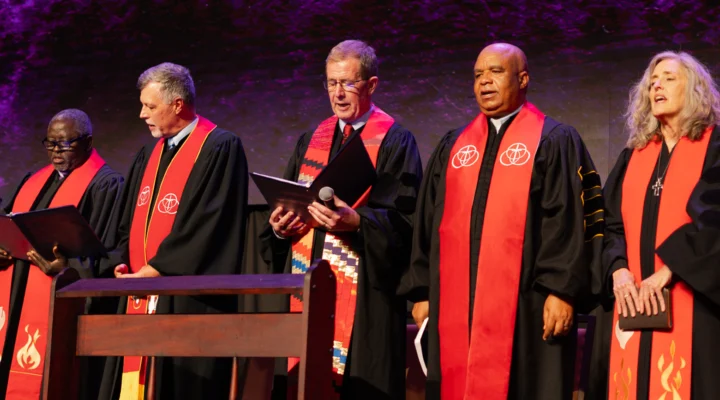
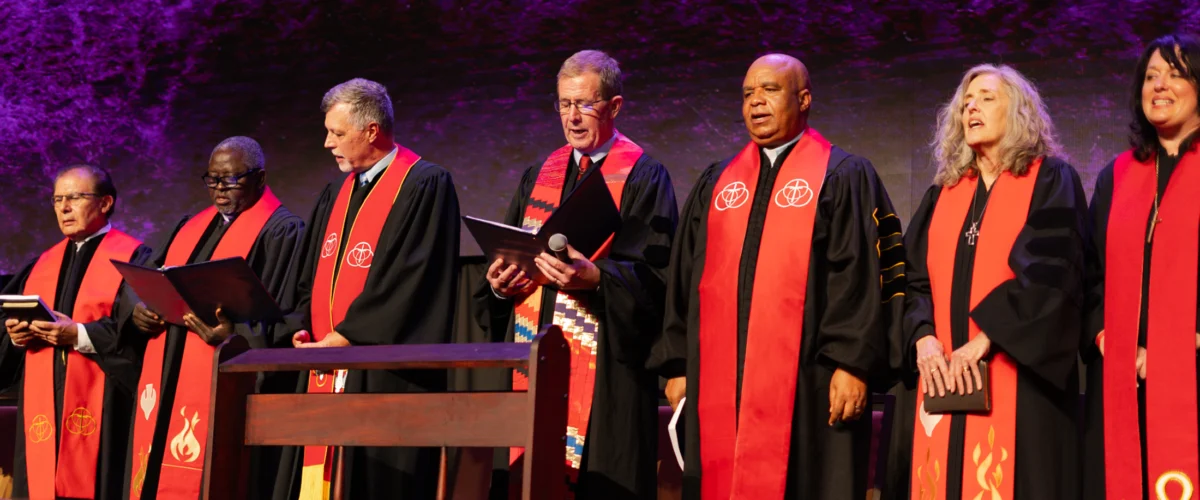
When, on May 1, 2022, the Global Methodist Church announced itself to the world, more than 2,000 churches already had taken advantage of the disaffiliation process to break with the United Methodist Church.
At the time of the announcement, I was a Methodist seminary student at Southern Methodist University’s Perkins School of Theology. Having grown up in Southern church culture, I was well-acquainted with both the text and the subtext behind the disaffiliations.
The text — or the part said aloud — was the assertion that the UMC had become too liberal, was no longer operating biblically and those leaving were the true orthodox Christians.
The subtext was a continuation of the decades-long battle over what is often called “biblical inerrancy.”
The same thing happened more than 160 years ago when the Methodists, Baptists and Presbyterians each split over the issue of chattel slavery. Those North of the Mason Dixon Line found slavery incompatible with the teachings of Jesus. Those in the South pointed to the inclusion of slavery in the Bible as simply a fact of life — something to be emulated by those who believed in the authority of Scripture.
In the years after the American Civil War, the Methodists and Presbyterians reunited North and South, while the Baptists did not. But fundamentalism (and biblical inerrancy) within American Protestantism did not disappear — it simply went underground for a while.
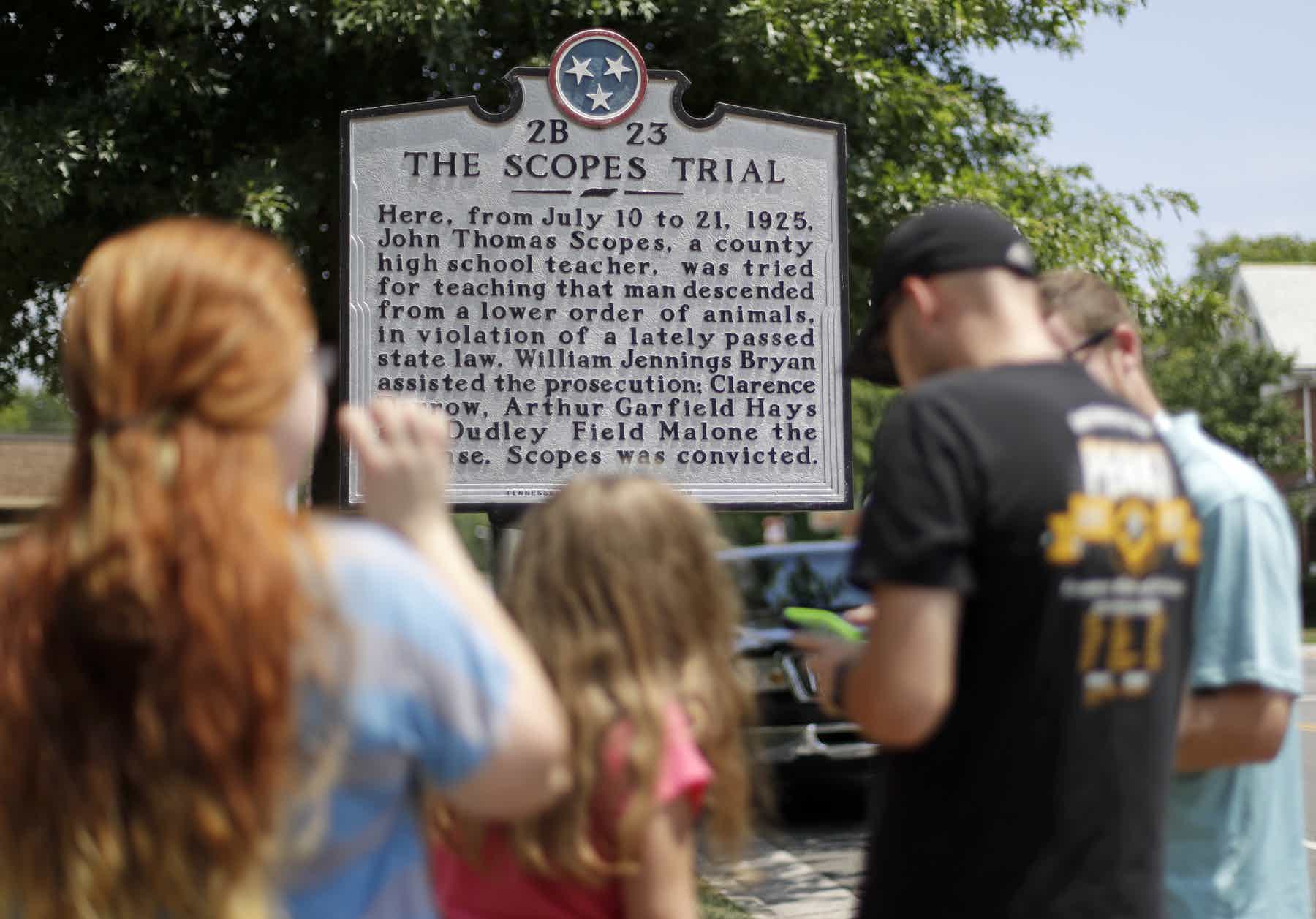
Historical marker at site of Scopes Trial in Tennessee.
One hundred years ago this month, the Scopes “monkey trial” brought the battle between the fundamentalists and everyone else back into the news.
The trial of high school teacher John Scopes — billed as a war between religion and science and a match between the fundamentalist celebrity prosecutor William Jennings Bryan and the agnostic defense attorney Clarence Darrow — was big news. In the end, Scopes lost, Bryan died five days after the trial ended and Scopes’ verdict later was overturned on appeal on a technicality.
Once again, fundamentalism in American Protestantism did not disappear — it simply went underground for a while.
In the 1980s, fundamentalism and its doctrine of biblical inerrancy again burst into the open.
In 1978, a coalition of evangelicals penned the Chicago Statement on Biblical Inerrancy — a doctrinal statement. The group went on to release two additional doctrinal statements.
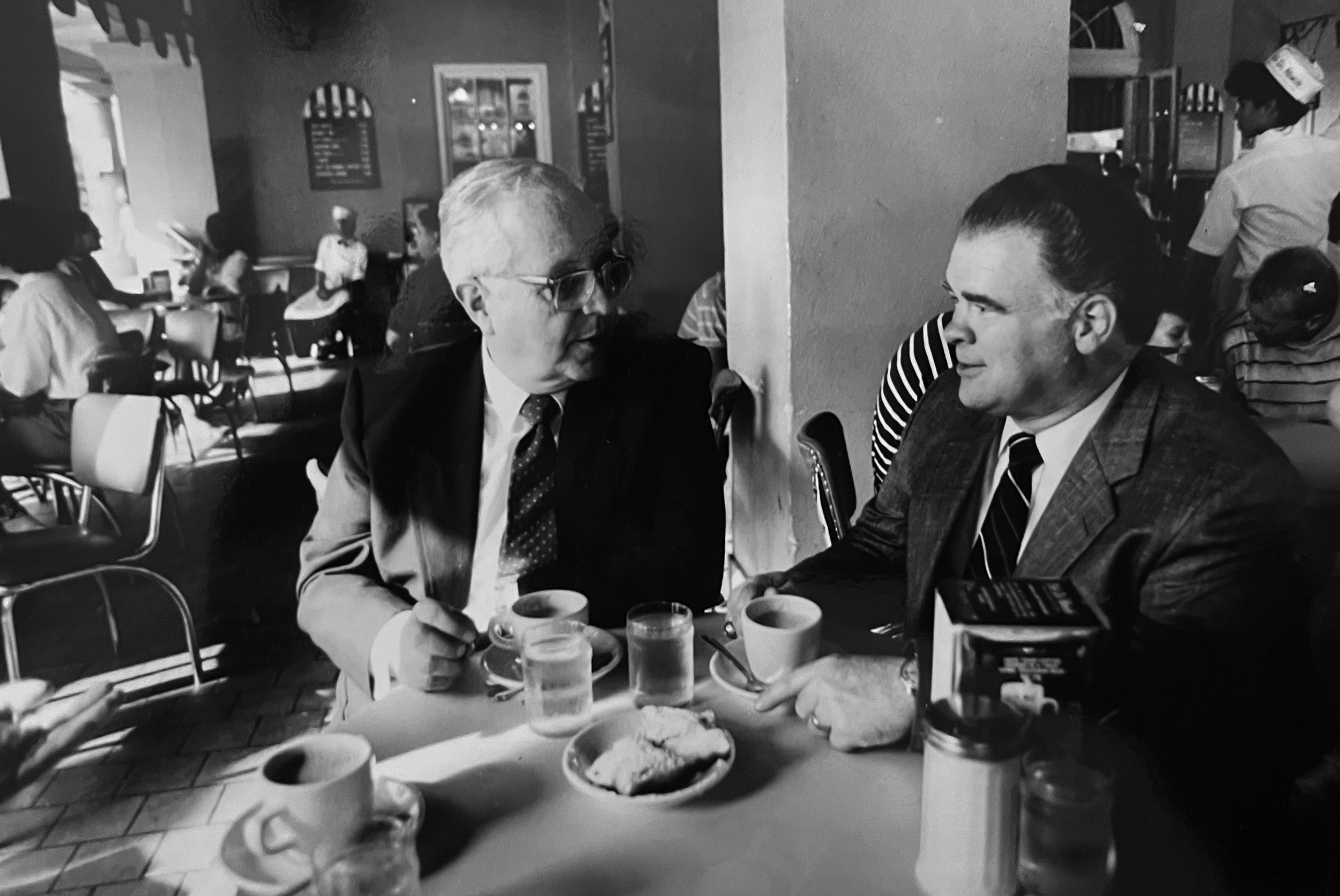
Paul Pressler (left) and Paige Patterson, architects of the SBC takeover, sit at Cafe duMonde in New Orleans June 9, 1990, comemmorating their meeting at the same spot 20 years earlier to conceive the plan to gain control of the nation’s largest non-Catholic denomination. (Photo by Thom Scott)
Around the same time, the Southern Baptist Convention — which had been making little strides toward embracing modernity by ordaining a few women — was besieged by the fundamentalists who managed a hostile takeover of the denomination.
The biblical inerrantists won the day and more moderate Baptists who lived in the South were forced into exile where they came together to launch both the Cooperative Baptist Fellowship and the Alliance of Baptists.
This history is important when considering the more recent split within the Methodist church. Once again, fundamentalism reared its ugly head. However, in the case of the Methodists it was those advancing some version of biblical inerrancy who broke away from the denomination. Many of them went on to form the GMC.
When the subtext becomes the text
At first glance, the GMC may not seem to be cut from the same cloth as the SBC; they do, after all, allow the ordination of women. However, on closer inspection the GMC and the SBC share more in common with each other than they do with the original Methodist and Baptist traditions from which they evolved.
In the case of the newly formed GMC, I was interested specifically in how it speaks of itself in comparison to the denomination from which it split. So, I downloaded the text for the Books of Discipline for the GMC and UMC and created a side-by-side comparison of them.
The word cloud images — like the denominations themselves — look similar but have significant differences in the emphasis placed on doctrine and polity.
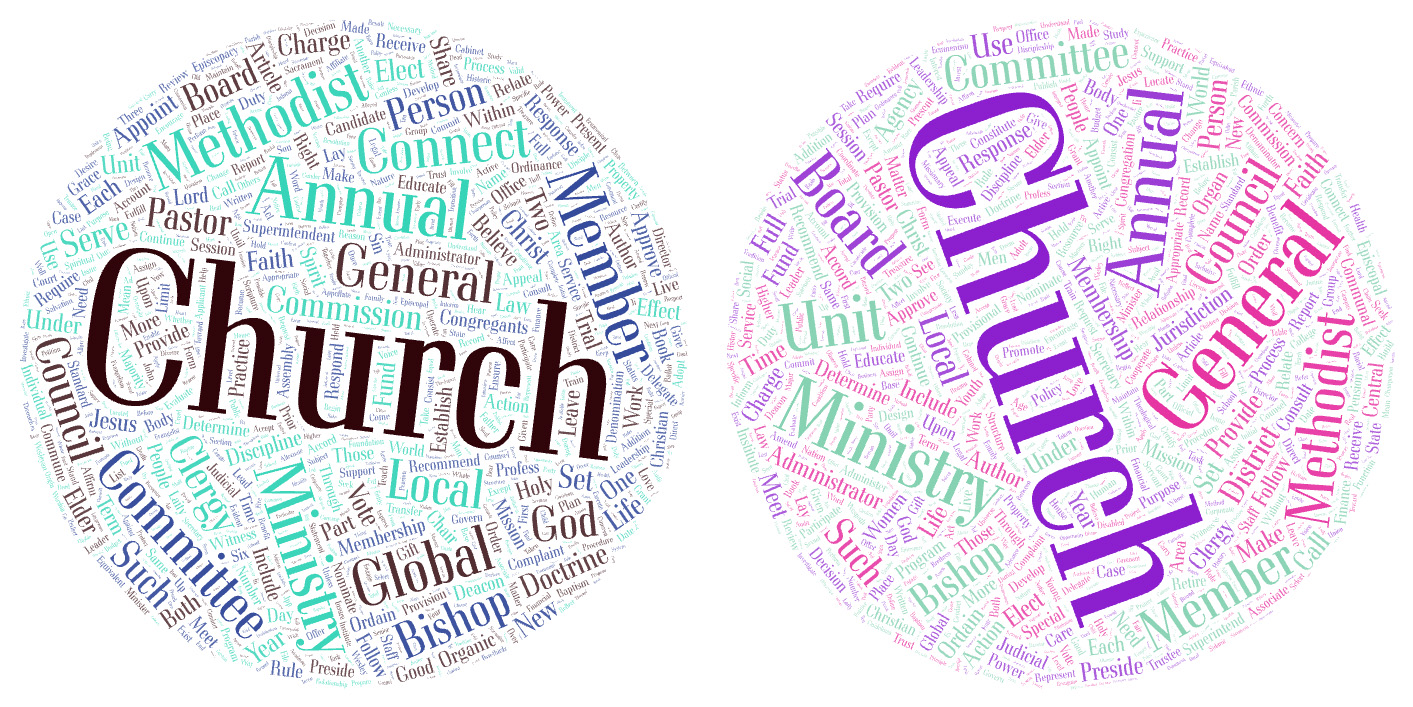
Global Methodist Church on left and United Methodist Church on right.
The GMC places great emphasis on pushing what it calls a “normative” or “true” teaching of doctrine. While both the GMC and the UMC confess the historic Christian creeds, in its Book of Discipline, the GMC says of them:
The following summaries of the apostolic witness disclosed in Scripture have been affirmed by many Christian communities and express orthodox Christian teaching. The word “normative” refers to the standards by which we judge true and false teaching. Normative teaching is binding and obligatory. It establishes the proper boundaries for preaching and teaching in our denomination.
In fact, the GMC really likes the word “normative,” using it 17 times to emphasize that its interpretations and Scriptures are the correct ones all members are to subscribe to. By comparison, the UMC Book of Discipline never uses the word “normative” and its only use of the word “orthodox” is in its explanation of the rise of biblical inerrancy in the history of the church:
“The GMC really likes the word ‘normative,’ using it 17 times to emphasize that its interpretations and Scriptures are the correct ones.”
Biblical fundamentalists and neo-orthodox theologians questioned liberal Protestant theology and accused it of undermining the very essence of the Christian message. Since each of these theological parties — fundamentalist, neo-orthodox and liberal — was well represented among the forerunners of United Methodism, heated doctrinal disputes were present in these churches.
It’s interesting to note that the UMC’s Book of Discipline goes on to encourage both ecumenical and interfaith cooperation even when disagreements over doctrine occur:
Christians, some of which continue to divide the church deeply today, faithful Christians need to face their disagreements and even their despair and not cover differences with false claims of consensus or unanimity. On the contrary, the church needs to embrace conflicts with courage and perseverance as we seek together to discern God’s will. With that understanding and commitment, we pledge ourselves to acknowledge and to embrace with courage, trust and hope those controversies that arise among us, accepting them as evidence that God is not yet finished in sculpting us to be God’s people.
By contrast, the GMC — intent on elevating its doctrine as the “correct” one — refers at length to the “false teaching” outside its denomination. In describing why their definition of the normative standards are good and true, their Book of Discipline states:
These constitutive, normative standards embody the “faith once for all entrusted to the saints” (Jude 3) and serve as a bulwark against false teaching, providing the framework for the praise of God in our teaching (orthodoxy), the development of our collective theology, and the launching point for our living and service (orthopraxis).
I have both a master’s degree in education and a master’s degree in divinity and disagree with the GMC defining its teaching as “orthodoxy.” Rightly understood, one might describe one’s beliefs as orthodox, but one’s teaching is better described as praxis. Orthodoxy is defined as right thinking or belief.
“By defining its praxis as orthodoxy, the GMC is making a doctrinal claim.”
By defining its praxis as orthodoxy, the GMC is making a doctrinal claim — one best described as the doctrine of biblical inerrancy. They also sound an awful lot like the present-day SBC, which sees its own praxis as orthodoxy.
Family and sexuality
Elsewhere in the GMC’s Book of Discipline, they embrace the doctrine of biblical inerrancy. They very clearly (and repeatedly) lay out their belief that marriage is between one man and one woman. Nowhere is there any mention of divorce or, as explicitly prohibited in by the UMC, child marriage.
By contrast, the UMC — having removed exclusionary language about sexuality at its last General Conference — goes to great lengths to validate and uplift adult relationships, single individuals and families of all types. Of marriage, their Book of Discipline states:
Within the church, we affirm marriage as a sacred, lifelong covenant that brings two people of faith, an adult man and woman of consenting age or two adult persons of consenting age, into union with one another and into deeper relationship with God and the religious community.
The UMC goes on to repeatedly affirm individuals in singleness or marriage, dedicating an entire section to the contributions of single individuals — even single parents. The GMC only mentions single people three times to emphasize they should remain celibate.
The UMC also speaks repeatedly of being a good interfaith partner (mentioned five times) and being involved in ecumenical relationship (mentioned 173 times). The GMC never mentions interfaith relationships and puts strict boundaries around who within the church hierarchy should engage in ecumenical relationships. In fact, within the GMC there is an emphasis on “the Great Commission” which is a phrase weighted down by centuries of colonialist and racist interpretation and which also echoes the SBC’s vision of its work in the world.
I could go on, but readers, no doubt, get the point.
Who are your friends?
The only question remaining for me about the GMC is this: When do you plan to strip women of the right to ordination? Remember the SBC did so in 1984 — years after its founding and all in the name of the doctrine of inerrancy.
There’s a saying: “Tell me who your friends are and I’ll tell you who you are.”
“Tell me who your friends are and I’ll tell you who you are.”
On June 29, the GMC announced its list of “approved” educational institutions for would-be pastors. Two of the six are UMC seminaries, two are Methodist-adjacent (meaning they once had ties to the UMC but have now parted ways), and two are SBC-adjacent (meaning they have historic ties through state Baptist conventions that, in turn, cooperate with the SBC).
Both the Baptist seminaries are notable for their attempts to weave a careful path through the fundamentalists controversies without appearing to be too progressive. And both exist within university systems that claim to be supportive of LGBTQ students while not granting them the same rights as heterosexual students.
Beeson Divinity School at Samford University is an intentionally odd school — led from its founding by a Calvinist Southern Baptist dean and appealing to an ecumenical audience within certain boundaries.
Baylor University’s George W. Truett Theological Seminary was birthed out of the fundamentalist controversy in the SBC — as a counter to fundamentalism — but its critics charge the seminary is not progressive enough. It is a school that enrolls women but shuns LGBTQ inclusion.
And both Samford and Baylor often make headlines for their anti-inclusion stances. Last year, Samford blocked affirming groups from being on campus.
Right now, Baylor University remains in the news for forcing its Diana Garland School of Social Work to return a $634,000 grant awarded from the Eula Mae and John Baugh Foundation for an academic study on LGBTQ inclusion in the church and how to address loneliness.
For a denomination claiming the mantel of John Wesley, the GMC’s choices of educational partners is interesting, to say the least.
It’s clear the subtext has become the text.

Mara Bim
Mara Richards Bim serves as a Clemons Fellow with BNG and is the first Justice and Advocacy Fellow at Royal Lane Baptist Church in Dallas. She is a spiritual director and a recent master of divinity degree graduate from Perkins School of Theology at SMU. She also is an award-winning theater artist and founder of the nationally acclaimed Cry Havoc Theater Company which operated in Dallas from 2014 to 2023.
Related articles:
Two Baptist seminaries among six ‘recommended’ by new Global Methodist Church
Truett Seminary names a controversial Methodist bishop to its faculty
Truett Seminary names theologian for breakaway Methodist group to chair Wesleyan Studies program