


Zach Lambert is a writer, public theologian and the founding pastor of Restore Austin. His new book, Better Ways to Read the Bible: Transforming a Weapon of Harm into a Tool of Healing, catalogs the ways the Bible has been deployed against people and offers a useful set of filters that might help us properly read the Bible as a text of joy, love and justice. I’m so grateful to Zach for his important book and for his very public stances on justice and the sacredness of every human being.
Greg Garrett: The first word of your title is “better.” You and I both grew up in Southern Baptist traditions where the Bible was often weaponized. I wonder if you could tell us about the book and how to build better lenses to counteract the ones that were really damaging in our upbringing.
Zach Lambert: Fundamentalism is a box with very hard boundaries, and these boundaries have to be policed constantly for fundamentalism to work. If you start asking questions, if you even take a half step outside of the fundamentalist box, then everything starts to break down. The most effective way to keep people inside the boundaries is by using the Bible as a baton to beat them back toward the middle every time they take a step toward the edge. That was how the Bible was used in a lot of my growing up.
Every time we read the Bible, we are deciding what things mean. We are deciding how they work themselves out in our lives. We’re deciding what is prescriptive for all time or descriptive of a certain thing. None of us just reads it, no matter how many times we’ve been told it’s simple black and white, I just read it. Nobody actually does that. We’re all bringing our experiences and biases and social locations to it.

Greg Garrett
We can’t take off every lens or experience or bias that we have. But what we can do is choose between harmful lenses for biblical interpretation and healthier ones. In the book, I identify four harmful lenses that are traditionally used in more fundamentalist spaces, that lead to the weaponization of Scripture that hurts people.
I talk about the lens of Moralism: The Bible’s a big rule book to tell me what to do and what not to do. I talk about the lens of Hierarchy: The Bible tells us who’s in charge of other people. This intersects a lot with your anti-racist racial justice war, right? So, you have something like “the curse of Ham” out of the story of Noah used as a theological justification to say that Black people should be enslaved because they’re actually descendants of Ham, cursed by God and meant to be ruled over. In the modern day, most of us are like, that is ridiculous and unbelievable theology. But many of the defenses of chattel slavery and the American South came from clergy talking about things like “the curse of Ham.” That’s a very significant weaponization. I discuss those four really harmful lenses, and I ask: What’s it look like to identify and discard those as much as possible? What does it look like then to replace them with healthier lenses?
“If there’s anything in our faith that contradicts Jesus, it’s wrong.”
I outline those four much healthier lenses — Jesus, Context, Flourishing and Fruitfulness — that I hope yield much better fruit. One of the lines from the book I love is “If there’s anything in our faith that contradicts Jesus, it’s wrong.” That is one of our strongest lenses. But it’s not a lens, strangely enough, that all of our Christian brothers and sisters acknowledge.
GG: Talk a little bit about how you have been using Twitter and other social media spaces to promote these healthy filters and a faith that centers love and justice. And how does it feel to take the abuse that comes at you from people who reject your readings?
ZL: To answer the first part, I think that we all have different roles when it comes to how we engage with following Jesus and how that plays out in the public square. Bernice King, Dr. King’s daughter, talks about how the work goes on in a multitude of places. The work is in art and writing and speaking and protesting and resting and joy and lament, and we all have these different roles.
I think that’s also borne out in Scripture. Paul talks about how we have different roles. If you’re a teacher, then teach well; if you’re a servant, then serve gladly. We all have different callings based on the unique makeups that God has given us.
I’ve come to the conclusion as an adult — and through a lot of therapy — that the way God has made me and the calling that I have is to do public theology, to talk about the intersection of faith and our social lives and our political lives. One of the reasons I think I can do that is because I am not unaffected by the hate, but I’m less affected than the average person. I don’t really dwell on it. Rachel Held Evans used to talk about having thick skin and a tender heart. I think about that all the time, that I want to be someone who has thick skin and a tender heart.
GG: Besides Blessed Rachel, you mention a number of others in the book as powerful influences on you. Could you talk a little bit about Rachel and Beth Allison Barr and other folks who have influenced you?
ZL: Absolutely. One of my favorite parts in the book is in the introduction. Three paragraphs of people who have been really influential, from preachers to activists to theologians and authors. Rachel Held Evans is a massive person for me I started reading a decade ago. I remember the first time I read Searching for Sunday, thinking she’s just saying all the things that I’m feeling all the time. I very much miss her and her voice in the world. But yeah, it was also people you’re familiar with like James Baldwin, who you’ve written a book on, and bell hooks, South American liberation theologians like the Boff brothers and Oscar Martinez.
I think about faith sometimes like a house, and fundamentalism is the dark basement. When you’re in the basement, you’re convinced this is what Christianity is, and if you leave the basement, you’ve left the faith. …
I think about faith sometimes like a house, and fundamentalism is the dark basement. When you’re in the basement, you’re convinced this is what Christianity is, and if you leave the basement, you’ve left the faith. Then you walk up the stairs and open the door into this big, beautiful house with tons of rooms and faith traditions. Some of them are thousands of years old, and some are new. And you realize that not only is Christianity bigger than you thought, but it’s actually more beautiful than you were ever led to believe. I can learn so much from Catholic social justice teaching and Jesuits and Black church traditions and immigrant churches.
The reason for the book is very pastoral: I wanted to have this resource that I could just hand people to say there really are better ways to engage with the Bible, and here are a whole bunch of people who helped me get there. I’ve joked that if you read the book and your only takeaway is that you need to start reading more James Baldwin or something like that, then I’ve done something good in the world.
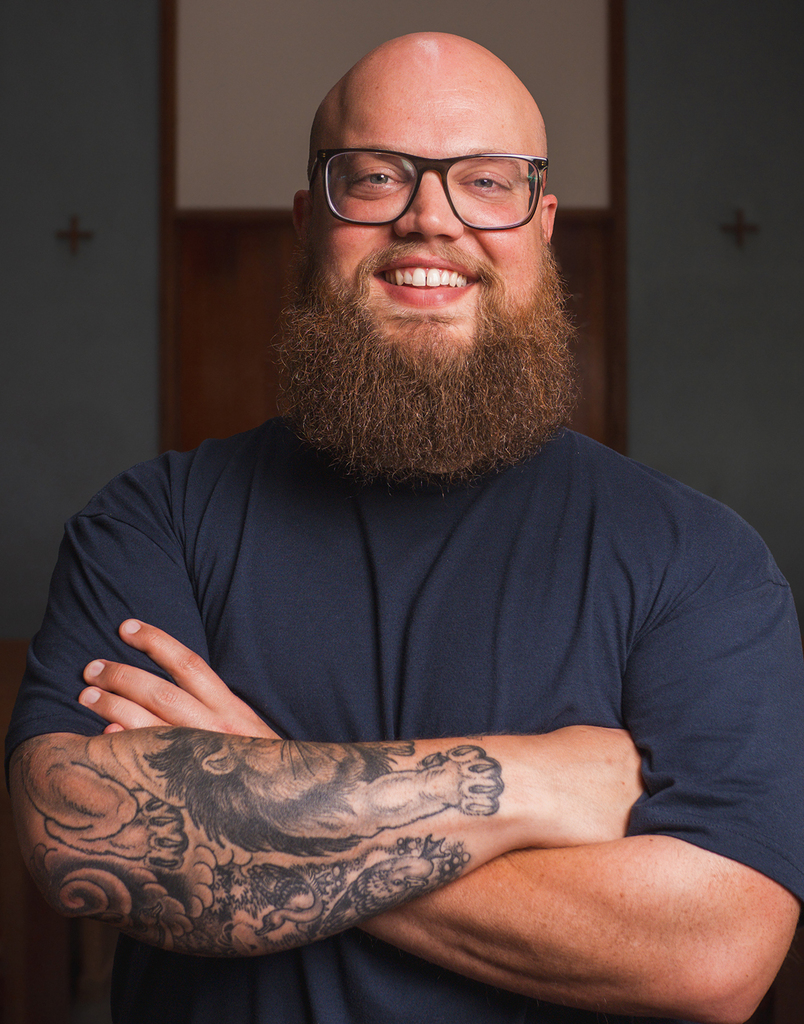
Zach Lambert
GG: Over the last few weeks, reading your book has been a balm for me. Seeing you stand up and profess your faith honestly in the face of resistance on social media — same. I wonder if you could talk with my readers a little bit about where you find the strength and joy and courage to get up every day and do the work.
ZL: The first thing that comes to mind is feedback like yours; it actually does help people. Dr. King used to say that at the end of the day, he was just a Baptist preacher. I’m not comparing myself to Dr. King, but I resonate so much with that, because at the end of the day, I am just a local church pastor. All I really care about is helping people take positive steps toward Christliness and transformation and flourishing. The fact that I get to hear from people that my work has helped them do that is No. 1, massively sustainable and brings me joy.
The second one is relationships in community. I’m starting with my wife and boys. I spend a tremendous amount of time with them. I get to go home every day and play with the boys and eat dinner and do homework and read to them before bed. I have an incredible wife and partner, Amy. She’s actually the better writer in our family. But it also extends to our church at Restore. You and I are talking on a Thursday. Tonight, I have small group, and we’re going to the house of this incredible family that hosts our small group, and we’re going to eat barbeque and swim and talk and probably be there for hours. That’s the kind of stuff that keeps me going.
I think joy is an act of resistance.
I think joy is an act of resistance. What I think of as evil embodied on the spiritual side, but also just harmful and oppressive practices on the material side seek to remove all joy from people’s lives, to make them desperate and depressed. And so, choosing to make time for friends and family and loved ones and burgers and beers, you know, with people like you is just as much an act of resistance as writing a post or something like that.
Have you ever seen The Trial of the Chicago Seven? So, the older antiwar activist guy has this quote basically about like how we can’t just be against things. We can’t just be against war and against poverty and against hate and against fascism. We have to also be for beauty and love and relationship and hope. Every person I know who’s done long-term advocacy and justice work will tell you that you’ll burn out so quickly if there’s not joy and beauty.
Greg Garrett is an award-winning professor at Baylor University, where he is the Carole McDaniel Hanks Professor of Literature and Culture. One of America’s leading voices on religion and culture, he is the author of 30 books, most recently the novel Bastille Day and The Gospel According to James Baldwin: What America’s Great Prophet Can Teach Us about Life, Love, and Identity. He is currently administering a major research grant on racism from the Eula Mae and John Baugh Foundation and finishing a book on racist mythologies for Oxford University Press. Greg is a seminary-trained lay preacher in the Episcopal Church and Honorary Canon Theologian at the American Cathedral of the Holy Trinity in Paris. He lives in Austin with his wife, Jeanie, and their two daughters.
Related articles:
There are better ways to read the Bible, opinion by Zach Lambert
Texas pastor posts ‘I Voted’ selfie and gets smacked down by the religious right