

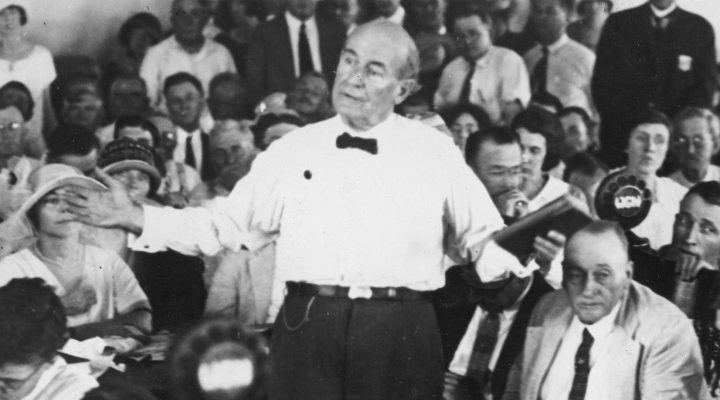
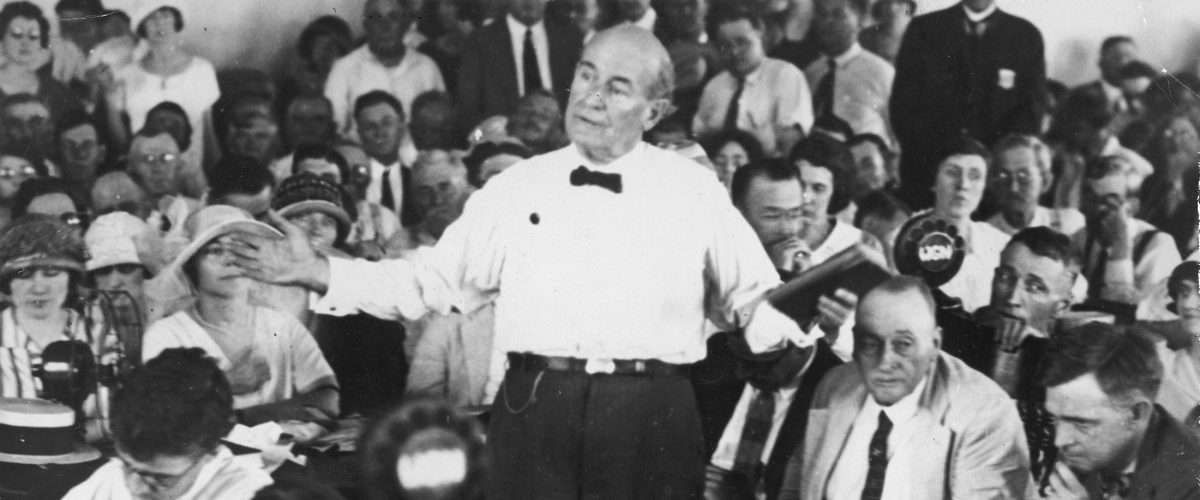
If the Scopes “Monkey” Trial is discussed nowadays, the tone usually is pejorative. The events of July 1925 — in which a small-town substitute teacher was charged with a misdemeanor for teaching evolution in a public high school — are remembered as the apotheosis of fundamentalist absurdity by secular culture.
The trial also is remembered as the partitioning of American Christianity from mainstream culture, with the former attempting to drag the latter into the Dark Ages through the force of the state.
This story is more nuanced than the mythologized version immortalized through films like Inherit the Wind. The real-life trial was an absurd 1920s spectacle that was about anything but the consequences of the law.
The American Civil Liberties Union, former Secretary of State William Jennings Bryan, celebrity lawyer Clarence Darrow and famed journalist H.L. Mencken descended upon a town that had knowingly broken the law for publicity. They wanted to turn it into a carnival spectacle. The defense asked for a guilty verdict for appeal purposes, and the prosecution offered to pay the $100 fine just to prove a point. Defendant John T. Scopes served no time in prison and went on to a modest life after getting a master’s degree in geology at the University of Chicago. Dayton successfully got its name on the map.
The fundamentalists and modernists took some hard jabs at each other in the trial, but this was merely an effect of the ongoing fundamentalist-modernist schism happening in the background.
In a world in which Christianity’s role in the public square is incredibly contentious, the Scopes Trial’s 100th anniversary raises challenging questions that continue to haunt the American experiment.
However, in a world in which Christianity’s role in the public square is incredibly contentious, the Scopes Trial’s 100th anniversary this past month raises challenging questions that continue to haunt the American experiment.
The Scopes 100 Symposium
To celebrate the centennial, numerous conferences across Tennessee in July facilitated discussion of the trial’s history. Vanderbilt University hosted a two-day evolution conference in Nashville, the Freedom From Religion Foundation sponsored a three-day conference in Chattanooga, and Bryan College welcomed the Core Academy of Science’s annual creationist conference, Origins 2025. Additionally, the Rhea County Historical Society put on an impressive science, theology and history symposium in the trial’s hometown of Dayton.
Dayton continues to celebrate the event that made it famous with an annual festival, in which local actors reenact the trial transcript in the actual courthouse where it played out. This year, the county historical society took extra steps to make the centennial celebration special. Included in this year’s agenda were an antique car show, tours of the local cemetery and Bryan College, and a two-day symposium, featuring many of the leading experts on the complex history of the battle between science and religion.
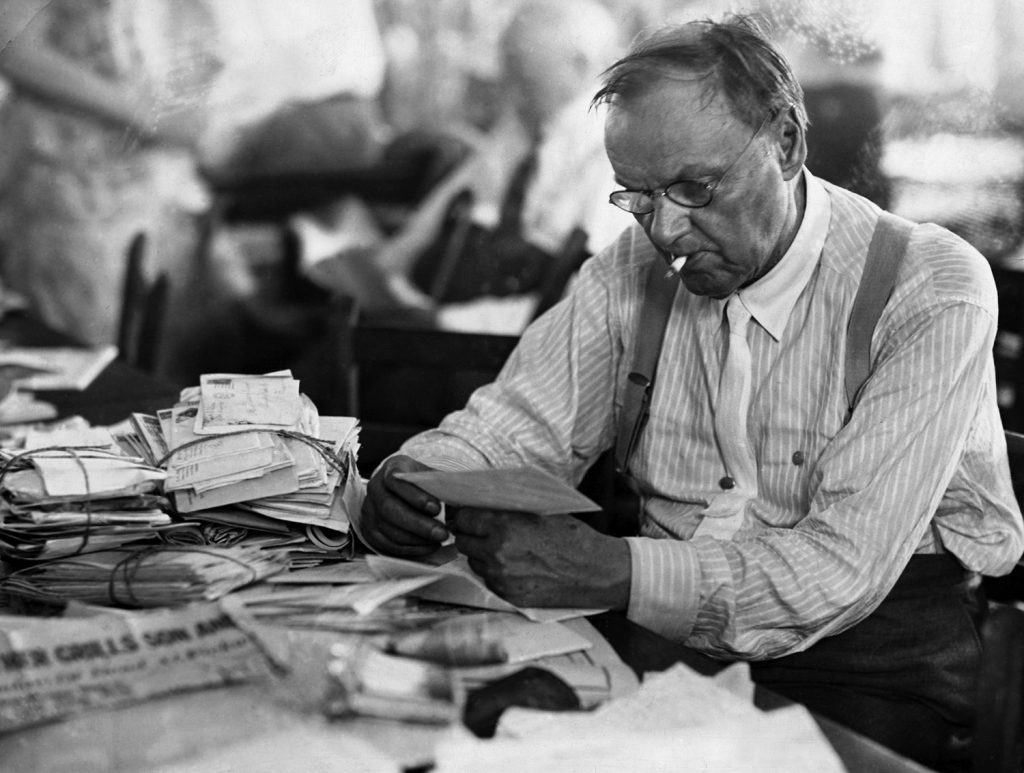
Defense attorney Clarence Darrow reading his mail during the Scopes trial in 1925. (Photo by George Rinhart/Corbis via Getty Images)
Despite a modest turnout of roughly 70 people, the crowd of enthusiastic “Scopes nerds” represented a well-traveled group, with guests flying in from as far as or farther than California and New York.
The impressive lot of speakers included prominent evolutionary scholars and theologians from the University of Wisconsin-Madison, Bryan College, Pepperdine University and the University of Akron. The hosts and participants ranged from enthusiastic young-earth creationists, to nontheistic Darwinists, to those who sit comfortably in-between.
What have we learned?
The Scopes Trial remains compelling in part because we continue to deal with its underlying legal and moral questions. Science vs. religion, the proper role of democracy, the nature of truth, freedom of speech and what books are taught in schools are equally compelling questions in 2025 as in 1925.
The trial accentuated the fundamentalist-modernist crisis, which divided American Protestant denominations between conservative fundamentalists and liberal modernists. That tension continues to be felt today, as current as the United Methodist Church’s ongoing schism.
Scopes … sits near an open wound at the heart of American culture that never quite seems to heal.
Scopes became the model of the modern celebrity trial, becoming known as “the trial of the century” and representing the first time a major trial was broadcast over radio. It’s echoed in everything from the O.J. Simpson trial to Republican attempts to remove “woke” books from high school libraries. It sits near an open wound at the heart of American culture that never quite seems to heal.
The Scopes Trial also remains compelling because it gives us a language to discuss modern issues. A guest essay in The New York Times even tried to use it as a model for how Democrats could appeal to rural voters through the voice of William Jennings Bryan. Much of the recent commentary about the trial has been an attempt to reframe it through modern issues.
“Simply denouncing anti-intellectual views, harmful as they are, will not persuade those who hold them to change their minds,” wrote Michael Kazin, a professor of history at Georgetown University. “If Democratic politicians proposed economic programs as ambitious as Bryan’s to help the devout inhabitants of small-town America — and acknowledged, in their own way, the moral virtues in sacred texts — they might have a chance to break through to millions of people who now mistrust them.”
What should we do?
Looking at the Scopes Trial and seeing solutions can be difficult. If anything, the trial seems to foreshadow more conflict. Participants of the various conferences offered many answers as to what the trial meant and why.
Adam Laats, a historian at Binghamton University and one of the speakers at the Vanderbilt conference, said Scopes was the spark of a century-long culture war that continues to rage today between mainstream institutions and an alternative fundamentalist apparatus that seeks to operate outside of traditional institutions.
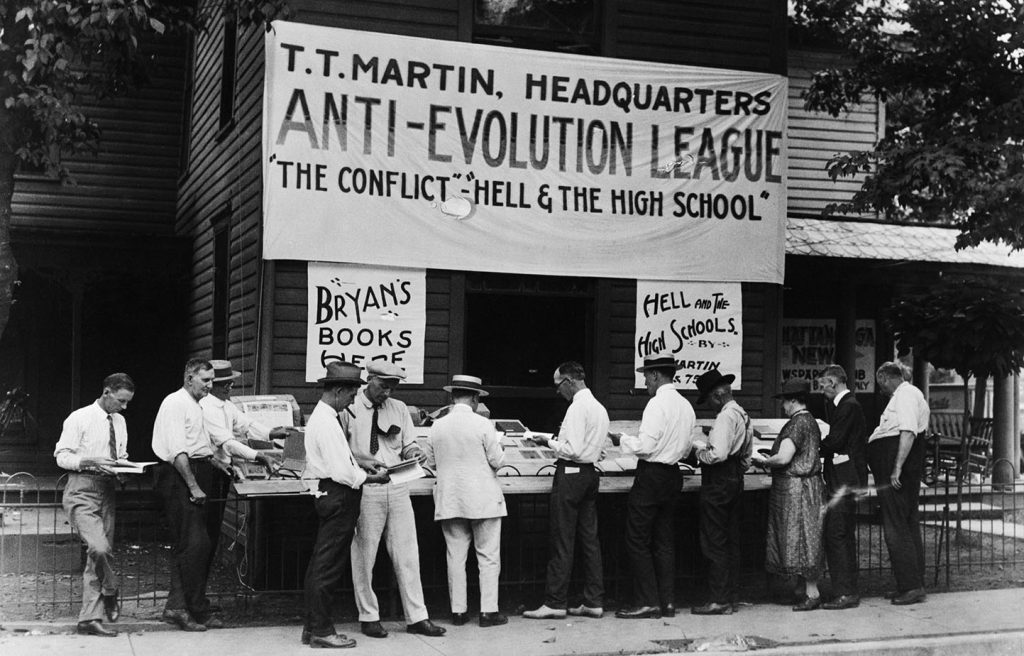
An Anti-Evolution League holds a books sales at the opening of the Scopes “Monkey” Trial in which biology teacher John T. Scopes is being prosecuted for teaching evolution in his class. (Getty Images)
“The Scopes Trial wasn’t really about evolutionary theory,” he said. It “was directly responsible for what we might call the fracturing of America’s cultural institutions; the creation of an entirely intentionally, explicitly separate and devoutly conservative group of institutions that we are seeing flowering today with things like Project 2025.”
The Scopes Trial was a blockbuster display of this existing fundamental divide about higher ed, the nature of morals and knowledge, and what those institutions represent.”
It “certainly didn’t start that, but the Scopes Trial was a blockbuster display of this existing fundamental divide about higher ed, the nature of morals and knowledge, and what those institutions represent.”
David B. Allen, a humanities lecturer at the State University of New York Maritime College and a participant in Dayton, said he had firsthand experience of the culture war in 1985 when he was serving as a 27-year-old first-time teacher in Cuba, Ill. He was somewhat traumatized when he was dragged before his principal and superintendent and questioned about why he was teaching evolution in his history class, before being asked cordially to teach creationism too, alongside evolution.
“It’s really complicated,” Allen said. “As long as people are trying to do the right thing, it’s going to be complicated, because what people think is the right thing may not be the constitutional thing. The Supreme Court deals with that every year, how to do the right thing with the constitutional thing. It’s complicated to write a set of rules for 300 million people all trying to do the right thing.”
Since the 1987 Supreme Court case Edwards v. Aguillard, teaching creationism in schools has been considered a violation of the Establishment Clause of the First Amendment. That clause prevents government from the “establishment” of religion.
Eugenie Scott, an anthropologist and evolutionist who founded the National Center for Science Education, said part of the problem with these debates is they serve as litmus tests for identity groups and often go beyond the actual science.
“One of the things that is striking about the Scopes Trial that is reflected today is the tribalization of science,” Scott said. “During the time of Scopes, the people who supported Scopes didn’t know much about evolution. … But what science/evolution became for either camp was a symbol of the identity group they favored — either religious fundamentalism or secularists, neither of whom knew much about the science involved, which we absolutely have to today.
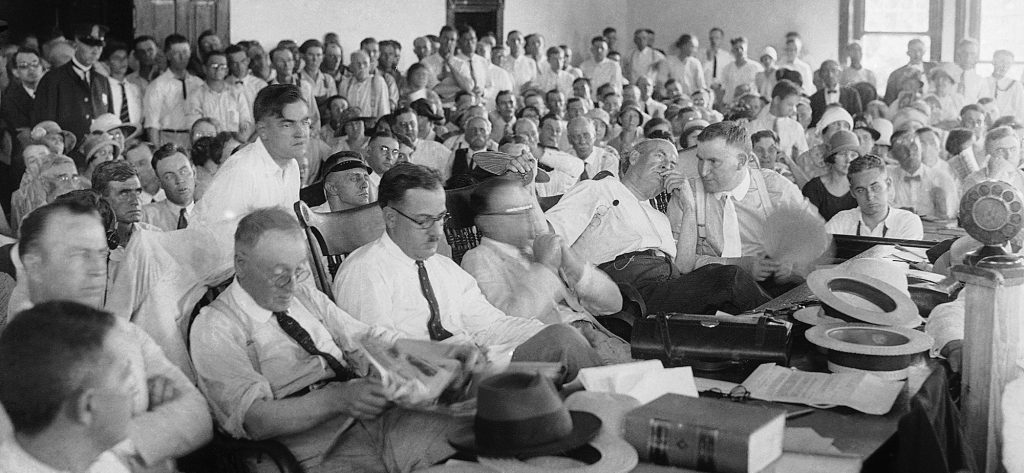
Court scene of Scopes trial, 1925. (AP Photo)
“If you look at climate change, vaccines, GMOs, or other science-related controversies, people who line up on one side or the other often don’t know much about it. Science becomes a symbol of tribalization of the group they wish to identify with. Climate change is the classic example of this.”
Reasons for hope
As Laats pointed out, lessons that can help us shape the future can be learned from Scopes. He pointed to a recent National Center for Science Education study that showed parents who trusted their teachers and didn’t fear teachers were intentionally trying to undermine their children’s faith were less likely to contest their children’s learning about the theory of evolution.
Building trust between parents and teachers is enough to successfully alleviate fear and nervousness that their faith is being undermined. Room for progress can be found in trust-building and commonality.
“People like William Jennings Bryan had a relatively inclusive vision of what it meant to oppose evolution, and that’s because he was a brilliant politician,” Laats said. “I think that same thing applies now. Americans, even people who think of themselves as ardent creationists, all love our children and want the best for them.
“Americans in general have this huge middle ground about what it means to say we want our schools and institutions to teach our kids the best science. We all want that.
“The differences are about which is the best science, and we have more middle ground than we tend to think of because politicians, pundits and influencers build careers saying, ‘I’m gonna tell you scary things to watch out for.’ It’s hard to build a TikTok following saying, “Actually, we all agree on high quality; let’s try and find a version of schooling that will not alienate people on the left, right and middle.’
“I take this from history. Back then, like now, people talk about the fight, but don’t talk about that there are these unspoken areas of agreement.”
Naturally, though, the seeds of this conflict are imbedded in human nature, and that is something we will all have to live with until we return to glory.
As William Jennings Bryan’s great-grandson Bill Forsyth put it to me: “There will always be parts of the Scopes Trial that echo into the future. Times change, but maybe not. Everything looks different and feels different now, but there will be issues that will always be with us.”
Tyler Hummel is a Wisconsin-based freelance critic and journalist, a member of the Music City Film Critics Association, a regular film and literature contributor at Geeks Under Grace, and was the 2021 College Fix Fellow at Main Street Nashville.
Related articles:
The Scopes Trial, then and now, analysis by Bill Leonard
Scopes at 100: The lasting legacy of the trial over human origins
A hundred years after the Scopes Trial, not much has changed