

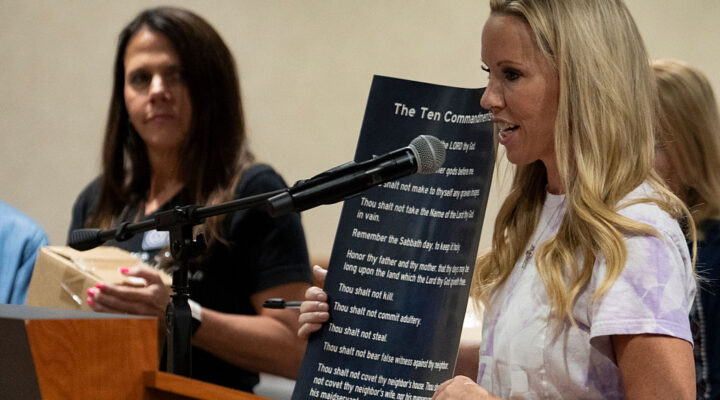

Texas Attorney General Ken Paxton has ordered school districts unaffected by a recent court ruling to comply with a state law requiring Ten Commandments displays in public school classrooms beginning Sept. 1.
The Aug. 25 directive came less than a week after a federal judge in San Antonio blocked the statute from taking effect in 11 school districts named in ongoing litigation filed by 16 multifaith and nonreligious families with children in public schools.
Paxton echoed supporters of Senate Bill 10, who say the 16-by-20-inch classroom displays are a way to honor the nation’s history and help instill traditional values.
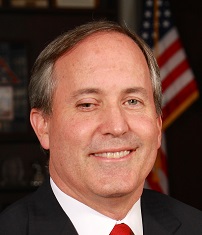 “From the beginning, the Ten Commandments have been irrevocably intertwined with America’s legal, moral and historical heritage,” Paxton said. “Schools not enjoined by ongoing litigation must abide by SB-10 and display the Ten Commandments.”
Alamo Heights, Austin, Cypress Fairbanks, Dripping Springs, Fort Bend, Houston, Lackland, Lake Travis, Plano, North East and Northside independent school districts are named as defendants in Rabbi Nathan v. Alamo Heights Independent School District and therefore blocked from displaying the posters or framed displays.
Paxton already has appealed District Judge Fred Biery’s Aug. 20 preliminary injunction describing the Texas law as “exclusionary and spiritually burdensome” on students and an infringement on plaintiffs’ constitutional right to the free exercise of religion.
“I am one of the plaintiffs in the lawsuit and as a Christian, a Baptist, a mother and a staunch advocate of the First Amendment, I believe this is a big win for the religious liberty of all Texans,” said Mara Richards Bim, justice and advocacy resident at Royal Lane Baptist Church in Dallas and Clemons Fellow with BNG.

Mara Richards Bim
SB-10 is part of an effort to equate “religious liberty” with “Christian supremacy” and to mandate others adhere to a particular expression of faith, she said. “Imposing a state-approved version of the Ten Commandments on schoolchildren and their families contravenes basic principles of religious freedom. The state has no right to religiously coerce children or usurp our parental rights to raise our children within our own faith traditions.”
Attorneys for the plaintiffs warned all other school systems should not implement the new law as litigation proceeds.
“Even though your district is not a party to the ongoing lawsuit, all school districts have an independent obligation to respect students’ and families’ constitutional rights. Because the U.S. Constitution supersedes state law, public-school officials may not comply with SB-10,” the American Civil Liberties Union, ACLU of Texas, Americans United for Separation of Church and State and Freedom from Religion Foundation say in an Aug. 22 letter to superintendents.
The groups added that a federal appeals court blocked Louisiana’s Ten Commandments law in June after being labeled “facially unconstitutional” by a lower court judge.
“Indeed, SB-10 directly contravenes the Supreme Court’s ruling in Stone v. Graham, which struck down a similar Kentucky statute that required public schools to post a copy of the Ten Commandments in every classroom,” the letter explains.
“… as a Christian, a Baptist, a mother and a staunch advocate of the First Amendment, I believe this is a big win for the religious liberty of all Texans.”
Displaying the commandments as litigation continues could result in costly legal actions for districts, the attorneys warn. “We thus urge you to respect the First Amendment rights of Texas students and families by not posting the Ten Commandments displays pursuant to SB-10 and/or immediately removing any displays of the Ten Commandments that have already been posted in your district’s classrooms.”
Attorneys issued a similar warning to school districts in Arkansas where a Ten Commandments bill was blocked by a federal judge Aug. 4.
But according to a report by WFAA TV in Dallas, Frisco ISD — located in the far northern suburbs of Dallas — spent $1,800 to have the displays in classrooms when school started Aug. 13.
Texas Values is leading a group of other conservative nonprofits to raise funds to purchase displays for classrooms across the state with 44,000 adopted by mid-August, the station reported.
The law does not require districts to purchase the posters but allows individuals and private organizations to donate them to local schools.

Jonathan Covey
“Our work to protect and support the Texas Ten Commandments law includes making sure the posters are displayed in the classrooms,” said Jonathan Covey, director of policy for Texas Values. “Whether we need to be in the court, the legislature, the media and school board meetings, we will be there to protect the law to make sure that it’s followed and implemented.”
The organization reported recently making a $6,000 contribution for Ten Commandments displays in Conroe ISD classrooms, located near Houston.
The situation also has caused a dust-up on social media between U.S. Sen. John Cornyn, R-Texas, and Paxton, who is running for Cornyn’s Senate seat in the 2026 primary.
It began on X when Cornyn re-posted the attorney general’s Ten Commandments directive to which Paxton added, “I will not back down from defending the virtues and values that built this country.”
The senator jabbed at Paxton by alluding to his ongoing divorce from Texas State Sen. Angela Paxton, who recently filed to end the marriage due to his alleged adultery.
“Might want to brush up on the Ten Commandments, Ken,” Cornyn said in reference to the seventh commandment’s prohibition of adultery.
But Paxton also played the morality card in his message to the districts. “The woke radicals seeking to erase our nation’s history will be defeated. I will not back down from defending the virtues and values that built this country.”
Related articles:
Federal judge strikes down Texas Ten Commandments law
I’m a Christian teacher who opposes posting the Ten Commandments | Opinion by Rebecca Johnson
Why I’m a pastor who opposes a Ten Commandments bill | Opinion by Preston Clegg
Court strikes down Louisiana Ten Commandments law