


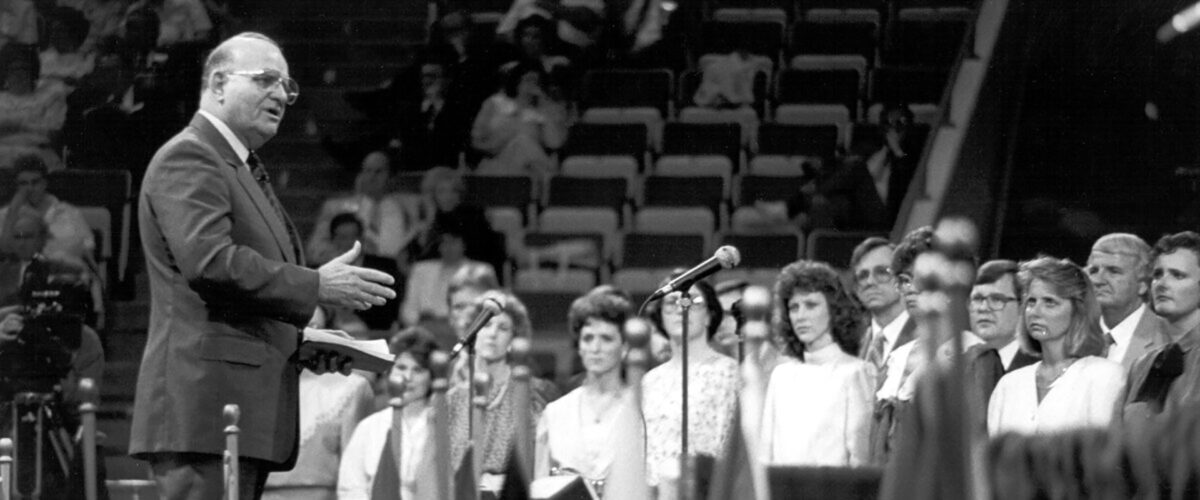
Keith Parks, who led global missions enterprises for both the Southern Baptist Convention and the Cooperative Baptist Fellowship, died Aug. 26 in Richardson, Texas, at age 97.
Parks committed his long life to telling people all over the world about Jesus, and he happily claimed missions as part of his DNA. Shortly before his death, a nurse asked him, “What did you do?” He immediately responded, “I was raised on a farm in West Texas, and I was a missionary.”
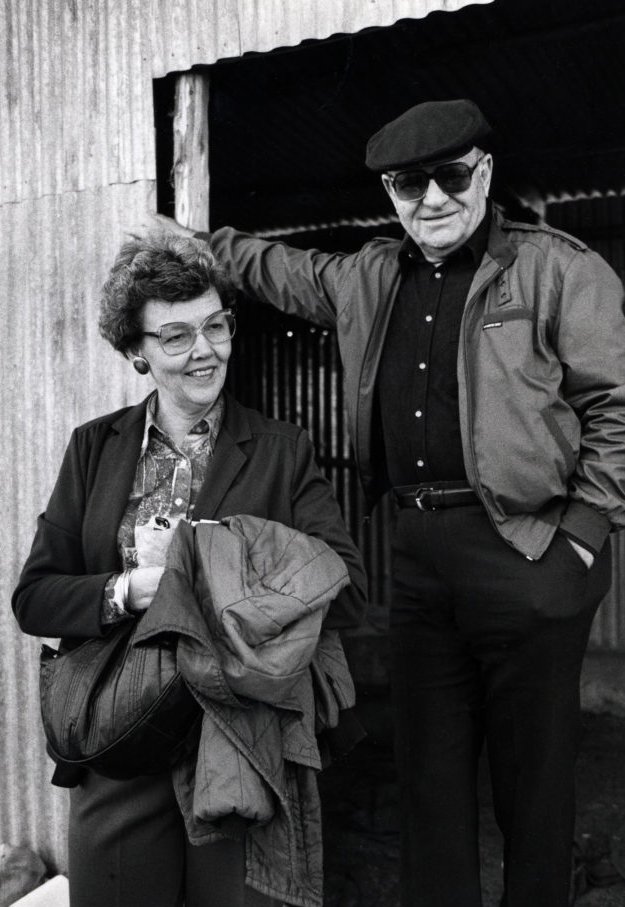
Helen Jean and Keith Parks
Parks and his wife, Helen Jean, began their career as missionaries in 1954, assigned by the SBC Foreign Mission Board (now International Mission Board) to Indonesia. There, he served as a pastor, seminary professor and president of the faculty of the Baptist Theological Seminary of Indonesia.
They returned to the United States in 1968, and he joined the FMB staff at the agency’s headquarters in Richmond, Va. Across the next 12 years, he was area director for Southeast Asia and director of the Mission Support Division.
Parks became the FMB’s ninth president in 1980. As a former missionary and innovative missions leader, he embodied Southern Baptists’ seemingly unanimous commitment to missions and adoration of missionaries.
Casualty of holy war
As the SBC’s “holy war” heated up, the SBC’s common-denominator love of missions initially kept Parks above the fray between the convention’s warring factions. His status began to change in 1985, however, when he told foreign missionaries he could not support the presidential re-election of Charles Stanley, who had the backing of the SBC’s so-called conservative faction.
Even as battles for control of the SBC raged, Parks led the mission board in various levels of expansion. The board cooperated with global missions partners, created a Global Strategy Group and strategized to attempt to reach more than a billion people who never had heard the Christian gospel. The board’s force grew to more than 5,000 missionaries, with more than 10,000 annual volunteers, working in 125 nations. These and other innovations supported an ongoing theme of “evangelism that results in churches.”

Keith Parks (Southern Baptist Historical Library and Archives)
As conservatives continually won battles for leadership of the SBC, they placed increasing numbers of partisan trustees on boards of the convention’s agencies. This created mounting pressure on Parks and other agency leaders. One such person placed on the FMB trustee board was Paul Pressler, co-architect of the “conservative resurgence.”
CBF Global Missions
Parks retired from the FMB under conservative duress Oct. 31, 1992. The following January, he became the first coordinator of global missions for the Cooperative Baptist Fellowship, the fledgling organization whose supporters had split from the SBC in 1991. He retired from CBF eight years later, in 1999.
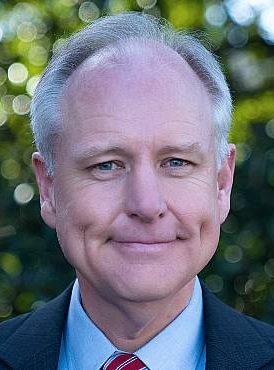
Paul Baxley
“Keith Parks was deeply committed to the global mission of Jesus Christ throughout his life,” CBF Executive Coordinator Paul Baxley said. “He provided visionary and transformational leadership in the establishment of CBF Global Missions. His experience, missiology and strategic clarity laid a strong foundation for our Fellowship’s participation in Global Missions.”
“Parks was deeply respected, not only by our Fellowship at large, but also by our first generation of field personnel who were touched by his leadership, integrity and vision,” Baxley added. “Our Cooperative Baptist Fellowship family joins me in offering prayers of gratitude for his life, leadership and personal participation in inviting people to faith in Jesus Christ and his mission of transforming love in the world.”
CBF field personnel lauded Parks for not only his missionary vision, leadership and compassionate friendship.

Nell Green
“As a global leader, Dr. Parks helped missionaries break out of their paternalistic molds by encouraging immersion into local culture and language proficiency,” said Nell Green, a retired missionary. “As our world began to change, he helped us see and engage in ‘a world without borders.’ No longer were we confined by geography in working among the peoples of the world.
“Because of his vision and understanding of our rapidly changing globalized world, field personnel with the Cooperative Baptist Fellowship began to work in new and unique ways among people living outside of their home countries,” she said.

Kim and Marc Wyatt
“Parks’ call to mission service was both a call to faith and a promise,” said Kim Wyatt, a missionary in the North Carolina Research Triangle, and Marc Wyatt, a retired missionary and now director of Welcome House Raleigh Ministries. “The call to faith included a realization that we had more of everything than many in the world, including salvation in Christ Jesus. The promise? It was on behalf of the entire Fellowship — that when we gave away everything, including a life near our families, the Fellowship would have our backs, no matter what the future might hold.”

Karen Morrow
“One of the highlights of my ministry was when Keith and Helen Jean participated in a prayer walk I led in Turkey,” retired missionary Karen Morrow recalled. “He stood with tears in his eyes overlooking the city/harbor of Antioch, where Paul and Barnabas were sent out as the first New Testament missionaries, and prayed with gratitude for all God had done. He said that day was a highlight of his ministry. Because of Keith’s life, service and leadership, countless people around the globe have come to have a personal relationship with Christ. Thanks be to God!”
“Keith Parks had a passion for making sure everyone could hear the good news about Jesus Christ in sustainable, culturally appropriate ways — and he was open to creative means of doing this,” observed Keith Holmes and Mary VanRheenen, retired CBF missionaries in The Netherlands.
“He was sharp, friendly and unafraid to operate from the edges,” said Jim Smith, a retired missionary and CBF Global Missions staff leader. “His vision for reaching the most unreached and most neglected around the globe made a difference in global missions. He visited works in a multitude of circumstances where he spoke very little and listened a lot. … He never stopped learning and loving others.”
‘Visionary’
“He was part of the ‘old guard’ of traditional Southern Baptist foreign missions,” noted Erich Bridges, a communicator who worked for Parks at the FMB and now writes for BNG. “But in addition to many other innovations — disaster relief/human needs, much greater use of volunteers, etc. — he had the vision to open up the board, the greater SBC and many other evangelical groups to the imperative of going to all peoples, not just the ones we could easily reach.”
“The common word many would associate with Keith Parks is ‘visionary,’” said Craig Martin, who grew up as a missionary kid in Thailand. “He appointed my parents, Jack and Gladys Martin, inspiring them and sending them on their way to Bangkok on a ship back in 1965. The vision Keith inspired them with led to the building of a Christian school in a remote village in Rayong Province because literacy was an issue. It still operates today. And my parents established the Christian prison ministry in Thailand which is also still in operation today through the House of Blessing. Great leadership requires great vision and Keith Parks had it.”
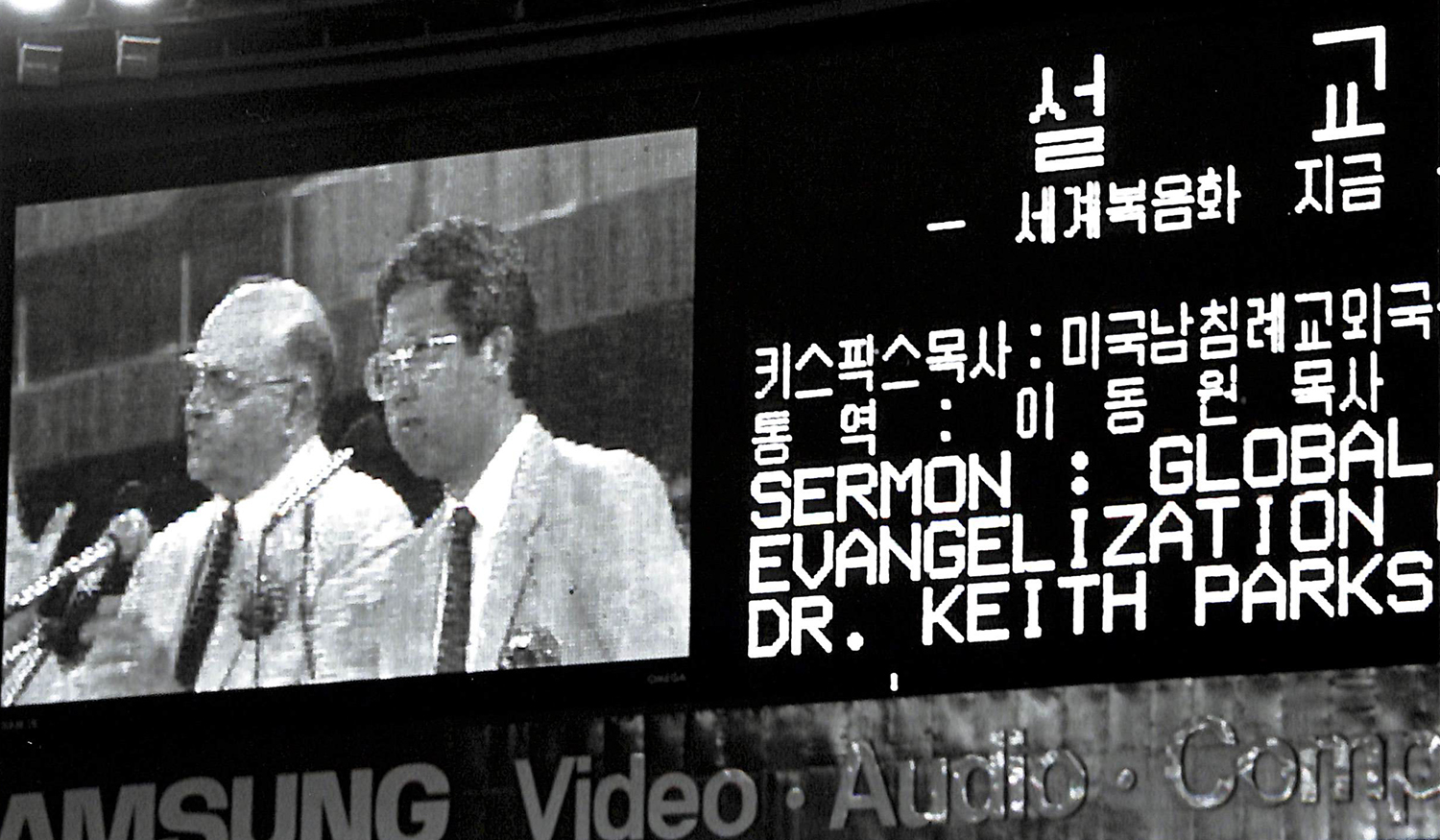
Keith Parks speaks with an interpreter at the Baptist World Alliance meeting in Seoul, South Korea, in 1990. (Southern Baptist Historical Library and Archives)
West Texas boy
Parks was born Oct. 23, 1927, in Memphis, Texas, to Robert Crews and Allie Mae (Cowger) Parks. He grew up in Texas and Arkansas and graduated from high school in Denton, Texas, where he earned an undergraduate degree from the University of North Texas.
Next, he earned bachelor of divinity and doctor of theology degrees from Southwestern Baptist Theological Seminary in Fort Worth, Texas. During that time, he was pastor of Red Springs Baptist Church, near Seymour, Texas.
Parks began to feel the call to missions during the summer between his graduation from college and entrance into seminary, when he was part of the second group of Baptist Student Union summer missionaries.
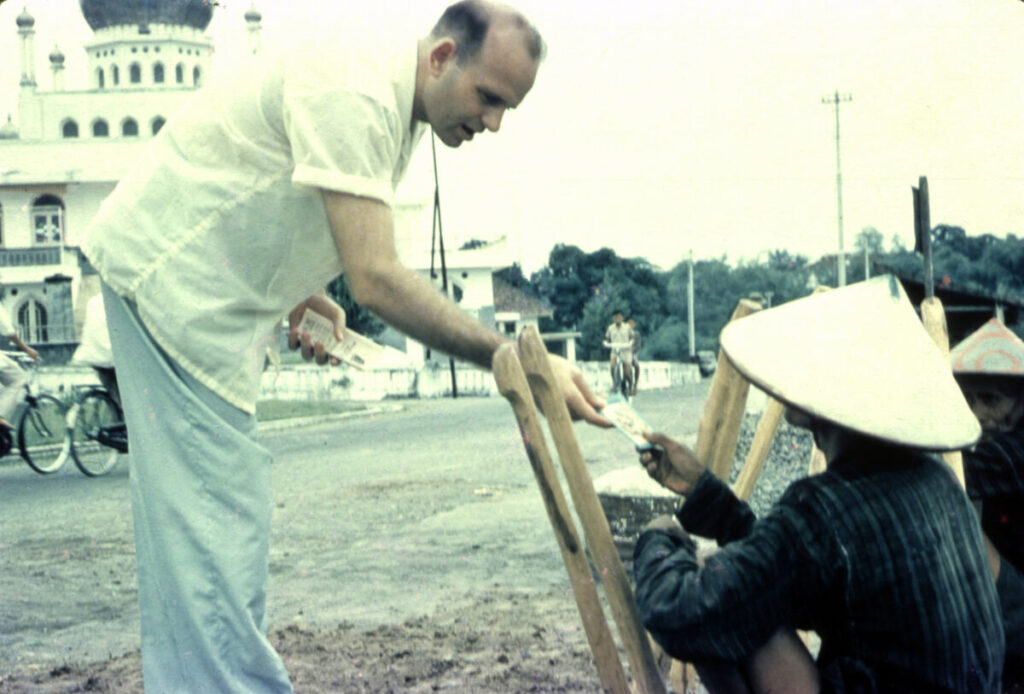
Keith Parks as a young missionary in Indonesia. (IMB photo)
“Four of us went to San Andres Island, off the coast of Colombia,” he said in a Baptist Standard interview. “Some who had never heard about Jesus accepted him as Savior. I did not know there were people like that in the world. I came back to enter Southwestern Seminary wishing I could go tell them.”
He made a commitment to missions at the conclusion of a Mission Day chapel service while he was a seminary student.
“I felt I should respond, but I was afraid I would make a public decision and then would not follow through,” he remembered. “Finally, I said to the Lord: ‘I am going to start toward the aisle. If this is not right, stop me.’ As I moved my foot toward the aisle, a warmth flowed through my body, an assurance filled my heart and I practically ran to the front.”
Perspective on missions
One of the most significant challenges he faced “was to help local churches and Christians to realize that the mandate to share the gospel with everyone was given to every church and every Christian,” Parks said. “It was not the mission board’s or the missionaries’ work that they should support. It was, and is, the responsibility of every church and every Christian, but each of us has a different role to fill.”
Parks once said a troubling thought ultimately changed his perspective on missions.
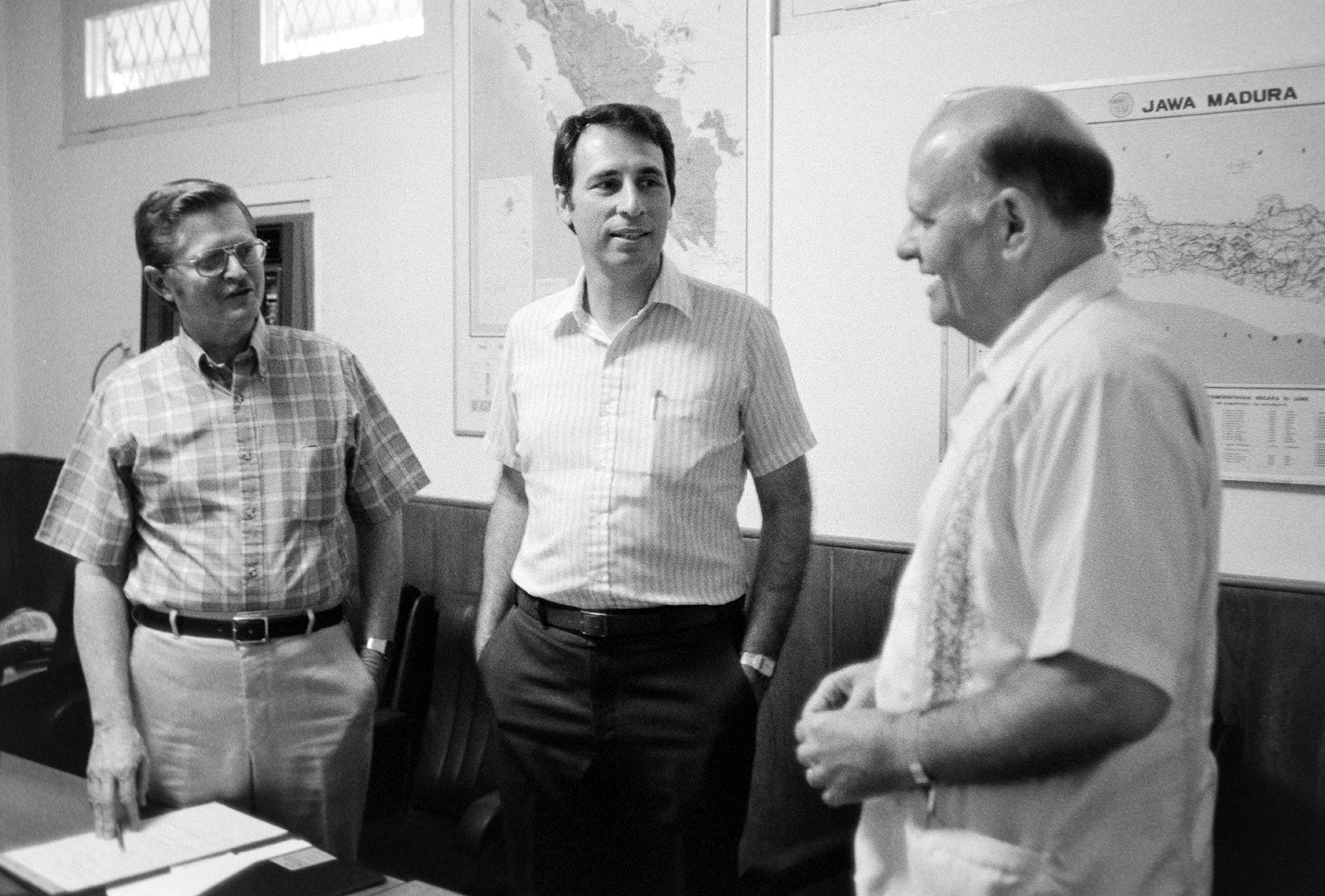
Former FMB missionaries John Ingouf and Clyde Meador meet with Keith Parks, then Foreign Mission Board president, in Indonesia in 1984. (IMB Photo)
“We had typically depended on spreading the gospel by sending missionaries to new locations,” he explained. “Southern Baptists were engaged in Bold Mission Thrust. We had committed … to have our part in sharing the good news with everyone in the world by 2000.
“As I was thinking about the role our agency was to have, I had a disturbing insight. We were the largest denominational mission agency. We were getting close to involvement in 100 countries. Then it hit me — that is less than half the countries of the world!
“Defensively, I tried to justify what we were doing by recognizing many countries would not allow missionaries to enter. Suddenly, I realized we must find other ways of getting the gospel to the rest of the world. That led to nonresidential missionaries, Cooperative Services International and focusing on unreached people groups.”
Family legacy
Keith and Helen Jean Parks’ children followed them into ministry. Their daughter, Eloise, was a pastor. Their sons, Randall, Kent and Stan, became missionaries.
Parks was preceded in death by Helen Jean and Eloise.
He is survived by his sons and their spouses: Randall (Nancy) Parks, Kent (Erika) Parks, Stan (Kay) Parks; his seven grandchildren and their spouses: Jenny Parks (Kevin Gregson), Jeff (Hannah) Parks; Katy (Keith) Leech, Lindsay Parks, Nöel Parks, Kaleb (Whitney) Parks, Seth (Emily) Parks; and seven great-grandchildren, with two more on the way: Sterling and Leighton Parks, Lewis and Madison Gregson, Joy (Isaiah) Leech; Davy Parks and Corrie (Harper) Parks, as well as by other much-loved extended family.
His family noted: “We are excited for him, as he is more vibrantly alive than he has ever been. He is in the presence of his beloved Savior, Jesus Christ, along with beloved family members as well as people who are there because he was used to bring them to Jesus. What a reunion and celebration he is experiencing with them as they worship Jesus together!”
Related articles:
Retirement marks shift in CBF missions
Betty Law was a Baptist missions pioneer, serving both SBC and CBF
At 25, CBF still building something new
Missiologist and ministry mentor Bill O’Brien dies