



What happens when a culture loses the concept of anything transcendent above? Truth, goodness and beauty become ends in themselves; they don’t lead anywhere, and they never make you look up. Truth, goodness, and beauty become hevel. Sure, they might be good in the moment, but like smoke, they have no stability in their structure
A culture like ours can live off the religious leftovers of Christianity, but those leftovers won’t last forever. This can be seen time and time again at funerals. I have heard atheists at funerals say something like, “We know that Grandma is in a better place.”

Isaac Serrano
Wait, what? Grandma is in a better place? In cases like this there is a holding on to some of the leftovers from the meal Christianity provided. Many are eager to eat the leftovers while denying the hands that prepared the food to begin with. The meal was great, and the leftovers still taste incredible, but eventually the leftovers will run out.
A consistent denial of God will saturate all levels of belief. In many cases today, the pure, undiluted nihilism has not yet fully set in. But it will.
Or you might hear a materialist speak of human rights. But where do these rights come from? Universal human rights were not assumed by ancient people. The average modern person might affirm them but is completely unaware it’s only because of 2,000 years of Christian tradition that they even believe in them.
If human beings are mere physical matter, where are their rights located? Can you point to them? Where do they come from?
The leftovers of Christianity are so good that in our culture you might see someone criticize the church for its treatment of women, the poor, the vulnerable or some other group, all the while not even recognizing the very ruler and metric they are using to critique the church is the metric given to them by the church.
“Universal human rights flowed from the idea that all people are made in the image of God.”
Where do we suppose the idea came from that all people have intrinsic and innate value? History demonstrates this was not the default position of humanity. Universal human rights flowed from the idea that all people are made in the image of God. Materialism loves to eat the fruit of Christianity while not acknowledging the tree that grew it.
These are but a couple of examples of how people can live and think inconsistently, holding on to the hopes and values the Christian faith gave while simultaneously abandoning it. Without the proper foundation, you can try and build meaning, purpose, morality and telos, but eventually the structure will collapse.
One can try and find meaning in lesser things, of course. It’s easy to find meaning in family, romance, love, children or career. But why do those things matter? If love matters, why does it matter? If having a solid work ethic is a good thing, why is it good? If treating your family poorly is wrong, why is it wrong? Is there something, someone or some authority above us?
 The question takes us back to Qoheleth. Most people who are familiar with the book today know it by a translation of its Greek name, Ecclesiastes.
Qoheleth answers the question with an astounding “Yes!” There is something above us. And we ought to live as if every moment matters, because it does matter. There is one who sees all and knows all, and it’s not only to dust that we will return; we will return to him.
As Qoheleth says: “The end of the matter; all has been heard. Fear God and keep his commandments, for this is the whole duty of man. For God will bring every deed into judgment, with every secret thing, whether good or evil” (Ecclesiastes 12:13-14).
In other words, for the modern person, the book of Qoheleth is like a thought experiment on the philosophy of materialism. If the material world is all that exists, then everything here is hevel. It’s meaningless. It’s vanity. What’s fascinating is that this thought experiment was not done by a modern nihilistic materialist; it was done by a man living millennia ago who was wrestling with the same problems we still have today.
Qoheleth looks at every layer and domain of reality and sees how very easy it is to say, “Hevel, all is hevel.” He ends, however, by looking upward. He looks beyond our mere material existence and says, “There is someone above, and it is in him you find your purpose.”
Without this, life is truly hevel.
You might be able to borrow meaning and purpose from religion, but eventually you will have to give it back. You will need something above and beyond your mere material existence to ground yourself. The leftovers will run out; you will need to return to their source.
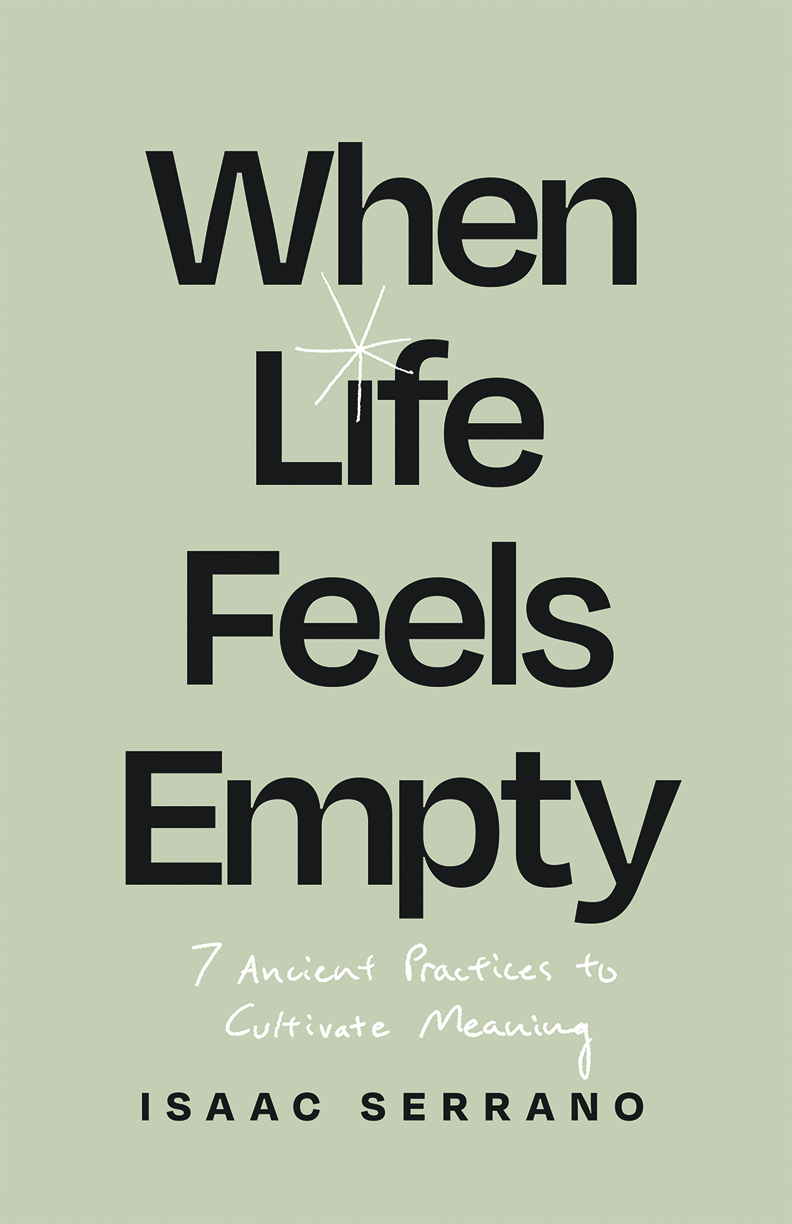
Isaac Serrano serves as lead pastor at South Valley Community Church in Gilroy, Calif. He also serves on the leadership team of the ReGeneration Project and is an adjunct professor teaching theology and ministry at Western Seminary. He earned a Th.D. from Evangelical Seminary. This article is excerpted from his new book, When Life Feels Empty © 2025, Joseph Isaac Serrano and InterVarsity Press, and used here by permission.