

I am pleading for my people,
A poor, downtrodden race,
Who dwell in freedom’s boasted land,
With no abiding place.
While I bear upon my body
The scars of many a gash,
I am pleading for my people,
Who groan beneath the lash.
— Sojourner Truth
Chattel slavery was bad in 1619 when the first slave ship from Africa arrived in Virginia. In 2025 it still is.
Lerone Bennett introduces that terrible commerce in his book Before the Mayflower, A History of the Negro in America, 1619-1962, writing:
The slave trade was people living, lying, stealing, murdering and dying. The slave trade was a Black man who stepped out of his hut for a breath of fresh air and ended up, 10 months later, in Georgia with bruises on his back and a brand on his chest. … The slave trade was a pious captain holding prayer services twice a day on his slave ship and writing later the famous hymn, “How Sweet the Name of Jesus Sounds.”

Bill Leonard
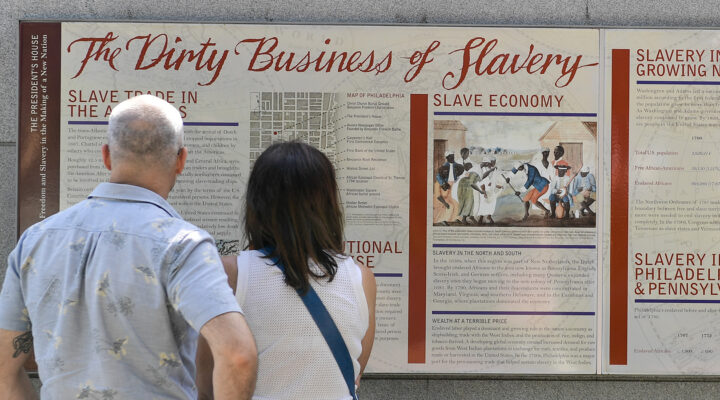
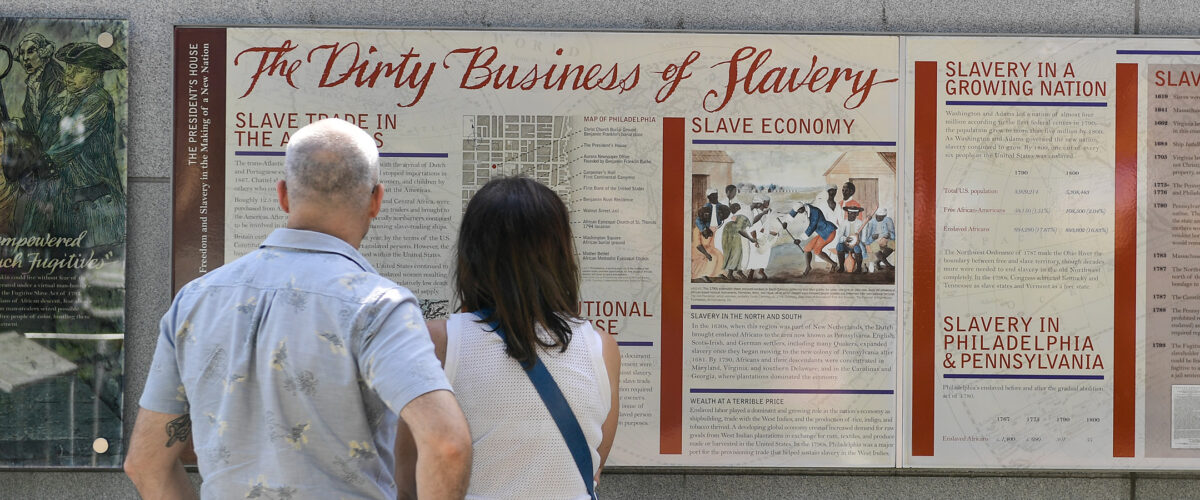
Four hundred six years later, the case of chattel slavery is back on the auction block. Some American political and religious leaders are not only revisiting the way the history of slavery is being told but also reassessing the meaning of enslavement itself.
The current United States president wrote recently: “The Smithsonian Is OUT OF CONTROL, where everything discussed is how horrible our Country is, how bad Slavery was, and how unaccomplished the downtrodden have been — Nothing about Success, nothing about Brightness, nothing about the Future.”
The president attacked the Smithsonian for its “divisive, race-centered ideology” exhibitions and demanded a review of the institution’s displays, art and documents. The Smithsonian’s National Museum of African American History and Culture is under particular scrutiny.
Certain Christian leaders waded into the debate long ago, some making a case for retaining or permitting slavery under a certain degree of “scriptural” guidance. The war on “wokeness” apparently brought their views into new prominence.
Doug Wilson and John MacArthur
Doug Wilson, a pastor in the Communion of Reformed Evangelical Churches, addressed these issues in two studies, Southern Slavery as It Was, 1995, written with Presbyterian Church in America minister Steve Wilkins, and Black & Tan: Essays and Excursions on Slavery, Culture War, and Scripture in America, 2004.

Doug Wilson
In Southern Slavery, the two writers noted: “Slavery as it existed in the South was not an adversarial relationship with pervasive racial animosity. Because of its dominantly patriarchal character, it was a relationship based upon mutual affection and confidence. There has never been a multi-racial society which has existed with such mutual intimacy and harmony in the history of the world. The credit for this must go to the predominance of Christianity. The gospel enabled men who were distinct in nearly every way to live and work together, to be friends and often intimates.”
They concluded: “When we turn to individuals and families, the situation is very different. The abolitionists maintained that slave-owning was inherently immoral under any circumstance. But in this matter, the Christians who owned slaves in the South were on firm scriptural ground. May a Christian own slaves, even when this makes him a part of a larger pagan system which is not fully scriptural, or perhaps not scriptural at all? Provided he owns them in conformity to Christ’s laws for such situations, the Bible is clear that Christians may own slaves.”
For Wilson and Wilkins, the question of enslavement is inseparable from “textual originalism,” AKA biblical inerrancy.
For them, Christians who followed the biblical dictums for the treatment of slaves were/are entitled to keep people in slavery. If God’s word authorized the holding of slaves, which they believed it did, then that permission is apparently timeless.
Wilson acknowledges that Southern Slavery created considerable controversy and that when “(real but inadvertent) citation problems were discovered in the booklet,” it was withdrawn from publication. Writing in 2020, he suggested that when reflecting on the degree of care or cruelty shown slaves, he “would not want to use any words that implied that I knew how to quantify the two kinds of experiences precisely. … I would content myself with saying that there were ‘many’ horrific abuses, and that there were ‘many’ situations that were characterized by benevolent masters, and leave it at that.” **
Richard Furman
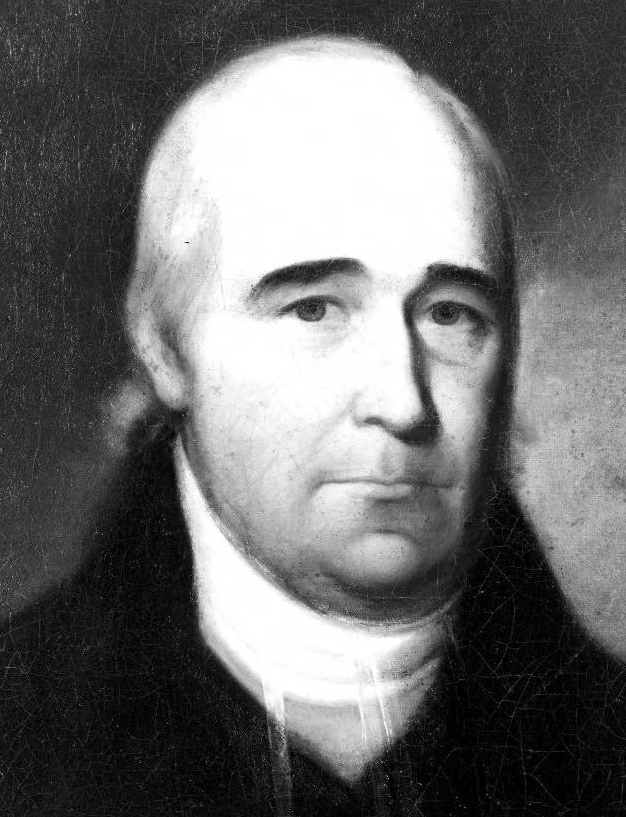
That response parallels the views of antebellum Baptist pastor Richard Furman, whose 1822 biblical defense of enslavement declared: “Had the holding of slaves been a moral evil, it cannot be supposed, that the inspired Apostles, who feared not the faces of men, and were ready to lay down their lives in the cause of their God, would have tolerated it, for a moment, in the Christian Church. … In proving this subject justifiable by Scriptural authority, its morality is also proved; for the Divine Law never sanctions immoral actions.”
The late John MacArthur, longtime pastor of Grace Community Church in Los Angeles, went even further, declaring: “Christianity does not free slaves. Christianity does not give equal social rights. … Jesus did not propound equal rights and he did not upset the social order. Neither did Peter, neither did Paul, neither did John, neither did any New Testament writer. Rather, they all affirmed that with great fear of God and great respect you are to be submissive to your masters, whether they’re good and gentle or whether they are unreasonable. You are to submit.”
A story from 1807
Those declarations call to mind the minutes of the Forks of Elkhorn Baptist Church in Kentucky: “The 2nd Saturday in January 1807 after divine Worship proceeded to business: Complaint brought against Sister Esther Boulwares Winney 1st for saying she once thought it her duty to serve her Master & Mistress but since the lord had converted her, she had never believed that any Christian kept Negroes or Slaves — 2nd for saying she believed that there was Thousands of white people Wallowing in Hell for their treatment to Negros — and she did not care if there was many more.”
The case was “Refer’d to next meeting” where the slave woman, whose church name was inseparable from the Christian who owned her, was congregationally excluded. Sister Winney’s conversion to Christ led her to another conclusion about the gospel and the nature of slavery for Christian and non-Christian alike.
What the Bible says
To say that Christians are “free” to hold slaves because the Bible gives permission, if slaves are treated “fairly,” is to contradict the gospel of Jesus Christ.
“To say that Christians are ‘free’ to hold slaves … is to contradict the gospel of Jesus Christ.”
Paul accepted slavery as a social given; since the 13th Amendment, Americans (supposedly) do not. And one of the reasons we do not is that we finally learned you can’t claim to be an “orthodox” Christian and own other human beings, restricting their freedom and demanding their submission in Jesus’ name.
In Luke 4, Jesus himself claims God’s anointing “to let the broken victim go free” as the prophet Isaiah declared. Because each new generation must be taught that, we recount the story of slaves and enslavement, since sooner or later somebody is going to restrict that story in order to enslave/undermine the freedom by which Christ has set us free.
In his classic history, Been in the Storm So Long, the Aftermath of Slavery, Leon Litwack illustrates the irony, intimacy and earthiness of master-slave relations, writing: “That a certain intimacy characterized the master-slave relationships in the Big House reveals little about the conflicting feelings it generated and precarious base on which it often rested. To live in close day-to-day contact with his master, to know his capacity for deceit and cunning, to know him as few of the field hands could, enabled some (Big House) slaves to hate him that much more, with an intensity and fervor that only intimate knowledge could have produced.”
Thus “recalling her many years as the cook in a North Carolina family, Aunt Delia suggested ways in which a house slave might choose to manifest that feeling: ‘How many times I spit in the biscuits and peed in the coffee just to get back at them mean white folks.’”
When you’re a slave, dissent takes many forms.
Bill Leonard is founding dean and the James and Marilyn Dunn professor of Baptist studies and church history emeritus at Wake Forest University School of Divinity in Winston-Salem, N.C. He is the author or editor of 25 books. A native Texan, he lives in Winston-Salem with his wife, Candyce, and their daughter, Stephanie.
Related articles:
How slavery still shapes the world of white evangelical Christians | Opinion by Richard T. Hughes
What has John MacArthur actually said about race, slavery and the Curse of Ham? | Analysis by Rick Pidcock
Baptist Calvinists defend slavery of Southern Seminary founders | Analysis by Brian Kaylor
14 dangerous words | Analysis by Harold Ivan Smith