


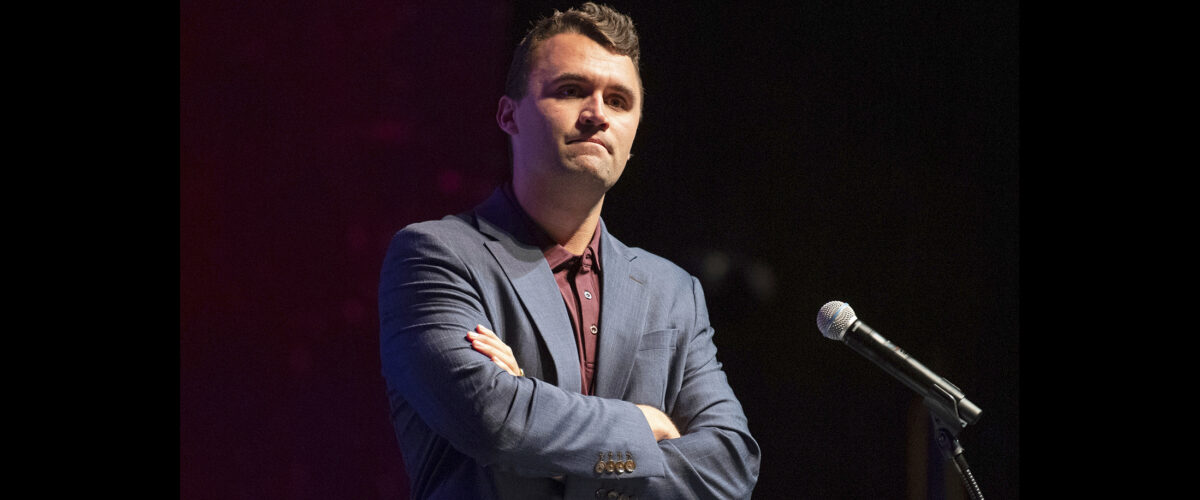
The devastating news that Charlie Kirk has been murdered at an event at Utah Valley University seems beyond belief. The evening news carried the awful news. A single bullet ended Kirk’s life.
Perhaps Shakespeare’s most famous lines weigh heavily on my heart in this moment. Antony’s eulogy for Ceasar:
Friends, Romans, countrymen, lend me your ears;
I come to bury Caesar, not to praise him.
The evil that men do lives after them;
The good is oft interred with their bones;
So let it be with Caesar.
Another act of American violence now swirls in the midst of all our other political storms. I can’t praise Kirk nor will I condemn him in his death.

Donald Trump Jr. (left) and Charlie Kirk in Greenland. (Photo: Instagram)
Who was Charlie Kirk? Kirk was a popular (among MAGA) conservative activist. He was the founder of Turning Point USA at age 18. He appeared frequently on college campuses to promote the causes of President Donald Trump. Although he was a college dropout, his on-campus activism and social media campaigns were credited by Trump with helping him win the 2024 election.
Kirk’s self-affirmed “confrontational Christianity” put him at odds with abortion rights, COVID vaccines, immigrants, wokeness, Critical Race Theory and various conspiracy theories. His influence exemplifies our new political setting where credibility, experience and education count for little. He was a right-wing flame-thrower.
Easy to oppose
I disliked Kirk as much as I was jealous of his influence. A few examples will suffice to show why my dislike was “triggered”:
- He told a megachurch congregation: Trump and MAGA are fighting against the “very same totalitarianism” Americans fought against in World War II when they “stormed the beaches of Normandy.”
- Of the Trump’s conviction on 34 felony counts: “We are up against pure evil.”
- He was Christian nationalism on steroids.
- He claimed pastors who encouraged their flocks to march in a Black Lives Matter rally were “introducing an unclean spirit from Satan into the church.”
- He belittled Bishop Mariann Budde’s “woke” sermon at the Inaugural Prayer Breakfast: “She was given a great honor today, a chance to unify America around a Christian message at the dawn of a new administration. Instead, she disgraced herself with a lecture you’d hear on CNN or an episode of The View. What an embarrassment.”
- He slammed Rick Warren: “Rick Warren promoted the vaccine and BLM in 2020 while he was pastor of Saddleback. Typical modern preacher — they get mad when you get involved in conservative (biblical) issues, but enthusiastically use the church for secular left-wing aims. Shouldn’t ever be called a ‘pastor.’ For the last decade he’s done serious harm to Christianity and the country.”
- And he said: “I think it’s worth (the) cost of unfortunately some gun deaths every single year so that we can have the Second Amendment to protect our other God-given rights. That is a prudent deal.”
In many respects, Kirk seemed a mini-Trump. He repeated Trump themes of resentment, nativism, nationalism, triumphalism and militarism with mind-numbing repetition. His mannerisms of outrageous statements, conspiracy-mindedness, intolerance and overt displays of patriotism included a mixture of racism, economic angst, bitterness, religious bigotry, antifeminism and hostility toward education.
“He seemed more like a political version of smiling Joel Osteen than a culture warrior.”
I watched him throwing baseball caps to the audience this afternoon with obvious delight and enjoyment. He seemed more like a political version of smiling Joel Osteen than a culture warrior. But he was as draped in Trump’s armor for war as surely as young David once tried to don the armor of King Saul.
Kirk’s speeches had nothing unique to offer. He flirted with violence on a daily basis as he “triggered” the libs. Why else would the word “trigger” be used if not a pretext for violence? How he managed to be identified as an evangelical indicates all the expectations of evangelical faith had been dropped.
There’s not a single reason in Kirk’s ideology, politics or rhetoric that should have made him the target of an assassin. Charlie Kirk should still be alive and promoting his right-wing agenda. His free speech rights, his First Amendment Rights, his right to live — all of this should still be in operation.
Our relationship with violence
A deeper concern is our own relationship with violence. There is a practiced drama to our mundane, meaningless response to violence.
We are quick to blame when violence erupts from the other side of the political spectrum. As soon as Charlie Kirk was killed, people were filling social media with blame of left-wing radicals or denunciation of violence, or cries for vengeance. Later tomorrow, narrow-minded politicians will attempt to use Kirk’s death for political advantage and other politicians will point out how scurrilous such a practice is.
There will be renewed calls for gun control. There will be more blame smeared around the entire incident — enough to disguise our own participation in the violence.
Christians enjoy the notion of being a nonviolent people. We believe we never would kill anyone for any reason. Then one of us — a fellow American — murders someone.
Our mistake: Thinking we can play with fire and never get burned. Rhetorical violence preys on our political discontent the same way it once manipulated good Christian men at a lynching.
“Once violent rhetoric plays the tune, the last dance will always be the potential of physical violence.”
Once violent rhetoric plays the tune, the last dance will always be the potential of physical violence. There’s no way of knowing the difference between the “rhetoric of violence” and the “violence of rhetoric.” The illusion of “mere rhetoric” haunts our political discourse.
Violence and rhetoric: A matched pair
Violence, we kid ourselves, is what the other side does. The history of political assassinations in the USA tells a different truth: President Abraham Lincoln, President James A. Garfield, President William McKinley, President John F. Kennedy. President Ronald Reagan and President Donald Trump were victims of attempted assassinations. So was Gov. George Wallace.
Violence erupts because the world already is violent. As soon as one person is murdered, we all throw up our hands and say, “I had nothing to do with it.” We are like the character in a Mona van Duyn poem telling the judge the guild belonged to the sun. “The sun did it coming up like it did every damn morning.”
When our political rhetoric exudes a nihilistic pathos, a destructive spirit of anarchy and chaos, we should know violence lurks in the shadows. When our politicians operate as political disruptors, promising the destruction of all enemies and promoting political mistrust, animosity and hatred, we should know violence is standing at the door. Ravaging democratic norms, disrespecting opponents with vile language and vitriol, and insulting others are the cheering squads for an outbreak of violence.
“Inhabiting, as we surely do, a culture of fear and hatred, we can’t really be shocked at acts of violence.”
Inhabiting, as we surely do, a culture of fear and hatred, we can’t really be shocked at acts of violence. Our political rhetoric is the petrol fueling the sporadic outbursts of violence that shock us. In a land of mistrust, animosity, revenge and enemies how can we possibly think we can prevent violence?
Our politics will not save us from the darkness of violence. We are thrown back on basic theological understandings. With the prophet Habakkuk we can only lament, “O Lord, how long shall I cry for help and you will not listen?”
We cling to the idea that we can play with the fire of violence in our rhetoric right up to the moment of a trigger being pulled, and then we know we would have the good sense not to kill anyone. Except we are all enmeshed in the violence we have loosed upon the earth.
Searching for meaning
If the death of Charlie Kirk has any future meaning, I believe it lies in the confession of sin, the real contribution of the church to the world as a first step in confronting violence. Can there be a Psalm 51 for the nation? Or can our national leader call us all to pray Psalm 51?
Have mercy upon me, O God, according to thy lovingkindness: according unto the multitude of thy tender mercies blot out my transgressions. Wash me throughly from mine iniquity, and cleanse me from my sin. For I acknowledge my transgressions: and my sin is ever before me.
There is the conversion and the confession and, I pray, the redemption for us all.
Rodney W. Kennedy is a pastor and writer in New York state. He is the author of 11 books, including his latest, Dancing with Metaphors in the Pulpit.
Related articles:
How Charlie Kirk went from college dropout to Trump influencer | Analysis by Mara Richards Bim