


In the aftermath of Charlie Kirk’s assassination, public employees across the nation are being suspended, investigated and even fired due to their social media posts about Kirk and his death.
This backlash is part of a larger conservative movement to blame Kirk’s death on “the left” and to punish anyone who disagrees with their view of the far-right political advocate as a saint and Christian martyr.
But are such suspensions and terminations legal? According to the U.S. Constitution and previous court precedent, such expressions of personal opinion are most likely protected free speech. But litigating such cases will take months or years, leaving school administrators with the power to threaten and even harm their employees in the meantime.
“This backlash is part of a larger conservative movement to blame Kirk’s death on ‘the left.’”
And in every state except Montana, employers don’t need to give a reason to terminate an employee due to “at-will” employment laws. However, those state laws are negated if an employee is fired for a discriminatory reason.
Thus, the current situation brings together questions of free speech rights on social media as an individual not representing an employer alongside questions of sincerely held beliefs tangled up with religion and guns.
Not to mention the opposite cases where conservatives have claimed employment discrimination for saying things objectionable to their local communities. But right now, the MAGA movement led by President Donald Trump and Vice President JD Vance is out for blood to punish their political enemies.
On Monday, Vance was guest host of Kirk’s podcast and pledged the White House will go after all “far left” organizations in the nation and shut them down.
“When you see someone celebrating Charlie’s murder, call them out,” Vance urged. “Hell, call their employer. We don’t believe in political violence, but we do believe in civility, and there is no civility in the celebration of political assassination.”

Amarillo example
In Amarillo, Texas, Michael Newman is one such teacher who fell into the trap of a negative social media post. The theater teacher at River Road High School was no fan of Kirk — having been bullied himself as a child — and posted Wednesday night about how Kirk bullied women and the LGBTQ community and “pretended to be a Christian to grift money.”
Kirk “made life in America harder for my daughter,” the teacher said and then concluded: “I’m sorry Charlie Kirk led such a miserable short life that people are breathing a sigh of relief he is gone.”
That post got shared beyond his own Facebook group and the backlash was harsh in this very conservative Texas Panhandle town. Later, Newman posted an apology on Facebook: “It was an emotional day for all, and I allowed my feelings and frustrations to choose uncaring words.”
His fate with the school district is unknown. But here’s an irony: Supporters of Kirk have said even his critics should show mercy because Kirk left behind a wife and two children. But Newman also has a wife and two children who depend on his job to support them. And high school theater teachers don’t make nearly as much money as the leaders of political advocacy groups.
“Should one angry post on a teacher’s personal Facebook page cost that teacher his job?”
Should one angry post on a teacher’s personal Facebook page cost that teacher his job and render him unhirable at any public school in the state? Should his wife and children suffer because of his words written and then retracted?
According to Texas Education Commissioner Mike Morath, yes.
Morath, a close ally of Gov. Greg Abbott, sent a letter to all school superintendents in the state with a stern warning:
TEA has been made aware of some Texas public school educators that have posted and/or shared reprehensible and inappropriate content on social media related to the assassination of Charlie Kirk. These educators’ comments do not reflect the vast majority of Texas teachers who are dedicated practitioners that work diligently to serve the more than 5.5 million impressionable young minds in our classrooms.

Mike Morath
In response to such posts, I am referring all documentation of educators that have proliferated such vile content to TEA’s Educator Investigations Division. Such posts could constitute a violation of the Educators Code of Ethics, and each instance will be thoroughly reviewed to determine whether sanctionable conduct has occurred and staff will investigate accordingly.
While the exercise of free speech is a fundamental right we are all blessed to share, it does not give carte blanche authority to celebrate or sow violence against those that share differing beliefs and perspectives. Mr. Kirk was a father and a husband, and tragically, his children no longer have their father, and his wife no longer has her spouse.
Morath invites anyone with knowledge of such social media posts to report the teachers via TEA’s Misconduct Reporting Portal.
He urged district leadership to take “swift action” against such public employees.
The American Federation of Texas is fighting Morath’s dictate.
“What started with lawmakers weaponizing their platforms against civil servants has morphed into a statewide directive to hunt down and fire educators for opinions shared on their personal social media accounts. In short order, the LibsofTikTok agenda has become the policy of the state of Texas,” said Zeph Capo, president of Texas AFT. “Here’s the thing about authoritarian regimes: They’ll take as much as the rest of us are willing to give them. It’s no surprise that, here in Texas, the purge of civil servants starts with teachers. If you value your freedom, now is the time to speak up and defend the rights of all Texans to exercise their constitutional right to have an opinion on matters of civil discourse.”
Not just Texas
The retaliation against Kirk’s critics reaches nationwide. Education Week reports teachers in California, Florida, Iowa, Pennsylvania, Maryland, Massachusetts, Michigan, North Carolina, South Carolina, Oklahoma, Oregon and Texas “have been fired or placed on leave ahead of investigations into alleged social media comments critiquing Kirk and implying approval of Kirk’s death.”
As indicated in Morath’s letter in Texas, there are other ways to hold employees accountable for social media posts. Various professional codes of ethics may be cited, and many large employers have social media policies employees are expected to follow.
What’s challenging is separating when a person is an individual and when a person is an employee.
Graphic created by First Liberty Institute to highlight their work on behalf of Coach Kennedy.
An ironic court precedent
On the legal side, there’s an ironic precedent in a recent Supreme Court case conservative evangelicals celebrated. But to explain that requires going back in time.
From its founding, the United States has struggled to balance free speech rights against generally unacceptable speech. Thus the First Amendment to the Constitution states: “Congress shall make no law … abridging the freedom of speech.”
Often these cases have occurred at the intersection of religion and free speech, such as the famous Scopes Trial that tested whether a public school teacher should be allowed to teach evolution. While that case concerned actual classroom teaching, the current issue does not involve classroom instruction but instead personal speech outside the classroom.
And on that matter, there is court precedent.
In 1968, the U.S. Supreme Court handed down a landmark ruling called Pickering v. Board of Education. That ruling affirmed the First Amendment right to free speech for public employees, including teachers, when speaking on matters of public concern, as long as the statements are not knowingly or recklessly false and do not unduly disrupt the employer’s operations.
“The court ruled a public employee’s right to speak on matters of public importance is not lost by entering government employment.”
From that case emerged the Pickering Balancing Test, which weighs the employee’s right to speak on public issues against the government’s interest in promoting the efficiency of public services.
Marvin Pickering was a high school science teacher who wrote a letter to the editor of the local newspaper criticizing the Board of Education’s financial decisions, including the allocation of funds toward athletics more than academics.
The Board of Education terminated Pickering’s employment because of the letter.
However, the Supreme Court ruled 8-1 in favor of Pickering, holding his dismissal was unconstitutional. The court ruled a public employee’s right to speak on matters of public importance is not lost by entering government employment.
More relevant to today, the case established that a teacher could not be dismissed for making statements about public issues, even if those statements are critical of the school board, unless the statements were found to be knowingly or recklessly false.
Even more relevant to today is a clarification of the Pickering Balancing Test in the 1987 Supreme Court case Rankin v. McPherson.
There, the court protected an employee’s critical comment, made to a coworker upon hearing of an unsuccessful attempt to assassinate the president.
Ardith McPherson, a deputy in the office of the Constable of Harris County, Texas, remarked to a coworker: “If they go for him again, I hope they get him.”
Although McPherson was fired for making the comment, the court said her words had no negative effect on the efficient operation of the office where she worked. Instead, her First Amendment rights outweighed any such concern.
Ironically, a more recent Supreme Court case celebrated by evangelicals involved the Pickering Test too.
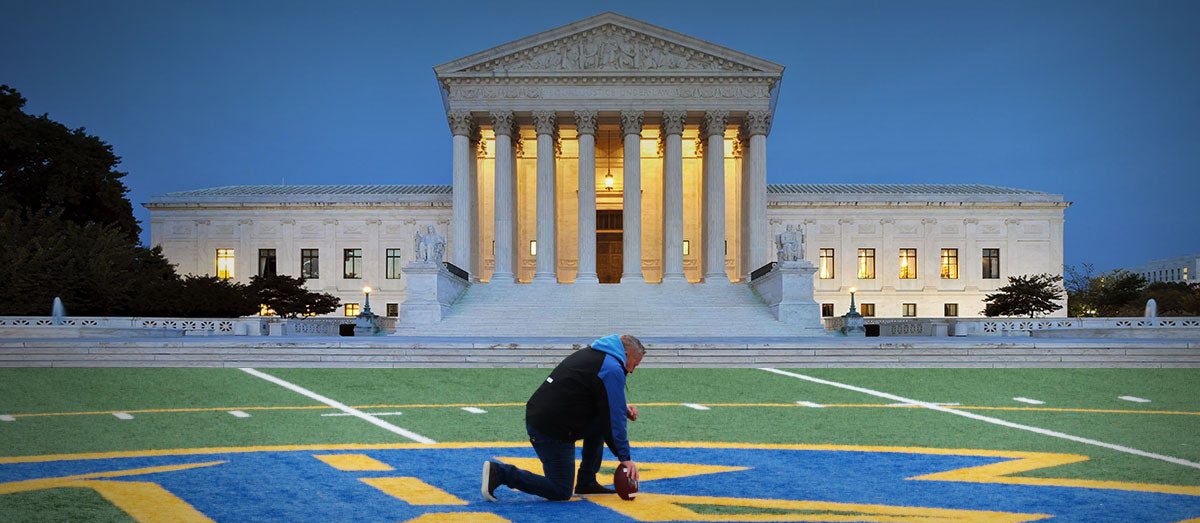
In the 2022 case Kennedy v. Bremerton School District, the contract of a part-time assistant high school football coach was not renewed after he insisted — against school policy — on leading after-game prayer meetings on the 50-yard line. The case turned on whether the coach acted in his capacity as a private citizen or as a public employee.
The school argued his speech was not protected under Pickering because he was speaking in his official capacity as a public employee. The court determined instead the coach’s prayers were private speech because they were not within the scope of his ordinary duties. Therefore, the school overstepped the coach’s First Amendment right to free speech and had insufficient basis to restrict it.
If a court applied that same logic to teachers posting from home, on their own computers, on their own time, with no identification of speaking for their employers, how could the same outcome from Kennedy not apply?
Related articles:
Listening to young adults explain their love for Charlie Kirk | Opinion by Rebecca Johnson
Was Charlie Kirk a martyr? | Analysis by Rodney Kennedy
Charlie Kirk was no King | Opinion by Joel Bowman
The morning after an assassination | Opinion by Mark Wingfield
How Charlie Kirk went from college dropout to Trump influencer | Analysis by Mara Richards Bim