

In today’s world of white supremacist politics, white evangelical worship is the sugar that helps the poison of power go down. And perhaps no event has put this more clearly on display than the Charlie Kirk memorial service.
When many Christians think about Christian nationalist worship leaders, their minds go to the likes of Sean Feucht or lesser-known extremists who clash with protesters in worship battles that end with police raids and arrests, or with LGBTQ advocates playing kazoos. The assumption is that mainstream worship leaders who can be found on Christian radio are more generically safe for the whole family, or at least for heterosexual white families.
And in one sense, there is some truth to that. As Worship Leader Research notes, the top worship songs today are written in a way so as to make them “theologically palatable to the broadest range of users.”
So it was rather surprising for many people to discover Chris Tomlin, Brandon Lake, Phil Wickham, Kari Jobe and Cody Cairnes leading worship at Charlie Kirk’s memorial service — perhaps the most politicized public memorial service in modern history.

Kevin M. Young
“I have deeply loved the Christian artists who performed at Charlie Kirk’s memorial service, and their music has dramatically impacted my spiritual journey for the better,” Kevin M. Young wrote on X. “However, I no longer think I will be able to listen to them again. It will undoubtedly be a long time before I can trust their faith or connection to the Spirit of Christ. I can’t support the things that were said from the same platform they shared today. Worship and hate speech do not belong together.”
“Worship and hate speech do not belong together.”
Young went on to lament, “We have lost evangelicalism to the unholy empire. It is now a state church, in a deviant state. In my view, by performing there, these artists give full allegiance to the content, speakers and speeches that accompanied them. And I cannot and will not support that.”
His words were echoed by many Christians who love modern worship music but are opposed to the white Christian supremacist values of MAGA and the Trump administration. And unfortunately, when we take a closer look over the past quarter century, we have to come to terms with the reality that the appearance of these worship leaders at Kirk’s memorial service was not an aberration.
They’ve been complicit in white Christian nationalism for decades.

Chris Tomlin onstage in Sunrise, Fla., in 2024. (Photo: Chris Tomlin Facebook)
‘Coming to America’
The signs of Chris Tomlin’s Christian nationalism go all the way back to an event hosted by Louie Giglio’s Passion Conference known as One Day 2000, during which 40,000 college students came together for worship and preaching at Shelby Farms in Memphis, Tenn., in May 2000.

Chris Tomlin
With thousands of worship leaders listening to John Piper preach his scripts about committing to the cause, Tomlin brought the gathering to a climax with a song containing the lyrics, “The Lord is coming, coming to America.” Then Matt Redman joined in singing about how a nation’s freedom is based on whether the nation knows Jesus.
When the thousands of college students and worship leaders went back to their churches, they took with them Piper’s scripts about sacrificing one’s entire life for a cause that includes gender roles of authority and submission, bolstered by Tomlin’s worship about Jesus focusing on the United States.
In the years since then, Tomlin has straddled the line of wanting his lyrics to resonate with the “broadest range of users,” while occasionally tapping into themes that blur the lines with Christian nationalism depending on how the listener might interpret them. For example, in “God of this City,” Tomlin explores Jesus being the “King of this people” and the “Lord of this nation.” In “Hymn for America,” Tomlin sings, “We turn our eyes on you” and then adds, “God bless America, heal our broken land.”
Of course, these lyrics may seem tame compared to those who wield worship as a weapon by commanding demons to leave and pretending to throw rocks at LGBTQ Goliaths. But by being more palatable, his theology slips past the defenses of most evangelicals, shaping them to become people who want Jesus to be the King and Lord of the United States. How else are Republicans supposed to interpret that than a sacralization of their own politics?
‘Perfect submission’
In the clip of Tomlin that’s been going viral, the camera pans to Secretary of War Pete Hegseth as Tomlin quotes a very simple verse from Philippians.
Therefore God exalted him to the highest place
And gave him the name that is above every name
That at the name of Jesus every knee will bow
And every tongue confess that he is the Lord
To the glory of God the Father.
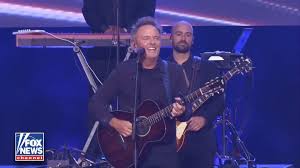 Even many progressive Christians likely will miss what’s going on here because few if any Christians are willing to question the exaltation of Jesus. But the language used here is unmistakably the language of hierarchy. Jesus is in the highest place above everyone, and thus everyone must bend the knee.
This is essentially the message of Tomlin’s “Holy Forever” and “How Great Is Our God” which he sang during the memorial. But by branding the hierarchy as bending the knee to Jesus, pairing it with beautiful worship music, and revealing a venue filled with the violent politicians of the Trump administration, its effect on white evangelicals becomes totally masked.
Brandon Lake continued sacralizing this lens of authority and submission by singing about “perfect submission.” Again, it’s subtle. It’s “theologically palatable to the broadest range of users.” It’s even a line from an old hymn. But Lake asks, “Who wants to be a part of what God is doing?”
Although subtle, the picture being painted through the framing of authority and submission while blended with images of the Trump administration and invitations to participate in God’s work feeds assumptions that to participate in God’s work means to submit to the authority of the Trump administration.
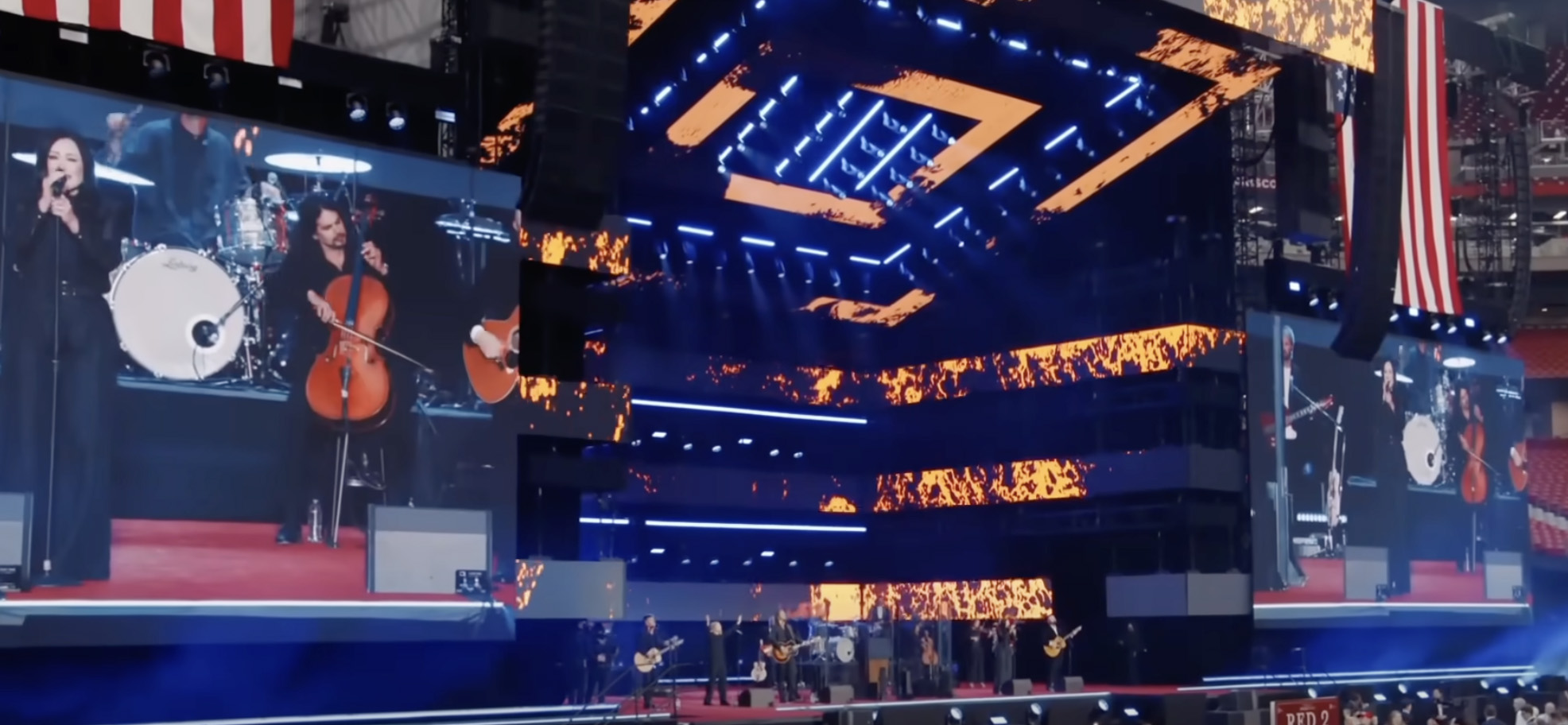
Worship leaders at Charlie Kirk memorial service (Screencap)
‘Who can be against me?’
Within the framework of authority and submission in a world where the work of God and the GOP are considered one, the question becomes what happens to those who don’t bend the knee to the Trump administration.
To put it more clearly: What happens to those who are against the white supremacist Christian nationalists?
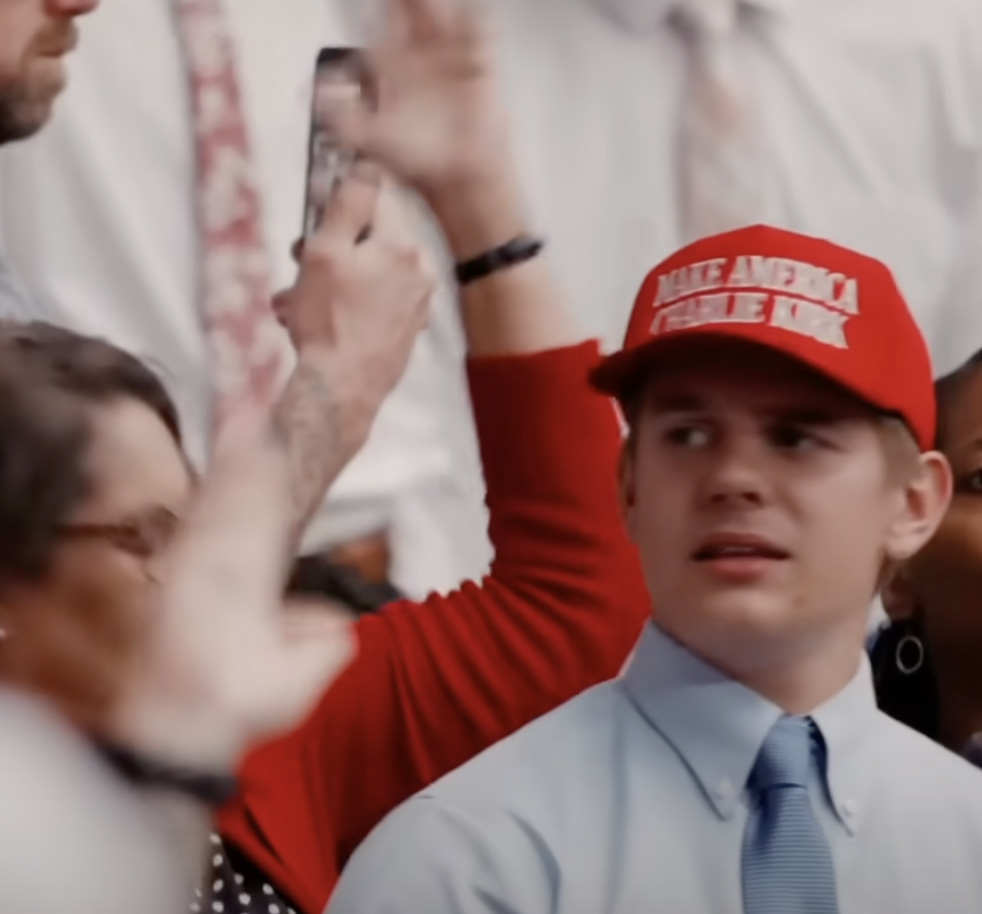
Attendee at Charlie Kirk memorial service with a red MAGA cap reading, “Make America Charlie Kirk.”
Tapping into themes of spiritual warfare, worship leader Phil Wickham sings such lines as:
When all I see is the battle, you see my victory.
The battle belongs to you.
Who can be against me?
Nothing can stand against the power of our God.
You go before us.
When read as a personal struggle with fear, temptation or any number of challenges in life, these lyrics can bring hope to many evangelicals. But when read in the context of spiritual warfare involving politics, then those who stand against the worshiper are standing against God.
It’s reminiscent of Tomlin’s hit song “Our God Is Greater,” in which he asks, “And if our God is for us, then who could ever stop us? And if our God is with us, then what can stand against?”
“It’s celebrating power and hierarchy while slipping past the consciences of evangelicals by labeling it as trust in God.”
Again, read that line from the perspective of white evangelicals who blend the power of God with the power of Trump. White evangelical worship isn’t offering an alternative vision of authority and power. Instead, it’s celebrating power and hierarchy while slipping past the consciences of evangelicals by labeling it as trust in God.
Sean Feucht likes to introduce worship gatherings with the line, “We are the army of God.” So when he later asks, “Who can defy the armies of the living God” in the midst of a politically heated time of worship, he’s essentially asking, “Who can defy us Trump supporters?”
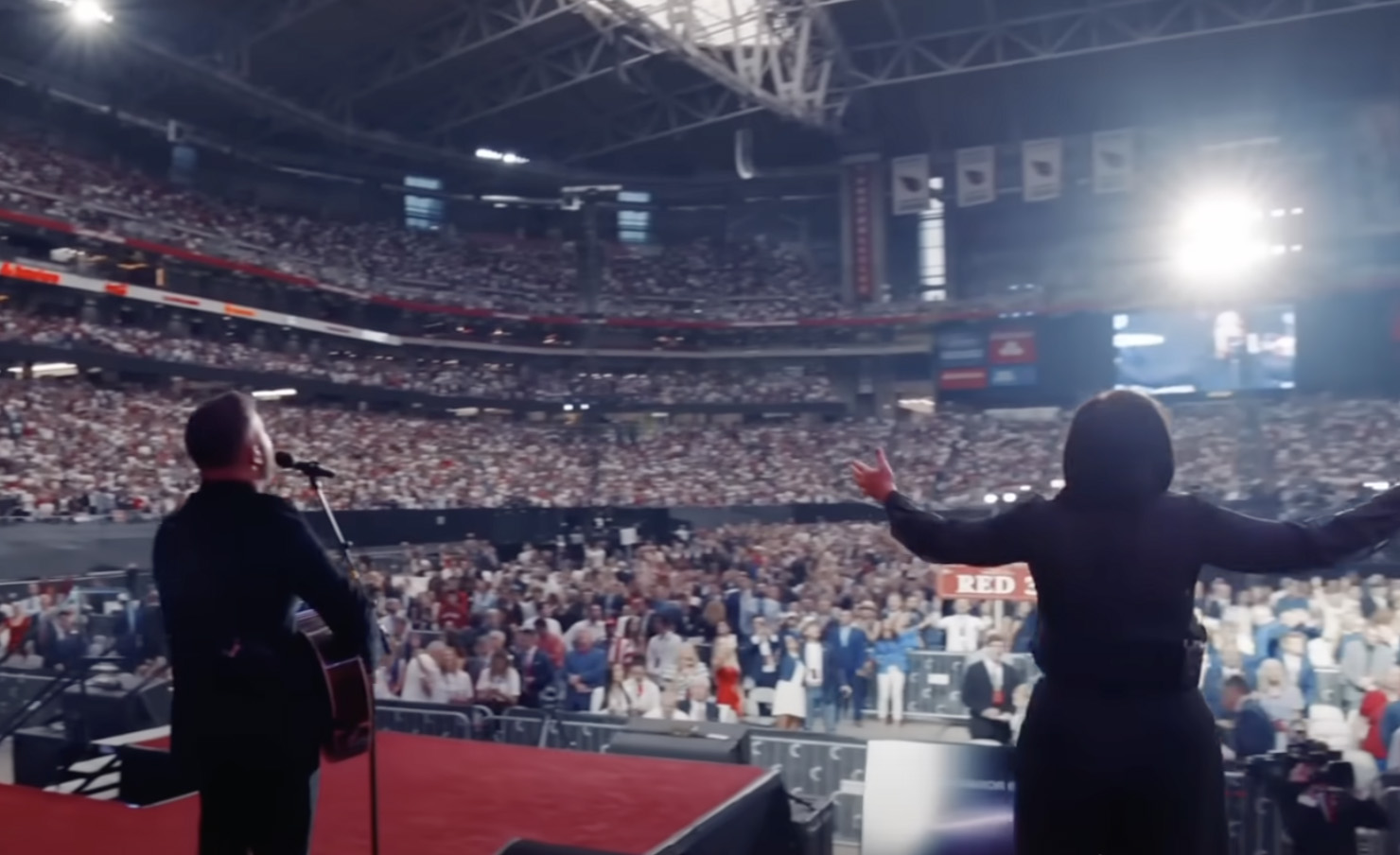
Singers leading worship songs at the beginning of the Charlie Kirk memorial service. (Screencap)
‘Beautiful’
“What a beautiful name it is,” Jobe sang with her eyes closed in a breathy tone.
“Beautiful” is one of Jobe’s favorite words to use, even in political spaces where Trump is in authority. When the first Trump administration invited her, Cody Carnes, Sean Feucht and 50 other worship leaders to the White House in November 2018, Jobe said, “I sat there with tears in my eyes because these beautiful people get up daily and go to work in a governmental facility and think about people. … It all seemed beyond politics — it was kingdom.”
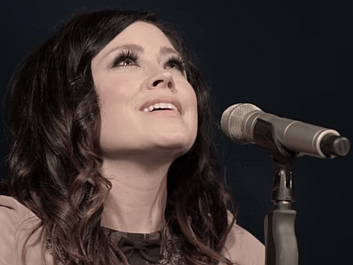
Kari Jobe (Wikipedia)
Then when Trump invited her back in December 2019 during the heat of his impeachment trial for what Vice President Mike Pence called a “worship leader’s briefing” along with top leaders from Hillsong, Bethel and others, Jobe gushed: “I’ve just been in tears all day. It’s been incredible. I’m just so thankful to be part of this today and to see what God’s doing in our White House. … It’s very beautiful.”
And while all these worship leaders are physically attractive, Jobe plays a particular role in the worship industry. As Kelsey Kramer McGinnis, a worship correspondent at Christianity Today, told me on “Highest Power: Church + State,” “Someone like Kari Jobe is described in Charisma Magazine as ethereal and angelic, and there’s something about the quality of her performance style that helps people lower their guards and enter into this more intimate, experiential form of worship. I see a connection between the feminine aspect of that performance and her voice, and this idea of being ushered into a more intimate form of worship.”
Accompanying her were Antonio and Allison Marin, playing beautifully as usual on the cello and violin.
“There was this moment during the service,” Antonio recalled on Instagram. “A silence just fell in the room and then Allison and I just began to play our instruments and people just started spontaneously just raising up signs with Bible verses and pictures of Charlie and it felt like a sacred moment like all of the sudden I felt like holiness, like a sacredness just fell in the room and people were weeping.”
He explained: “The Spirit of God was moving. The Holy Spirit was touching us.”
With Allison walking by his side, Antonio said, “It felt like everyone that stood up and picked up a microphone just spoke of Jesus, spoke of the message, beautiful, glorious message of the gospel.”

Worship leaders at Charlie Kirk memorial service (Screencqp)
The worship of power
One of the most common statements evangelicals say about their worship is that, among other things, it “prepares the hearts for the sermon.” So consider how the worship at Charlie Kirk’s memorial service prepared the hearts of those present for the sermons by the men from the Trump administration.
They utilized mainstream worship leaders and the most popular modern worship songs. So no evangelicals would notice anything unusual.
“These worship leaders set up a theology of authority and submission.”
These worship leaders set up a theology of authority and submission that blended bending the knee to God with bending the knee to the work of God through the Trump administration. They set up a dynamic where those who do not perfectly submit are considered enemies who are destined to lose to the highest power. And they utilized beauty in a way that made it all feel intimate.
So with Jobe getting down on her knees, she sang: “What a powerful name it is. Nothing can stand against.”
That was the moment of truth. Despite whatever beauty was moving people to tears, at its heart the worship at Kirk’s memorial was moving white supremacists to worship power and dismiss as powerless anyone who might stand against them.
That’s why none of them seem bothered by Trump admitting, “I hate my opponent, and I don’t want the best for them. … I can’t stand my opponent.”
And that’s why none of them appear concerned about Stephen Miller shouting, “You have nothing. You are nothing.”
Instead, the worship set everyone up to accept Miller’s self-deluded declaration that, “We are the ones who lift up humanity. … We have beauty … We are on the side of God.”
Rick Pidcock
Rick Pidcock is a 2004 graduate of Bob Jones University, with a Bachelor of Arts degree in Bible. He’s a freelance writer based in South Carolina and a former Clemons Fellow with BNG. He completed a Master of Arts degree in worship from Northern Seminary. He is a stay-at-home father of five children and produces music under the artist name Provoke Wonder. Follow his blog at www.rickpidcock.com.
Related articles:
Here’s the real context for understanding Charlie Kirk | Analysis by Rodney Kennedy
These are the helpful conversations about religion we need | Analysis by Rick Pidcock
‘We are on the side of God,’ Stephen Miller says
Why Trump proudly hates his enemies | Opinion by Tyler Hummel
Reflections on a five-hour memorial service | Opinion by Dan Day