


What went around for Southern Baptist Theological Seminary three decades ago has come back around for Baylor University this fall. Woe be unto Baylor.
In 1995, Southern Seminary’s newish president, Al Mohler — who publicly questioned the role of social work in theological education — fired the dean of the seminary’s Carver School of Church Social Work, Diana Garland.

Jon Singletary
This fall, Baylor forced the ouster of the dean of its social work school that bears Garland’s name, Jon Singletary, for accepting a grant to fund a study that might — might — support compassionate relationships between churches and LGBTQ people and women.
A brief history lesson
Southern Seminary’s history intertwines how to prepare women for ministry with what to do with Christian compassion.
The Woman’s Missionary Union Training School for Christian Workers — created to teach women how to minister in careers considered appropriate for females — started alongside the seminary in 1907. It evolved into the Carver School of Missions and Social Work in 1952 and merged with the seminary in 1963. It became the seminary’s Carver School of Church Social Work in 1984.
Mohler rode the Southern Baptist Convention’s so-called “conservative resurgence” — known by adversaries as the “fundamentalist takeover” — to the seminary’s presidency in 1993. Almost immediately, he expressed doubts about the Carver School’s place in the seminary. Along the way, he said the “culture of social work” and the seminary’s theology were “not absolutely congruent.”

Al Mohler, the day of his election as seminary president in 1993, with Roy Honeycutt behind him.
In 1995, Mohler took overt steps to reshape the Carver School. Timothy Johnson, a contract professor at the Carver School, resigned, citing racism and broken promises that he would be offered a tenure-track position.
That created a faculty opening, and Garland nominated David Sherwood, an eminently respected evangelical Christian social worker, active Baptist and head of the social work program at Gordon College in Wenham, Mass. Sherwood’s hiring process went well until Mohler asked him to provide written answers to questions about a variety of topics, including the role of women in ministry.
Sherwood wrote, “God’s Spirit blows where it wills and certain (but not all) women may be called to any role in the ministry of the church.” Mohler determined Sherwood’s personal belief — not his intention to teach this view, but his own private belief — to be outside the realm of Southern Baptist orthodoxy. So he declared Sherwood unfit for the faculty.
Garland reported the results of the process to social work students, expressing her fear the Carver School might die. Later that morning, Mohler fired her for “preemption of official administrative structures.”
Southern Seminary closed the Carver School in 1997 and ultimately sold the name, “Carver School of Church Social Work,” to Campbellsville University, a Kentucky Baptist school.
Also in 1997, Baylor hired Garland to teach social work and hired her husband, David Garland, a New Testament professor at Southern Seminary, to join the faculty of its George W. Truett Theological Seminary.

Diana Garland
Guided by Diana Garland, Baylor’s social work program advanced. The university created its School of Social Work in 2005, and she became its first dean. Baylor’s undergraduate and master’s degree social work programs boomed. The School of Social Work and Truett Seminary teamed up to create a joint program, enabling students to earn master of divinity and master of social work degrees side-by-side. And the school admitted its first Ph.D. cohort in 2013.
Meanwhile, Singletary joined the School of Social Work faculty in 2003. He served as director of the Baylor Center for Family and Community Ministries from 2005 to 2011, associate dean for baccalaureate studies from 2011 to 2014 and associate dean for graduate studies from 2014 to 2015.
Baylor changed the name of the social work school to the Diana R. Garland School of Social Work in the spring of 2015, and she died prematurely that fall. Singletary succeeded her as dean in 2016.
Among other developments, Singletary has overseen a burgeoning online education program and the growth of the Ph.D. program.
This year, the Garland School received a grant from the Eula Mae and John Baugh Foundation to study loneliness among women and LGBTQ churchgoers. The university received blowback from anti-inclusion forces, forcing Singletary to give back the grant under pressure. That set off circulation of competing open letters from groups affirming and condemning Baylor’s action.
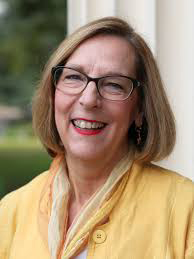
Nancy Brickhouse
In the latest move, Baylor Provost Nancy Brickhouse told faculty Sept. 25 Singletary will “step down” as dean effective Oct. 15. Her message did not say if Singletary voluntarily resigned or was fired, but the signs of intense pressure are hard to miss.
Singletary will take a sabbatical and then “return to the faculty and focus on interdisciplinary research and approaches to tackling the growing crisis of mental health in our country,” she said.
Ironic repetition
If you abhor the smell of déjà vu in the morning, then your nostrils burned as news of Singletary’s decision to “step down” spread.
Upon hearing about Singletary, a Baylor alum asked, “Do you think this was decided by Dr. (Linda) Livingstone,” Baylor’s president. Livingstone might or might not have been the one to pull the trigger, but no university president is out of the loop when a dean is forced from office. If Livingstone wanted to stand up for academic freedom, intellectual integrity and Christian compassion, Singletary would continue to serve as dean.
Sadly, people who care for Baylor, love academic freedom and oppose fundamentalist rigidity and outright meanness had reason to believe something like this never would happen to Baylor.
In 1990, when so-called “conservatives” confirmed their control of the Southern Baptist Convention, Baylor’s president at the time, Herbert Reynolds, took steps to ensure the dominance by fundamentalists that already was occurring at SBC seminaries would not befall Baylor.

Herbert Reynolds at this Baylor inauguration, 1981.
Reynolds led the university’s board of regents to essentially become self-perpetuating. Baylor allowed the Baptist General Convention of Texas to continue nominating some members of the board — but not a majority, and not without approval by the overall board itself.
The move seemed to preclude an attempt by conservatives to stack the board and purge the university of its president and administrators, as well as any faculty deemed out of favor with SBC conservatives.
Even most so-called “moderate” BGCT leaders opposed Baylor’s move. In 1990, the BGCT appeared to have resisted the conservative quest to control the SBC, and they could not imagine Texas Baptists would fall to so-called “fundamentalists” — as the SBC had cratered and as other state Baptist conventions had begun to crater.
Reynolds’ move was prescient for the arc of the current development, 35 years later. By removing Baylor from the danger of dominance by conservatives, he paved the way for Diana Garland to move to Waco and to build the strongest Christian-oriented, church-focused social work school anywhere.
Mercifully, the social work school was soaring when Garland passed away, and she never had to see the foundations she and Reynolds built undermined.
Foundation eroded
Appearances can be deceiving, and that has been true of perceptions of the Baptist General Convention of Texas.
During the SBC “holy war,” the BGCT resisted conservative dominance of the state convention that succeeded at the national level. The BGCT continued to elect so-called “moderate” leaders, who refused to go along with the SBC’s conservative reforms. In fact, conservatives got so fed up with the BGCT, they created their own organization, the Southern Baptists of Texas Convention, in 1998.
“Most Texas Baptists weren’t moderate or progressive as much as they just didn’t like somebody telling them what to do.”
As it turns out, however, most Texas Baptists weren’t moderate or progressive as much as they just didn’t like somebody telling them what to do. For the most part, they remained biblically and historically conservative, but they didn’t want to kowtow to the SBC’s new rulers.
That stubborn streak of independence resulted in strong advocacy for one particular Baptist distinctive — the autonomy of the local church. They agreed no denominational organization at any level could tell an individual congregation what to do.
So, even though the vast majority never would hire a woman to be their pastor, most believed every church had a right to make that decision without interference. And that set them apart from the SBC.

Logsdon Seminary chapel window
Across time, that distinction has proven to be a weak defense against the gravitational pull of SBC-style conservatism. For about 15 years, the BGCT has migrated back to the right, getting closer and closer to the SBC — in relationships, language and things they fear.
That’s their choice, of course. But it has left some observers wondering why so many bothered to resist the SBC’s right-wing juggernaut if they were going to cozy up within the span of a generation.
This felt acutely poignant in 2020, when big-steeple West Texas pastors pushed Hardin-Simmons University in Abilene to close its Logsdon Seminary. Its sin was its refusal to draft an overtly anti-LGBTQ statement. (Ironically for the time, most of those pastors — not coincidentally Baylor grads — did not pressure Baylor’s Truett Seminary to draft a similar document.)
And now, the pressure has come full circle. Once-untouchable Baylor has succumbed to the pressure to conform to an ultra-conservative cohort of pastors.
The Kryptonite here, of course, is homosexuality. The grant that caused all the controversy at the Garland School was not designed to defend any LGBTQ position, but rather to help churches learn how to be kinder — not only to the LGBTQ community, but also to women.

Linda Livingstone (Photo/Baylor)
Some Baptists and other evangelicals apparently are so afraid of seeming to condone something they believe the Bible teaches against that they can’t practice what Jesus explicitly taught — kindness and compassion for the most vulnerable among us.
What’s next?
In addition to the rightward movement in the BGCT, it’s impossible to separate Baylor’s actions from the larger context. The United States’ current government abhors empathy and kindness, much less diversity and inclusion. That is playing out in how it treats all kinds of institutions, with colleges and universities atop the list.
Even private schools like Baylor depend upon government funds and partnerships and relationships, as well as policies and regulations. In addition to fearing conservative pastors, Baylor’s administrators no doubt fear government officials.
And rather than flexing its strength, in part to defend the rights of those who are weaker, Baylor appears to be caving.
Someday, Baylor may proclaim a lament that paraphrases Nazi-era German pastor Martin Niemoller: First, they came for Hardin-Simmons, and I did not speak — because I did not operate Logsdon Seminary. Then they came for Harvard and Columbia, and I did not speak — because I was not in the Ivy League. Then they came for social workers, and I did not speak — because I did not really believe in social work, anyway. Then they came for me — and there was no one left to speak for me.

Marv Knox
Marv Knox notes he tried to write this article transparently and forthrightly while acknowledging his long association with the people and developments that coalesced in this moment:
- He graduated from Hardin-Simmons University in 1979, years before HSU launched Logsdon Seminary.
- He graduated from Southern Seminary in 1984, the year the seminary launched the Carver School of Church Social Work. He was a seminary classmate with Mohler.
- While Marv was a seminary student and later when he was editor of Kentucky’s Western Recorder, his family attended church with Diana Garland and her family.
- As editor of the Western Recorder in the early 1990s, he covered Mohler’s disdain for social work and firing of Diana Garland.
- As a staff member and then editor of the Baptist Standard in Texas, he covered Garland’s move to Baylor and the launch of its social work school.
- He served on the Baylor social work school’s Board of Advocates twice, under Garland and then Singletary, and chaired the board for a term each time.
- As coordinator of Fellowship Southwest, he worked closely with the social work school’s Center for Church and Community Impact, which initially received the ill-fated grant Baylor forced Singletary to decline.
Related Articles:
Baylor rejects grant to study LGBTQ exclusion in the church
Amid LGBTQ controversy, social work dean ‘steps down’ at Baylor
Could Jesus teach social work at Southern Seminary (Western Recorder, Texas Baptists Committed)
School’s history reflects changing Southern Baptist attitudes (Baptist Standard)
Carver School of Social Work was a victim of American fundamentalism
Diana Garland, social work educator & bridge builder, dies (Baptist Standard)