

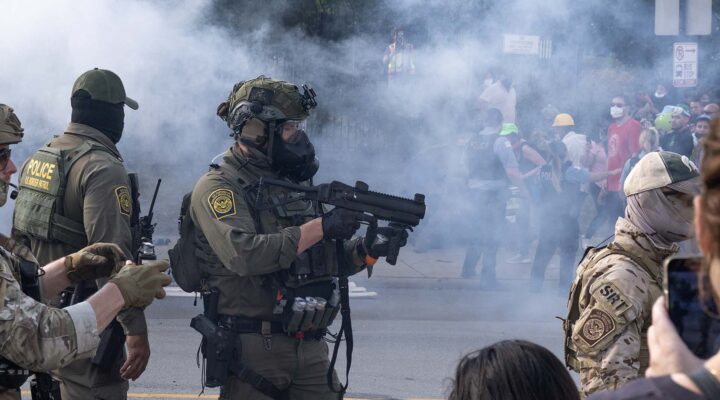
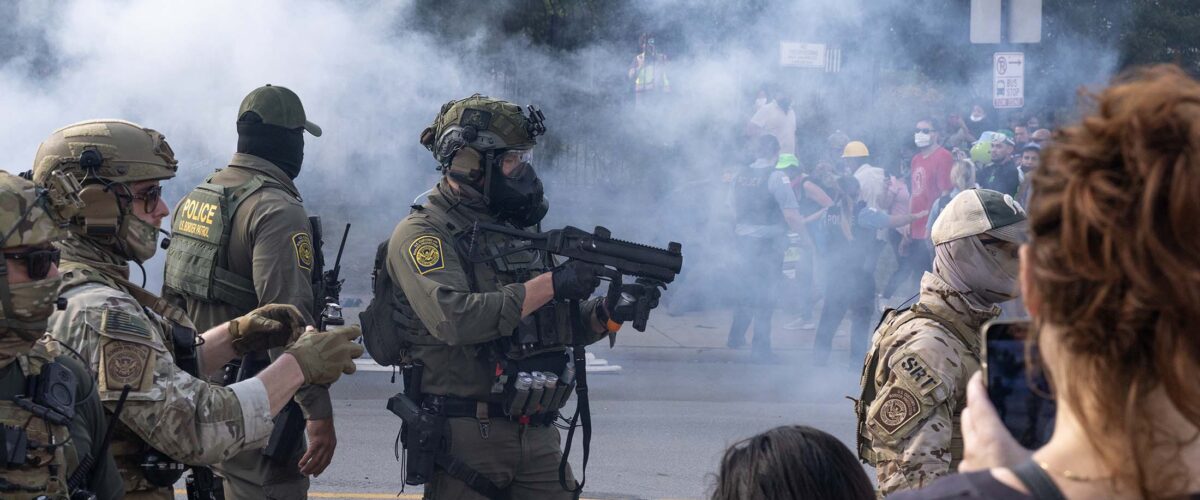
History teaches us a hard truth: Democracies don’t collapse only when institutions fail — they collapse when leaders turn their weapons on the very people they are sworn to serve.
Tanks in the streets, tear gas in the squares, troops facing down their own citizens. These moments may restore order in the short term, but they do something far more corrosive in the long run. They strip a nation of its moral authority.

Stuart C. Lord
Once that authority is gone, no election, no speech, no military victory can restore it. A democracy that silences dissent with force may still call itself free, but to the world — and to its own people — it looks no different from the dictatorships it claims to oppose.
That is the fragile currency of democracy — not just ballots and laws, but trust. And when leaders spend that trust by turning guns inward, they may win control, but they lose credibility.
Lessons from history
When governments have turned their weapons inward, the lesson has been the same across nations and decades: Force can crush a crowd, but it cannot command respect.
Tiananmen Square, China (1989): The image is seared into memory: a lone man standing in front of a column of tanks. The Chinese government’s decision to use brute force against peaceful protesters silenced dissent in the moment, but at an unfathomable cost. For decades since, the world has associated Tiananmen not with stability but with brutality. China’s global image still bears that scar.
Belarus (post-election repression): In Belarus, when contested elections brought people into the streets, the regime responded with violence — mass arrests, beatings, shuttered media outlets. The crackdown preserved political control but triggered international sanctions and travel bans. Far from strengthening the regime, it confirmed what many already believed — that the government feared its own people.
France (recent years): Even democracies are not immune. In France, growing powers to restrict protests, dissolve organizations and curb civil liberties have sparked alarm. Human rights groups now warn of “authoritarian drift.” The very nation once held up as a beacon of liberty is finding its democratic reputation under strain, precisely because silencing dissent corrodes credibility.
“When leaders meet protest with repression, the short-term victory is always offset by a long-term loss of legitimacy.”
The common thread is clear: When leaders meet protest with repression, the short-term victory is always offset by a long-term loss of legitimacy.
Authoritarian parallels abroad
Across the world, authoritarian governments long have relied on the same playbook: Silence dissent, criminalize opposition, export fear beyond their borders.
Russia: Kremlin critics rarely live long in safety. Journalists and dissidents have been poisoned in foreign cities. Political opponents have been imprisoned or killed. When Vladimir Putin invaded Ukraine, he not only waged a war on another nation — he waged a war on truth itself. Independent media were shut down; even using the word “war” became a punishable offense. The result: a country locked inside its own narrative, unable to see itself clearly.
China: Beijing’s reach extends far beyond Tiananmen. Chinese authorities track, intimidate and detain dissidents abroad — from student activists in the U.S. to Uyghur exiles in Europe. The state’s digital surveillance empire allows it to censor critics at home and abroad with a sophistication that blurs the line between domestic control and global intimidation.
Iran: The Iranian regime’s crackdown on women-led protests after the death of Mahsa Amini revealed again the brutality of governments that fear their own citizens more than foreign adversaries. Even in exile, Iranian activists face harassment, abduction attempts and assassination plots.
“Regimes that cannot tolerate dissent at home seek to erase it everywhere.”
The pattern is chillingly consistent: Regimes that cannot tolerate dissent at home seek to erase it everywhere. Their authority rests not on consent, but on control. And every bullet fired at a citizen, every dissident silenced, every exile hunted across oceans erodes the last claim these governments have to legitimacy.
The United States case study
No democracy is immune from decline, not even the one that has long called itself the world’s oldest and strongest. On January 6, 2021, as the world watched rioters storm the U.S. Capitol, the myth of American exceptionalism cracked in real time.
The images shocked allies and emboldened adversaries. They showed what many had quietly feared — that America’s internal divisions had grown so deep that even its peaceful transfer of power was now under siege.
For decades, the United States has urged other nations to protect free elections, reject political violence and honor the rule of law. But that day, America’s credibility wavered. Chinese and Russian state media wasted no time exploiting the moment, pointing to the chaos as evidence that democracy itself was unstable and hypocritical. They didn’t need to invent propaganda — the footage from Washington was enough.
And the damage didn’t stop there. When a nation that once stood as a moral compass begins to wobble, others take notice. Allies hesitate. Adversaries pounce. Citizens lose faith. The power of example — the quiet influence that shaped the postwar order — depends on integrity at home. Without it, even the mightiest democracy finds itself adrift.
The universal lesson
History does not repeat itself exactly, but it does echo. And one of its clearest echoes is this: When democracies start borrowing the tactics of the regimes they condemn, they begin to forfeit the very thing that makes them different.
When leaders label dissent as disloyalty, when peaceful protesters are met with force, and when political opponents are treated as enemies of the state, democracy’s foundation begins to crack. The tools of repression may look like control, but they breed the same fear and fragility that define autocracies.
“A nation that cannot tolerate dissent cannot lead others toward freedom.”
The tragedy is not only moral but strategic. Democracies derive their power not from fear, but from faith — from the belief of citizens and allies alike that their principles mean something. Once that faith erodes, no amount of military strength or diplomatic spin can restore it.
This is why moral authority matters more than ever. It cannot be purchased with weapons or speeches. It must be earned — day after day — through restraint, accountability and courage. A nation that cannot tolerate dissent cannot lead others toward freedom.
And so the question for every democracy, including our own, is not whether we can silence protest or suppress opposition. It is whether we can still listen.
The price of silence, the power of restraint
In every era, nations are tested not only by their enemies but by how they respond to their own people. The measure of a democracy is not its ability to crush dissent, but its willingness to hear it.
Silence in the face of abuse is not peace. It is decay. And when governments — ours included — treat protest as threat, critique as disloyalty or difference as danger, they trade moral strength for momentary control. That bargain never ends well.
True leadership is not the exercise of power but the restraint of it. It is the discipline to remember that force may command obedience, but only justice earns respect. Every baton raised against a citizen, every word of mockery or menace from the powerful toward the powerless, widens the moral gap between what we say we are and what we show ourselves to be.
If America wishes to lead, it must first listen. If we hope to be a model of democracy, we must stop mirroring the behaviors of those who fear it. The price of silence is credibility lost; the power of restraint is credibility restored.
The world is watching. But more importantly, our children are too. May they inherit not the echoes of our failures, but the courage of our better angels.
Stuart C. Lord is a civic leader, CEO of Y Solve Foundry and a founding member of the Y Solve Lab and founder of the Declaration of Respect. Based in Boulder, Colo., he has spent his career advancing nonviolence, interfaith collaboration and ethical leadership. He is recognized for building bridges across communities and championing justice with a vision rooted in service and respect.