

Proponents of book banning may differ in the titles or subjects they want to suppress, but they almost always are motivated by religious beliefs, college senior Katie Turcke observed during a recent webinar on censorship.
The Pomona College student said she picked up on the trend as a youth when book bans began to proliferate in her home state of Idaho.
“I noticed people who are proponents of banning those books often used religious language or they would often refer to religious texts to explain why those books should be banned,” said Turcke, a former youth organizing fellow with Americans United for Separation of Church and State, which hosted the event. “That struck me as problematic, and it showed me the intersection of religious freedom and democracy with book banning.”
Katie Turcke
Turcke was one of three panelists to discuss the issue during “Uncensored: Youth Voices Against Book Bans.” The Oct. 9 webinar coincided with Banned Books Week and covered topics ranging from commonly targeted genres, the emotional effect bans have on marginalized communities, and actions Americans can take to oppose efforts to limit democracy and intellectual freedom.
“The rise of book bans isn’t just about what’s on the shelves, it’s about whose stories are silenced and who gets to define truth, identity and belonging in our classrooms,” said Adriyanna R. Andrèus, conference and partnerships manager at Americans United.
“One of my favorite banned books, Their Eyes Were Watching God, by Zora Neal Hurston, felt like someone handed me a mirror and a megaphone. It’s a story about voice, agency and a Black woman daring to define herself on her own terms,” she said. “That’s what makes these bans so dangerous. They’re not just erasing ideas, they’re erasing people.”
And book banning is still going strong with “an uptick in recent years,” said moderator Alicia Johnson, national organizer and student network manager at Americans United.
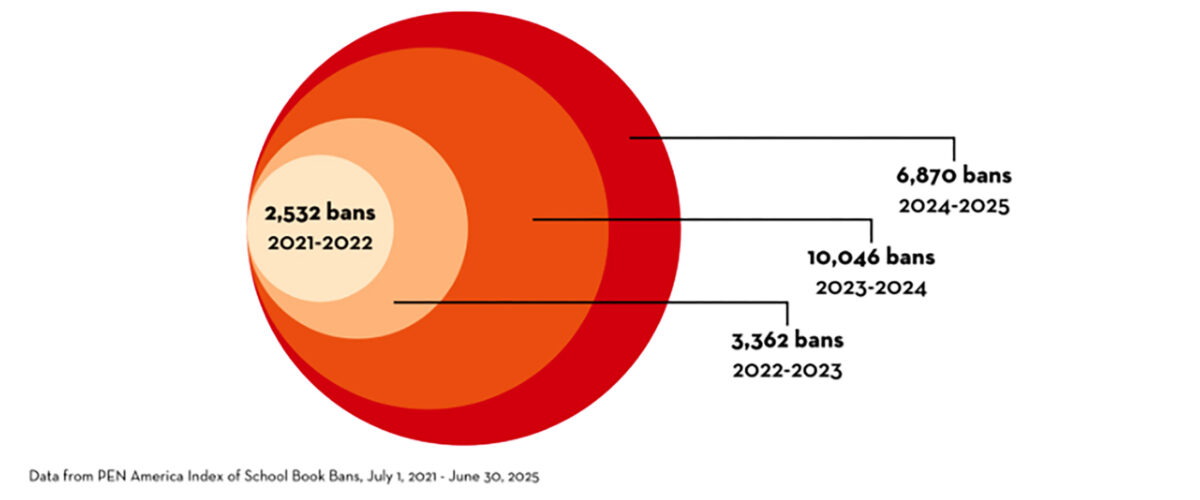
PEN America’s latest study, “Banned in the USA: The Normalization of Book Banning,” reported 6,870 instances of book banning across 23 states and 87 school districts during the 2024-2025 school year alone.
“Never before in the life of any living American have so many books been systematically removed from school libraries.”
“In 2025, book censorship in the United States is rampant and common. Never before in the life of any living American have so many books been systematically removed from school libraries across the country,” according to the nonprofit dedicated to championing free expression. “Never before have so many states passed laws or regulations to facilitate the banning of books, including bans on specific titles statewide.”
The American Library Association reports 72% of all censorship demands have originated from organized groups or movements outside the communities where bans are attempted: “Parents only accounted for 16% of demands to censor books, while 5% of challenges were brought by individual library users. The 120 titles most frequently targeted for censorship during 2024 are all identified on partisan book rating sites which provide tools for activists to demand the censorship of library books.”
The most commonly targeted books are those with LGBTQ characters and themes, those falsely labeled as obscene or pornographic, and those dealing with equity, race, racism and social justice, according to the association.
Azeemah Sadiq
Those bans are especially harmful to people of color and LGBTQ groups because “they silence our voices and chip away at our democracy,” said Azeemah Sadiq, senior policy associate for Students Engaged in Advancing Texas. “When students walk into a library now, they don’t feel the same sense of belonging because the stories that reflected who they are have been taken off the shelves, which sends a clear message that they don’t matter, or their voices should be silenced.”
But the bans also harm society at large by limiting intellectual freedoms and opportunities to understand different people and ideas, Sadiq said.
“Inhibiting access to books is an attack on our freedom of expression, something that’s becoming increasingly threatened in today’s political climate. What’s most troubling about these decisions is that they’re being made without inputs from students and the communities mostly affected, the very people whose stories are being erased.”
Yet it is possible for free-speech proponents to push back against censorship, said Josie Mitz, campaign manager at Parents, Families and Friends of Lesbians and Gays, or PFLAG. The organization has found individuals considered to be persuadable on an issue may adopt different views when conversations are held face-to-face.
“Something we’re finding with parents speaking to school board members is that human connection — meeting with school board members, legislators, city council members and library board members — dismantles that wall when having those conversations,” Mitz said.
Proponents’ claims that book bans are about parental rights can be effectively countered by reframing the issue in terms meaningful in local contexts, Turcke said.
For example, an effective argument against book banning in Idaho is to emphasize bans as threats to personal freedoms, she explained. “It’s always helpful to point out these laws go totally counter to ideas of individual choice or individual freedom.”
Related articles:
Fear and loathing of history led to Hegseth’s book ban, authors say
States counter growing number of book bans with book ban bans