

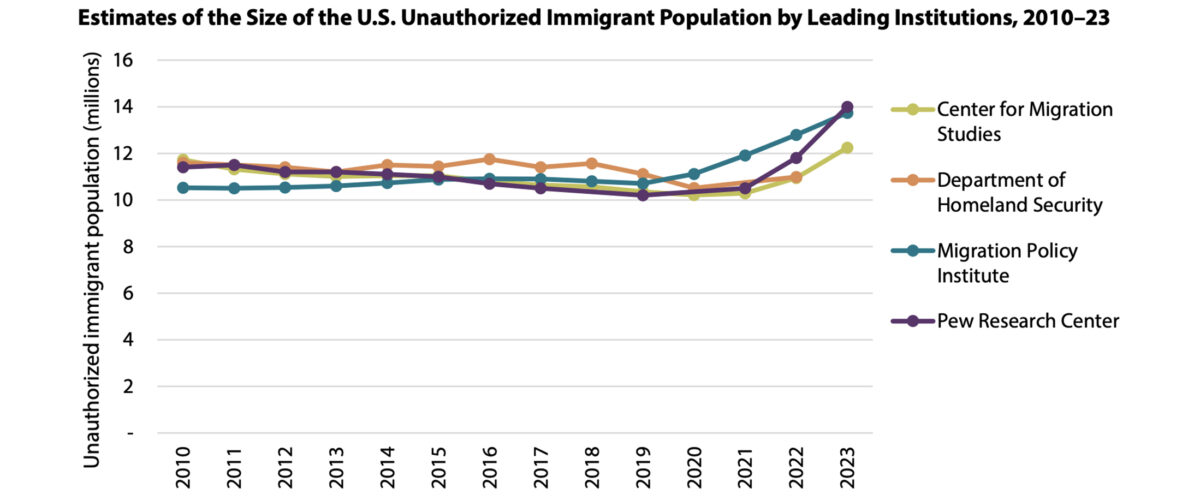
The number of undocumented immigrants in the United States spiked to nearly 14 million just more than a year before President Donald Trump returned to office and launched his aggressive detention and deportation campaign.
The population of unauthorized residents increased from 10.7 million in 2019 to 13.7 million by mid-2023, according to a new Migration Policy Institute report based on the latest complete-year data available.
MPI attributed the surge to increased job opportunities during the COVID-19 recovery, political and economic instability in portions of Central and South America, increased violence in Ecuador, Haiti and Mexico and government repression in Cuba, Nicaragua and Venezuela.
Researchers estimated the number of unauthorized immigrants continued to grow through mid-2024 given high levels of border encounters and entries permitted early last year. But President Joe Biden’s termination of asylum protections and Trump’s presidential victory likely stopped the trend.
“Beyond mid-2024, that growth likely stalled, and in 2025, may have even reversed based on the very low numbers of U.S.-Mexico border encounters, heavy immigration enforcement inside the country, and an overall atmosphere intended to convince would-be migrants not to come and current unauthorized immigrants to leave,” the report says.
Recent government data indicate that reversal is well under way and continuing rapidly amid Trump’s immigration crackdown with nearly 229,000 arrests, almost 60,000 immigrants in detention and more than 234,000 already deported.

“The Trump administration is on pace to shatter historic records and deport nearly 600,000 illegal aliens by the end of President Donald Trump’s first year since returning to office,” the U.S. Department of Homeland Security announced Sept. 23. “Two million illegal aliens have left the United States in less than 250 days, including an estimated 1.6 million who have voluntarily self-deported and more than 400,000 deportations.”
Enforcement actions at the U.S.-Mexico border dropped significantly during the 2025 fiscal year ending Sept. 30, according to U.S. Customs and Border Protection. The agency’s latest report showed total encounters fell from 2.9 million to nearly 666,000 from 2024 to 2025.
“DHS has made it clear: The era of open borders is over. For four straight months, United States Customs and Border Protection has released zero illegal aliens into the country,” the administration said.
However, White House claims that it is detaining and deporting hardened criminals have been debunked by Immigration and Customs Enforcement statistics, according to an analysis by TRAC, a data clearinghouse that monitors government actions.
“While President Trump claims he is deporting the ‘worst of the worst,’ the actual data indicate ICE is locking up individuals without any criminal records — not even a pending charge,” TRAC reported.
Of the undocumented immigrants in ICE custody as of late September, 71% had no criminal convictions of any kind, and most of those with records had committed traffic violations and other minor offenses.
In the two weeks ending Sept. 25, the net number of detained immigrants with criminal records fell by 170 and the number of those arrested without criminal histories rose by 1,016, according to the TRAC analysis. “This shift reflects the growing tendency for this administration to lock up individuals with little concern about having any legal basis for their actions.”
The trauma these immigration actions policies are causing families, communities and businesses can be discerned in the MPI report released Oct. 21.
About 4.2 million unauthorized internationals were married to a U.S. citizen or a lawful permanent resident during that time frame, and 5.3 million U.S. citizen children under age 18 lived with at least one parent in the country illegally. Another 1 million noncitizen children also lived with at least one immigrant parent.
“Such children are often strongly affected by their parents’ limited employment opportunities and restrictions on eligibility for public assistance, as well as the threat of separation due to immigration enforcement,” MPS explained.
About 14 million U.S. citizens and the holders of green cards and temporary visas shared a household with an undocumented immigrant through mid-2023, the report added. Up to 4 million unauthorized residents held “liminal” designations through humanitarian parole, Deferred Action for Childhood Arrivals, Temporary Protected Status or through pending asylum cases.
But those designations no longer guarantee refuge in the U.S. as the Trump administration wages aggressive efforts to terminate or revoke programs that once protected immigrants fleeing repression, violence and economic or environmental disasters in their home countries.
The economic challenges mass deportations may inflict on the families and employers of undocumented immigrants also is shown in the MPS research.
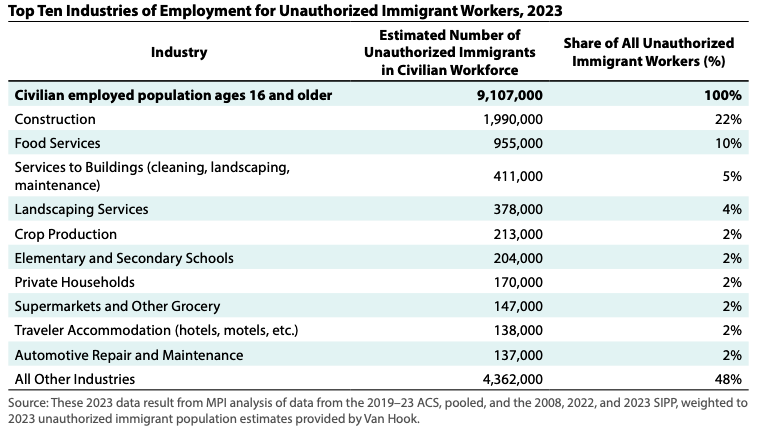
Of the 13 million unauthorized immigrants 16 and older in the U.S. in 2023, 9.6 million were in the labor force, including 1.9 million working in construction, 955,000 in food services, 411,000 in cleaning or maintenance, 378,000 in landscaping and 213,000 in crop production.
MPI noted that 47% of unauthorized immigrants in the U.S. classify as low income and about 2.7 million of them “reported income below 100% of the poverty level. Still, more than half the total unauthorized immigrant population reported income at or above 200% of the poverty level.”
Additionally, MPS found more than 25% of the U.S. immigrant population was made up of undocumented immigrants up to the middle of 2023, and 80% had lived in the country for at least five years.
Naturalized citizens (45%) comprised the largest share of immigrants in the U.S. at that time, followed by unauthorized immigrants (26%), lawful permanent residents (24%) and nonimmigrants (5%), MPS reported.
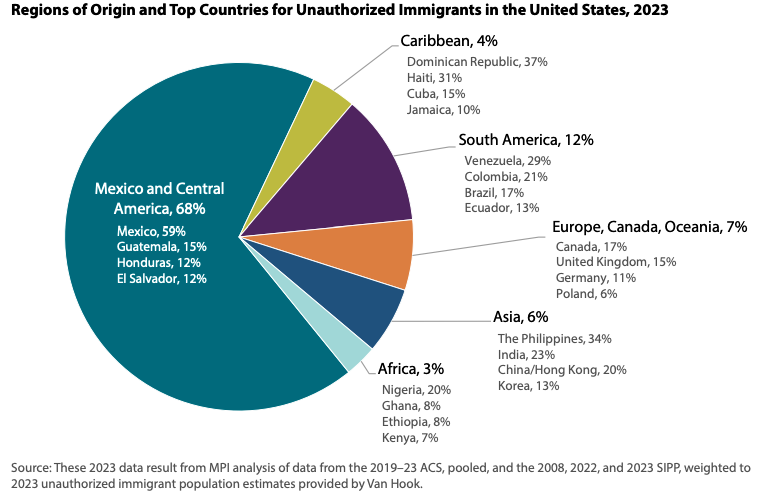
States with the most unauthorized immigrants included California with 2.9 million, Texas with 1.9 million and Florida with 1.2 million. By nationality, 5.5 million unauthorized residents were from Mexico, 1.4 million from Guatemala and nearly 1.1 million each from Honduras and El Salvador.