

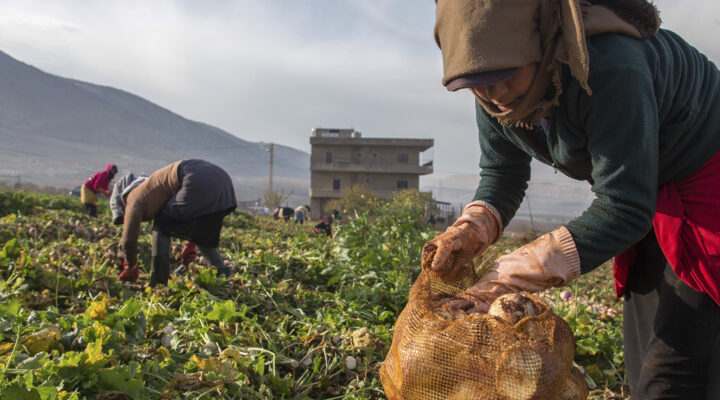
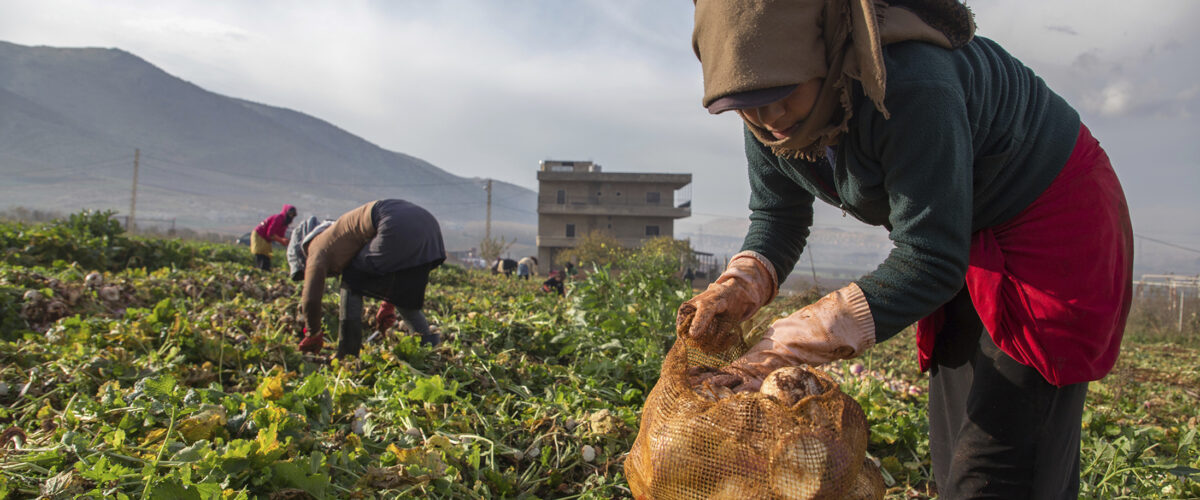
“I don’t know if I’ve started ignoring everything because I got used to the ugliness, or because the smell of cannabis makes it easier not to care.”
With these words, Ftoun, 15, a Syrian refugee working in cannabis fields in the plains of Baalbek-Hermel in Lebanon, describes how she deals with the near-daily sexual harassment she experiences.
Ftoun arrived in Lebanon with her family of nine in 2012, after losing her father and two brothers in the Syrian war.
“We came from Deir Ezzor, but I don’t remember much of it,” she explained. “My mother says it was beautiful, and our house was way bigger than this tent. It had real stone walls. And we had our own bathroom, not like here in the camp, where we share everything.”

Hassan Tabikh
Thousands of Syrian refugee girls working in agriculture live under the same harsh conditions as Ftoun. According to UNHCR, more than 300,000 Syrian refugees live in the Bekaa and Baalbek-Hermel region, most working in agriculture. Lebanese law criminalizes the cultivation, production or trade of substances that can be used as drugs, including cannabis.
The sexual exploitation of children in agriculture goes hand in hand with economic, social and legal exploitation. “Farm laborer” isn’t even a legally recognized job — there are no contracts, no health insurance, no days off. That’s if you’re talking about legal crops like vegetables or tobacco, and if the day laborer is Lebanese. What if the work is illegal, hidden deep in rural areas, controlled by tribal customs, unwritten rules and powerful figures from major clans?
Ftoun’s story
Ftoun recounts her painful story: “The first time I went to the field, I was 7. Within the first week, one of the older boys, maybe five years older than me, tried to touch me in private places. I screamed and ran to my mother, who was working nearby. I told her, ‘That boy is doing shameful things.’ My mother told me to keep quiet: ‘That’s the foreman’s son. We need to eat. If his father hears you, he’ll kick us out.’ That was the day I stopped seeing my mother the same way.”
“That’s the foreman’s son. We need to eat. If his father hears you, he’ll kick us out.”
The shaweesh, the foreman, is a middleman between the landowner and the workers, often a refugee with legal papers and local influence. He recruits workers, transports them and pays them, all under a system riddled with abuse and inequality. The shaweesh typically takes more than a third of the workers’ wages as commission. Men earn twice as much as women. Children earn half what women make. Pregnant women earn half what nonpregnant women do. Even the best-paid men barely make $6 a day. And anyone who disobeys the shaweesh or the landowner risks being fired or losing their ID papers — if they even have any.
After working on child protection in 13 countries in the Middle East and Africa, I can say with confidence: Sexual harassment of children in agriculture is widespread, especially in remote regions far from capitals, services or reporting mechanisms.
But what shocks me in Ftoun’s case and in that of her peers is that they work in areas controlled by tribes where traditional and religious values view any sexual misconduct with children as a grave offense. And yet, somehow, Ftoun and the girls around her are exceptions to these rules. The same patriarchal norms that preach “honor” are the ones forcing them into this life.
“The same patriarchal norms that preach ‘honor’ are the ones forcing them into this life.”
Is it because they’re refugees? Because they’re minors? Because they’re girls? Or is it because traditional leadership in these regions revolves around three pillars: masculinity, weapons and money?
Ftoun and her peers are poor, stateless girls, with no testosterone to dictate what’s acceptable and what’s not, and no beards long enough to claim what’s honorable and what’s not.
Going for a ‘ride’
Ftoun continues her story. She talks about when she turned 11 and her body started to change. One day, while working a little far from the others, the landowner pulled up in his pickup. “Come here,” he called, “I want to take you on a ride.”
“I’d always feared this day,” Ftoun says. “I’d seen what happens to girls who went on ‘rides.’ When they return, they’re quiet, in pain, crying. The others would mock them: ‘So… did you enjoy the ride?’
“I pretended not to hear him and moved closer to the other workers. Luckily, one of the male workers called him away to fix a broken irrigation pipe.
“That night, I told my mom while my older brother was around, hoping he’d protect me. But my brother, 25, just said, ‘Shut up. Do whatever he asks, maybe he’ll help us out. Just don’t let him touch down there.’ I didn’t sleep for nights after that. I held up a small mirror, looked at my body, blaming myself. I thought about harming myself to make him stop wanting me. It didn’t work. From time to time, I still had to go on those ‘rides.’ But I followed my brother’s advice to protect ‘down there.’
“And it’s not just the landowner. There’s daily harassment from the shaweesh, from the workers, especially in the truck that crams 40 people into four square meters as it carries us to and from the fields.”
Three truths
Ftoun and her friends live in a world of pain, injustice and silence. Their story is not just about cannabis fields, it’s about thousands of girls who don’t speak the language of privileged human rights defenders, or polished politicians who spend more time picking ties than picking their priorities. It’s about a broken system that chooses tradition over justice and hierarchy over humanity.
It exposes deeper truths.
First, the twisted idea of “honor.” Ftoun’s family who, like many, live in conditions close to slavery would force her into marriage if they knew she liked a boy. They’d demand a dowry, apply all the rules of “honor.” But not when she’s being exploited by the powerful.
The same landowner who assaults children by day becomes a respected “sheikh” by night, flaunting his rosary beads and quoting Scripture while dealing in drugs. If anyone did to his own child what he does to others, there would be blood feuds for generations.
“Human dignity cannot be selective.”
Second, the need to break the elitism of NGOs and donors. Child sexual abuse is far more brutal and widespread than the strategies created by Ivy League graduates who’ve never touched the soil that stains Ftoun’s hands. Even when they acknowledge children like her exist, they choose the “easy wins” and move on to shiny events and fancy words.
It’s time survivors lead the conversation. It’s time local organizations led by real, fearless leaders take over.
Third, we must reject how society normalizes abuse against the most marginalized. Lebanon, a country battered by endless crises, has pushed its most neglected areas, like Baalbek-Hermel, to survive however they can. I understand the link between underdevelopment and legal vacuum. But I refuse to accept that this makes abuse inevitable. That geography or poverty somehow makes it “normal.”
No, it should be condemned from every mosque pulpit, every political speech, before we talk about fuel subsidies or salary hikes.
This cannot be ignored. Human dignity cannot be selective. And Ftoun’s only “crime” is being a refugee without papers. The blame lies with a government that failed to reach them, with a society that erased them and above all with the landowner who, in the absence of law, ethics or conscience, chose to prey on those weaker than him.
All these outdated ideas, the ones that made Ftoun call abuse “that thing,” and made her believe it only matters if it happens “down there” are pushing us to ask: Isn’t it time we made protecting the most vulnerable children our top priority?
Isn’t it time our methods spoke with the people, in the language of the people?
Isn’t it time donors and governments asked themselves: Have we been wrong? Have our elite perspectives been just as cruel as the society that judges Ftoun and her friends?
And for all of us, wherever we are, what does dignity even mean if girls like Ftoun are still suffering?
Hassan Tabikh is a human rights practitioner from Baalbek, Lebanon, with more than a decade of experience in human rights, social justice and child protection across the MENA region. He is the MENA Regional Coordinator at ECPAT International and a Public Voices Fellow on prevention of child sexual abuse with The OpEd Project.