


Over the past four weeks, I’ve remained close to home, venturing out only when Brad accompanies me. I’ve avoided meeting friends at coffee shops — spaces where ICE has targeted African Americans and immigrant communities. My doctoral work has been confined to my living room and bedroom. I live with a persistent fear for my safety: the fear of being separated from Brad and my family, of disappearing without a trace.
My emotions mirror grief — a tug-of-war between sadness, anger, acceptance and depression, cycling endlessly through these states. I struggle to reconcile this reality with my identity as a free-spirited, freedom-loving person. How does my existence in this “blue city” as a queer activist and minister who has challenged and will continue to challenge the Trump administration align with the reality I now inhabit?
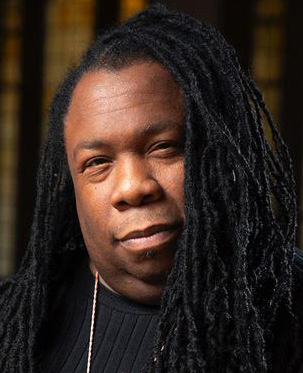
TJ Williams Hauger
It was just about a week and a half ago when my husband and I walked into a Starbucks to get coffee. The plan was getting my favorite latte — hazelnut with oat milk and blonde shots — so I could return home to work on my doctoral project on resistance in social media. While there, a group of masked white men stopped us and demanded my papers. I knew I had to respond carefully and give them no reason to detain me.
My husband, who is of Irish and German ancestry, told them he could be an undocumented immigrant. They said to him, and I quote, “We are not talking to you, so shut the f*** up.” They refocused their attention on me and again asked if I had papers. I asked if they had a warrant. They didn’t answer, and I said to Brad, “Please call the mayor’s office and other folks.”
They told Brad they could have me arrested quicker than I could dial a phone.
Last November, I knew this moment would come. My Mother Evangelist Idella Cora Thomas equipped me with the spiritual discernment to recognize evil. I tried to sound the alarm — to family, to friends — but my warnings went unheeded. Trump supporters in my own family turned the accusation back on me, insisting my activism and preaching were the real sources of division.
They demanded I conform to their notion of “unity.” One relative challenged me directly: “We need to unite. Why won’t you?”
Donald Trump is not the disease but a symptom — a manifestation of systemic oppression that reveals how white supremacy and white terror operate through our political and religious institutions in this era. He is merely the face of a deeper spiritual cancer coursing through America’s veins.
W.E.B. Du Bois articulated the concept of “white terror” — the systematic use of violence, psychological manipulation and cultural oppression by white supremacists to seize and maintain power over Black people. This white terror continues to fuel contemporary violence against Black communities.
“This terror is not random but a deliberate targeting of brown communities.”
This is why it’s crucial to recognize that this terror is not random but a deliberate targeting of brown communities. White House Chief of Staff Stephen Miller has been linked to the white nationalist “Great Replacement” theory, which falsely claims the achievements of Black Americans will lead to the demise of white America.
Du Bois’s concept of “white terror” refers to the systematic use of violence, psychological manipulation and cultural oppression by white supremacists to maintain power and control over Black people. This terror is not random but deliberate: deploying tear gas, breaking car windows — with crying children in the back seat while their parents are dragged out — instilling generational terror.
This is what white terror has been throughout history, from when the lynching tree was used to display Black bodies hanging not just for an hour, but for weeks and months, rotting in the Southern sun as a message. Black bodies were hung as physical telegrams in places where African Americans lived, raised families, built churches and historically worked in fields.
Black Americans had to walk on soil drenched in the blood of loved ones and neighbors. James Cone, in The Cross and the Lynching Tree, describes this as a powerful message of psychological and spiritual violence — Black people forced to “stay in their place.”
I submit that Donald Trump and Stephen Miller’s immigration crackdown is about terror that has now become a lived reality for all of us with Black, brown and yellow skin. This occupation of Chicago is an old tactic drawn from the history of white supremacy, manifesting in its modern-day form — screaming to be heard, demanding to be recognized.
But what is different now is that white brothers and sisters of goodwill are being directly confronted by this violence. They must witness it through social media memes and news alerts. They cannot turn away and pretend the suffering isn’t happening. They are seeing the violence in real time through TikTok videos and Instagram posts, and many are using their privilege to interrupt the kidnapping of human beings and the militarization of our city.
“White supremacy cannot build a legacy with real depth, so it must erect monuments of shallowness.”
Just last week, ICE conducted operations in my Irving Park neighborhood, an affluent area on Chicago’s Northwest side. They deployed tear gas during a Halloween parade while children were present. Neighbors mobilized in response, and a lawyer has committed to investigating this action.
This hope found in community stands in defiance of an administration whose whiteness bulldozes through our democracy and the White House itself — because white supremacy cannot build a legacy with real depth, so it must erect monuments of shallowness.
The hard work of statesmanship and community service flows from a love of people, a respect for tradition and an understanding that legacy building is never done alone. Bullying and distractions are nothing but manufactured shallow walls, but the real work of legacy is done in spirit work — work that produces tangible outcomes that change lives for the better.
Our conservative brothers and sisters are going to learn the hard way that taking away health care from 57 million Americans, dismantling food share programs and erasing the legacy and accomplishments of Black Americans is not the flex that will make history remember them well. No matter how many ideological lies they tell themselves.
As a minister and person of faith, I know dark days don’t last long. In the Christian tradition, Good Friday is a powerful reminder that we had to sit in it, but three days later a few women standing in their autonomy found an empty tomb and a risen Jesus.
In the Torah, God separates the light from the darkness as a powerful reminder to humanity that light takes over darkness. In the Quran, Allah is the light for the people who stand in light. And in the Buddhist tradition, the assurance of Amitabha offers hope: Believers recite the nembutsu (“Namo Amida Butsu,” meaning “I take refuge in Amitabha Buddha”) to seek rebirth in the Pure Land, a realm where enlightenment can be more easily attained.
Across humanity’s sacred traditions, trouble doesn’t last always. This “Spirit work” that produces tangible outcomes and changes lives is the true legacy — not ideological monuments. Across sacred traditions, we must cling to the light that ultimately overcomes darkness. Community solidarity provides hope against authoritarian actions.
TJ Williams Hauger is a Baptist pastor in Chicago, an activist and content creator. He earned a master of divinity degree from New York Theological Seminary and is a doctoral student.