


Mike Godwin was right. The longer an internet discussion goes on, the higher the likelihood someone will compare their opponent to the Nazis (colloquially known as Godwin’s Law).
So, let me cut to the chase: I’m going to talk about Nazis.
Well, to be completely accurate, I’m not going to talk about Nazis per se; rather, I’m going to talk about a group of Protestant Christians who enthusiastically supported the Nazis and their vision of a Third Reich. This group referred to themselves as the “German Christians” (Deutsche Christen) — a name originally suggested to them by Adolf Hitler.
The German Christian movement had roots back in the late 1800s, but it really picked up steam in the late 1920s and early 1930s, culminating with the official establishment of the German Christian Faith Movement (Glaubensbewegung Deutsche Christen) in 1932. The movement went through a variety of changes, splintering and reconstituting, until it finally dissolved at the end of the war in 1945.
Historian Doris Bergen estimates that, at its height, the German Christian movement had about 600,000 members, consisting of laypeople, clergy and highly respected theologians, including the famous Gerhard Kittel.
“The German Christians actively and enthusiastically supported Hitler and his vision of a renewed German empire.”
The German Christians actively and enthusiastically supported Hitler and his vision of a renewed German empire. For instance, Arnold Dannenmann, a prominent German Christian leader who published The History of the “German Christian” Faith Movement in 1933, wrote, “For the ‘German Christians,’ January 30, 1933 (the day Hitler was appointed chancellor of Germany) was … God’s day.”
The German Christian theologian Paul Althaus proudly declared, “Our Protestant churches have greeted the turning point of 1933 as a gift and miracle of God.”
To the German Christians, Hitler had been given a “divine mission” to save the German people, the German nation and the German church.
Complete alignment
The German Christians were not just enthusiastic about Hitler; they were completely in alignment with Hitler’s vision of a renewed Germany. Imitating the Nazis, the German Christians fought for the racial purity of the German church by purging Jewish Christians from positions of church leadership. They even sought to adopt their own version of the Aryan paragraph.
 The German Christians believed the church ought to ally itself with the state, since the state was God’s agent to reform society. German Christian theologian Emanuel Hirsch asserted the state and the church are divinely appointed “coworkers” to shape the spiritual lives of the people.
The German Christians believed God would use national socialism to return the German people to a more traditional and spiritually healthy state. In their view, German culture had become too liberal and corrupt during the years of the Weimar Republic (1919–1933). Discipline, order and respect for authority had eroded in society. Decadence, obscenity and sexual excesses were rampant. Effeminacy and a lack of manliness were seen as a threat to the social fabric. German family values were deteriorating as women abandoned their traditional roles in the home and German birthrates declined. Perhaps most worrying of all to church leaders was their belief that German culture had become too secular and that the church was losing the power it once had to influence the society.
All this was birthed out of the tumultuous Weimar years, which were characterized by economic instability, political polarization and increased political extremism. Throughout this period, many Germans lost confidence in the power and effectiveness of liberal democracy and began moving toward the political right and an embrace of authoritarianism. This rightward shift was catalyzed by a propaganda campaign among the political right to blame enemies within Germany (the Jews, liberals, socialists and communists) for Germany’s defeat in World War I and its subsequent problems (known as the “stab-in-the-back myth”).
Sound familiar?
Much of what I have written about Germany and the Germany Christians in the 1920s and 1930s probably seems eerily similar to trends and events we now see in the United States and the American evangelical church. It would not be difficult to draw parallels between the economic instability, political polarization and extremism of Germany a century ago and America today.
“It is the similarities between the German Christians and American evangelicals that are the most interesting.”
But it is the similarities between the German Christians and American evangelicals that are the most interesting, and most worrisome, to me.
Like the German Christians who saw Hitler as a “gift and miracle of God” and jubilantly welcomed him to power in 1933, evangelicals have repeatedly and openly proclaimed Donald Trump to be divinely ordained and chosen by God.
Just as the German Christians consciously and intentionally allied themselves with the National Socialists believing the Nazis would reform German society and make Germany great again, American evangelicals have yoked themselves to the Republican Party with the same aspirations.
German Christians wanted to restore the power and prestige of the church in German society, and American evangelicals have the same longing.
The German Christian views about social morality, liberalism, family values, traditional roles for women, manliness, declining birthrates and the need for order and discipline in society all sound like evangelical talking points you might hear in a present-day sermon or podcast.
The flag and the Cross
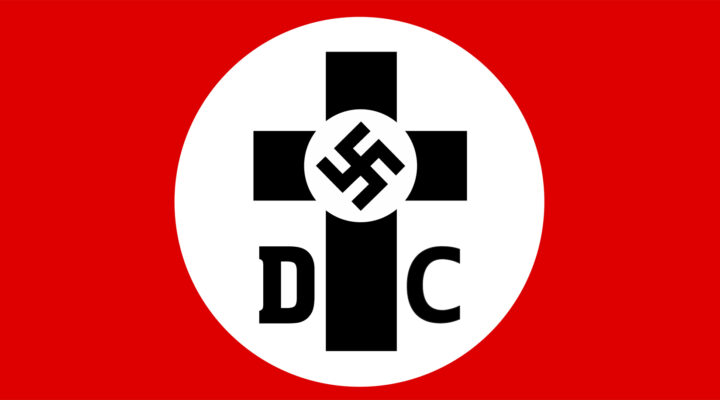
As I have pondered these similarities between the German Christians and American evangelicals over the last few months, one haunting image keeps coming to mind. The image is the flag of the German Christian movement: A traditional Christian cross inlaid with a swastika. To me, this image represents the merger that took place between the church and the state within the German Christian movement.
It also is notable that where the crucified Christ should be, the King of Kings has been replaced by the emblem of the Nazi regime. The German Christian flag is deeply disturbing, but it is not unlike so many images we have seen in recent years of crosses draped with American flags. The significance is the same.

German Christians celebrating Luther-Day in Berlin in 1933.
What to do?
So as Christian church leaders, how should we respond to this?
First, we need to instill in our congregations the unequivocal conviction that the church and the state never can be joined together. The church is disconnected from any earthly nation. As Christians, we are sojourners, and our identity does not rise and fall with the nation to which we pay taxes.
“The fundamental failure of the German Christians was that they associated their Christian identity with their national identity.”
The fundamental failure of the German Christians was that they associated their Christian identity with their national identity. For them, to be Christian was to be German, and vice versa.
Second, we need to teach our church members that neither the state nor any political leader can be the savior of the church. Our confidence is not in chariots, horses, princes and the strength of men.
The German Christians believed Hitler and National Socialism would be their allies and saviors. The sad reality is that once Hitler came to power, he turned his back on the German Christians. He didn’t need them anymore. Nevertheless, they kept trying to please and woo him, but, as one scholar said, “it was an unrequited love.”
Evangelicals should know better. The same love story played out a few decades ago during the heyday of the Moral Majority, and it had the same outcome: Evangelicals allied themselves with political conservatives hoping to reform American society but, despite all their political prostitution, evangelicals gained little for their efforts. Throughout Christian history, whenever the church has felt weak, powerless and fearful, it has looked to political powers for strength and salvation. Whenever this happened, it always turned out badly.
Third, we need to instill hope in the people of our churches. The German Christians had lost hope in God’s sovereignty, and they gave into fear — fear of a declining church, fear of liberalism and secularization, fear of social change, fear of economic uncertainty and political instability.
“To prevent these same fears from seizing the hearts of our people, we need to give them an unwavering hope that God is in control.”
To prevent these same fears from seizing the hearts of our people, we need to give them an unwavering hope that God is in control and has a plan for the world. When our people have a firmly rooted hope in God, they will not give into fear and they will not be tempted to look for salvation elsewhere.
As we enter November 2025, it is worth reflecting on an event that took place 92 years ago. On Nov. 10, 1933, Nazis and German Christians joined together to celebrate Martin Luther’s 450th birthday. A surviving photo shows Nazi and Protestant leaders standing side-by-side under flags bearing crosses, swastikas and the German Christian cross with an inlaid swastika.
Looking back now, almost a century later, it is hard to imagine how this could have happened — until we look at recent events in our own country and in our own churches.
As time goes on, American Christians are increasingly looking and acting like the German Christians in the 1930s. I wonder, a century from now, will historians be writing about our present American Christian faith movement and asking the same questions we ask of the German Christians? How could these professing followers of Christ align themselves so closely with the state? Why were they so blinded by their desperation for power and social influence? How could they read their Bibles and not see the blatant contradiction between the word of God and their socio-political allegiance?
History does not need to repeat itself — if we learn from the mistakes of the past.

Eric Montgomery
Eric R. Montgomery earned his Ph.D. in Early Judaism and Early Christianity at McMaster University in Hamilton, Ontario. He previously served as a pastor in St. Joseph, Mo. For the past nine years, he has served as a missionary and professor of New Testament studies in South and Southeast Asia.