


After a five-year effort that began outside the United States, United Methodists have overwhelmingly approved four constitutional amendments that make the worldwide denomination into a global network of co-equal regions devoted to including all people in the church no matter their race, gender or physical ability.
The Council of Bishops announced the results of a year-long vote Nov. 5, with all four amendments garnering more than 90% approval, meaning by church law they take effect immediately.
The highest-profile amendment, known as “Worldwide Regionalization,” restructures the denomination into eight geographical regions, giving each region authority to craft its own operational rules except for the denomination’s core tenets.
The bishops’ announcement said the amendments enact the following:
- Amendment 1, Worldwide Regionalization: A set of changes creating eight new regional conferences with equal power to adapt portions of the Book of Discipline, the UMC’s collection of church laws, to meet their respective cultural contexts.
- Amendment 2, Inclusiveness of the Church: Adding the words “gender” and “ability” to constitutional categories that cannot be used to exclude membership.
- Amendment 3, Racial Justice: Strengthening the denominations commitment to combating racism, racial inequity, colonialism, white privilege and white supremacy.
- Amendment 4, Educational Requirements for Clergy: Standardizing educational qualifications for which clergy may vote for clergy delegates to General Conference.
Regionalization, gender and disability inclusiveness and racial justice were issues garnering the most attention.
Traditionalists contended for years that regionalization was a smokescreen that would allow the UMC’s U.S. segment to drop churchwide condemnation of sexual minorities as “incompatible with Christian teaching.” Regionalization proponents countered regionalization was a means for the UMC to drop its U.S.-centric focus perpetuating colonialism and give the denomination’s international regions autonomy to craft their own operational rules according to their respective cultural contexts.
As that debate turned out, delegates to last year’s General Conference eliminated the UMC’s anti-LGBTQ restrictions without needing regionalization.
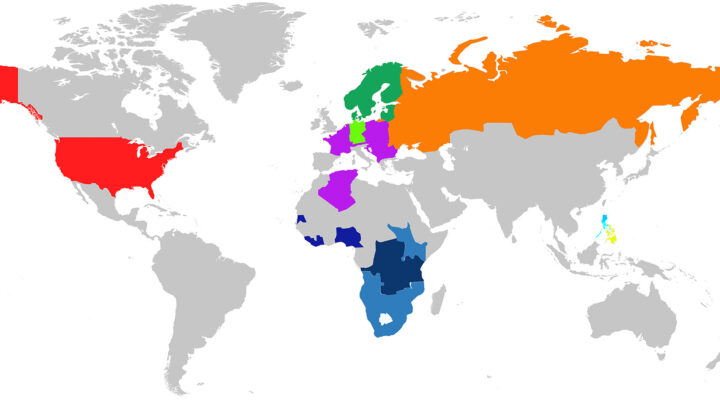
The UMC is now divided into eight regional conferences.
Almost overlooked in debates about regionalization, inclusiveness and racism was the amendment that standardizes educational requirements for those eligible to vote for clergy delegates to General Conference. The General Board of Higher Education and Ministry, which proposed the legislation, said the amendment’s intent was to ensure clergy delegates had sufficient education to understand and adapt the UMC’s theology and structure. Opponents contended the high-level educational requirement disenfranchised nonseminary-trained pastors.
The UMC is now divided into eight regional conferences: Africa, Congo, West Africa, Central and Southern Europe, Germany, Northern Europe and Eurasia, Philippines, and the United States. Each region now has authority to craft its own operational rules, including whether to accept LGBTQ people as ordained clergy and to allow UMC clergy to perform same-sex marriages.
“This has been called the most significant structural change in the church since the merger of The Methodist Church and the Evangelical United Brethren Church in 1968 to form The United Methodist Church,” said Judi Kenaston, chief officer for the ministry coordination body, the Connectional Table. “Regionalization is the opportunity to de-center the church so that it isn’t a U.S.-dominated church but that United Methodism in every region is a unique expression of the church.”
The Connectional Table worked with the Standing Committee on Central Conference Matters and the Council of Bishop to craft the proposal that was ratified Nov. 5.
Moves toward restructure rather than schism began in late 2019 after a special General Conference tightened the UMC’s anti-LGBTQ restrictions. The movement also rejected a negotiated proposal to divide the UMC according to theological differences over LGBTQ acceptance.
Regionalization emerged in a statement called the Christmas Covenant, a church unity proposal from Philippines United Methodists. The Christmas Covenant and the separation proposal were to be voted on at the 2020 General Conference, the UMC’s top legislative assembly, but were delayed three times by the worldwide coronavirus pandemic.
Those delays, along with declining support for the negotiated splintering, led to the UMC’s division that began in May 2022 with creation of the traditionalist Global Methodist Church. Since then, more than 7,500 churches have “disaffiliated” from the UMC, but not all joined the GMC.
When the 2020/2024 General Conference finally voted on regionalization in April 2024, the Christmas Covenant had been adapted by the UMC’s ministry coordinating body, the Connectional Table, in consultation with the Council of Bishops and the Standing Committee on Central Conference Matters. The latter body represented United Methodist interests outside the United States.
“In all things, the amendments require regional conferences to comply with national laws and not stray from the Articles of Religion and Confession of Faith that contain the denomination’s doctrines, including belief in Christ’s resurrection, the Trinity and the sacraments of baptism and communion,” reported Heather Hahn of UM News. In passing the amendments originally, General Conference designated nonadaptable parts: the Constitution, “Doctrinal Standards and Our Theological Task,” “The Ministry of All Christians,” and “The Social Principles.”
U.S. bishops must name a committee to create a U.S. regional conference, deciding whether the United States region should continue to have jurisdictions, Hahn reported. Currently there are five multi-state jurisdictions: Northeastern, North Central, Southeastern, South Central and Western. Jurisdictions are a holdover from the racially segregated structure that resulted from a 1939 three-way merger that created the UMC’s predecessor Methodist Church. Opponents said regionalization would put an added bureaucratic burden on U.S. jurisdictions.