

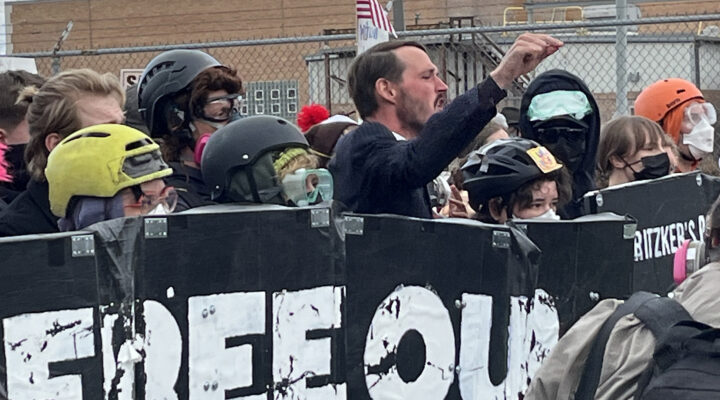
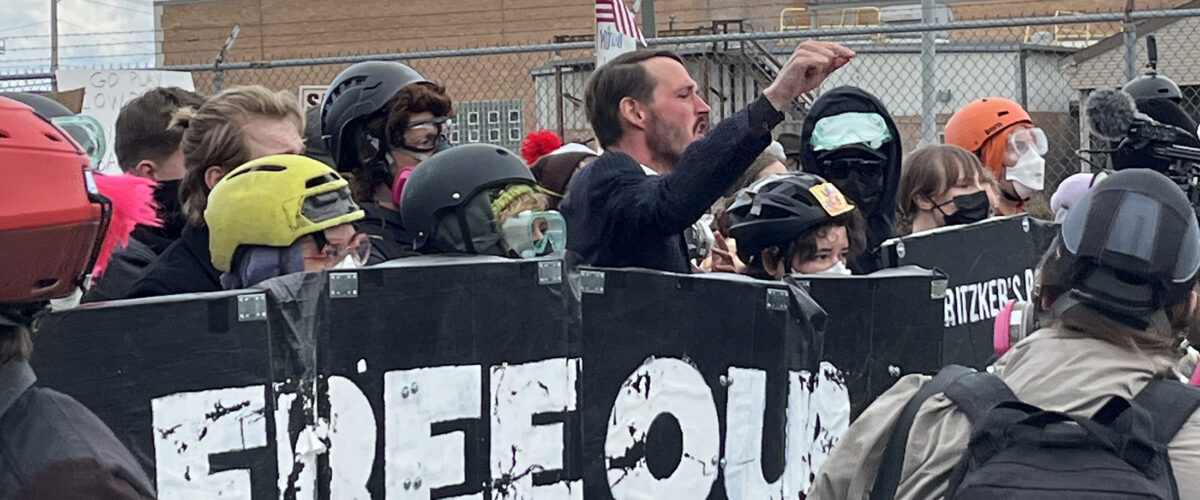
On Halloween, ICE agents carried out a number of raids in and around Chicagoland — including in Evanston, home of Lake Street Church, an Alliance of Baptist congregation. In response, Lake Street’s senior pastor, Michael Woolf, joined protests at the Broadview detention facility the next day.
As communities were celebrating All Saint’s Day and Dia de Los Muertos, Woolf — who is affiliated with the American Baptist Churches USA and the Alliance of Baptists and also serves as one of the associate regional ministers for the American Baptist Churches of Metro Chicago — marched alongside other clergy and parishioners at the facility.
What played out next has become a familiar sight: Illinois State Police in riot gear using truncheons to beat protesters back deployed chemical munitions on the crowd.
Woolf, who was wearing his clergy collar, was hit in the leg by a pepper ball.
He joins a long line of clergy who have, in recent weeks, been assaulted by militarized agents from ICE and state police.
Woolf’s interaction with Illinois State Police continues to raise two questions: 1) Who are the Illinois State Police protecting? And 2) What role to clergy have in this moment?
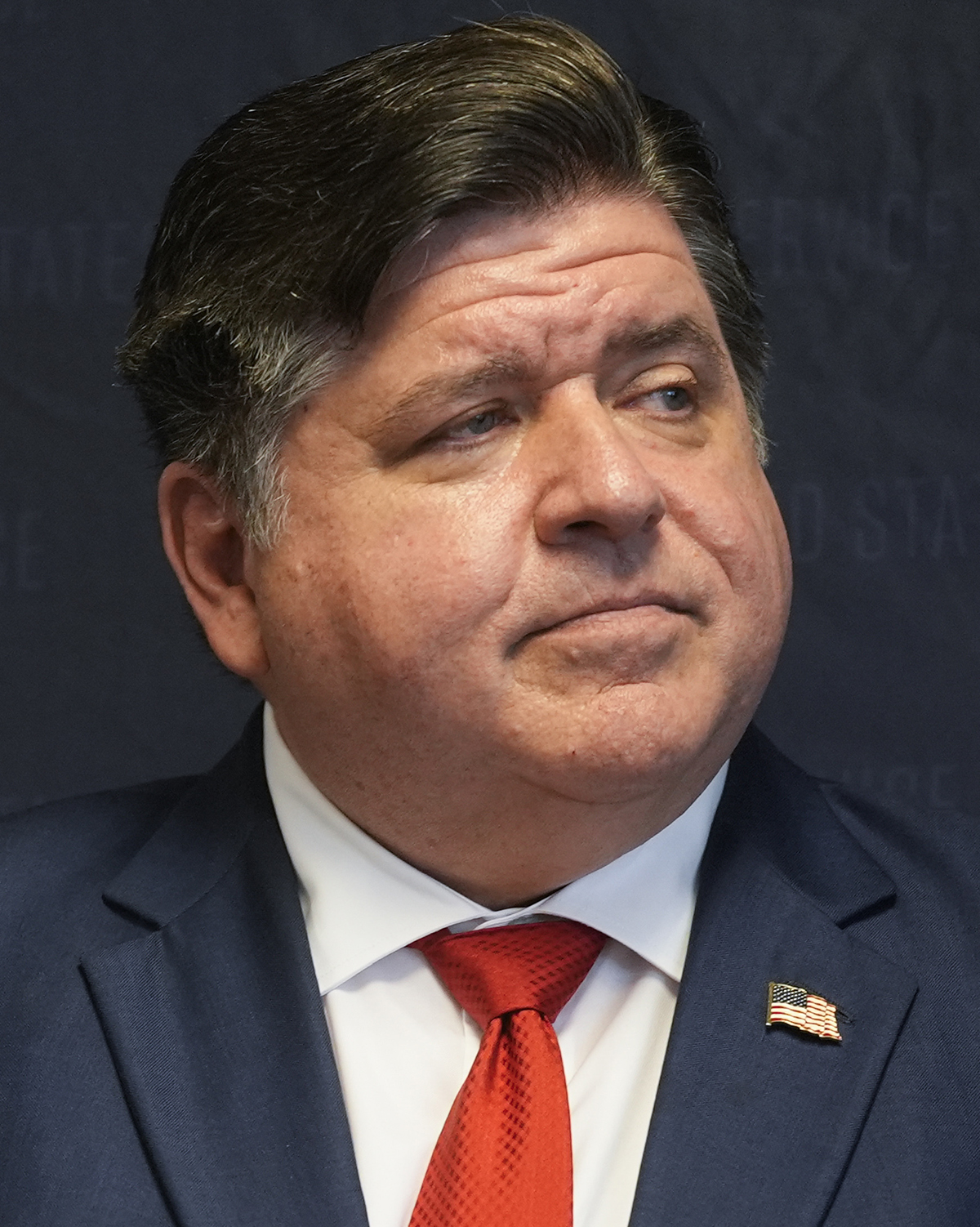
Illinois Gov. JB Pritzker (AP Photo/Erin Hooley)
According to Gov. J.B. Pritzker — a Democrat and a likely 2028 presidential candidate — the state police are there to protect protesters from ICE agents. Why then are the State Police utilizing the same violent tactics that lawless ICE agents are using?
I spoke with Woolf at length about his experience. Here is that conversation, edited for length and clarity.
Mara Richards Bim: Talk to me about Gov. Pritzker.
Michael Woolf: You know, he’s still quite lauded as sort of a liberal hero in some sense. But there’s a disconnect there because at the heart of this, his police are not protecting protestors.
It’s not like in Oregon. In Oregon, the state police actually tell ICE, “You can’t do that, and we’re going to arrest you if you violate these people’s rights.” In Illinois, instead of ICE violating our rights, the governor allows his to police to violate our rights.
I think it’s going to be a real problem for him when he runs for president, because there’s a lot of images and we’ve done a lot of work to sort of say that what’s happening there is wrong. It makes no sense.
Frankly, we are confounded. The people on the ground there are absolutely confounded about why Pritzker would allow this to happen.
MRB: Has he made any public comments about any of this?
MW: No, and he avoids it. I think he’s had some meetings with people like David Black — you know, he’s very high profile. But nothing’s come with that. No protections have come with that. I think there was supposed to be something about Illinois State Police are not supposed to use chemical munitions on us unless they’re threatened.
I’ll tell you what, people gathering and trying to express our First Amendment rights are telling them repeatedly: “We are no threat to you. We are not going to do any harm to you. We are completely peaceably assembled.”
I’m there in my collar, completely committed to peace every time. And, you know? They don’t care. These people do not care. There’s some officers in particular who are quite joyous to get in there and abuse people.

Border Patrol Chief Gregory Bovino of the El Centro Sector stands amid a protest outside an ICE facility in Broadview on September 27. Bovino, who recently spearheaded controversial immigration crackdowns in Los Angeles and Chicago, faces demonstrators voicing opposition to immigration policies. (Photo by Jacek Boczarski/Anadolu via Getty Images)
MRB: Is ICE visible? Was ICE visible during this?
MW: Yeah, they’re right behind the line smirking at us right behind the Illinois State Police.
MRB: Is there anything else you feel like you want to share from your faith perspective?
MW: Yeah. I think, for me, right now you never can have the benefit of history, but we know what’s happening there is torture. We know what’s there is a concentration camp, and we can understand that very clearly. And people of faith have to be willing to raise their consciences and take some risks.
For me, it’s really important to take some risks. While I’m in my clerical collar, it’s important because it’s not just about the public witness part. It’s actually healing for people to see the people who represent the church and represent God in public really care about this and that they’re not going to shrink from the violence. That they’re not afraid of what’s going to happen.
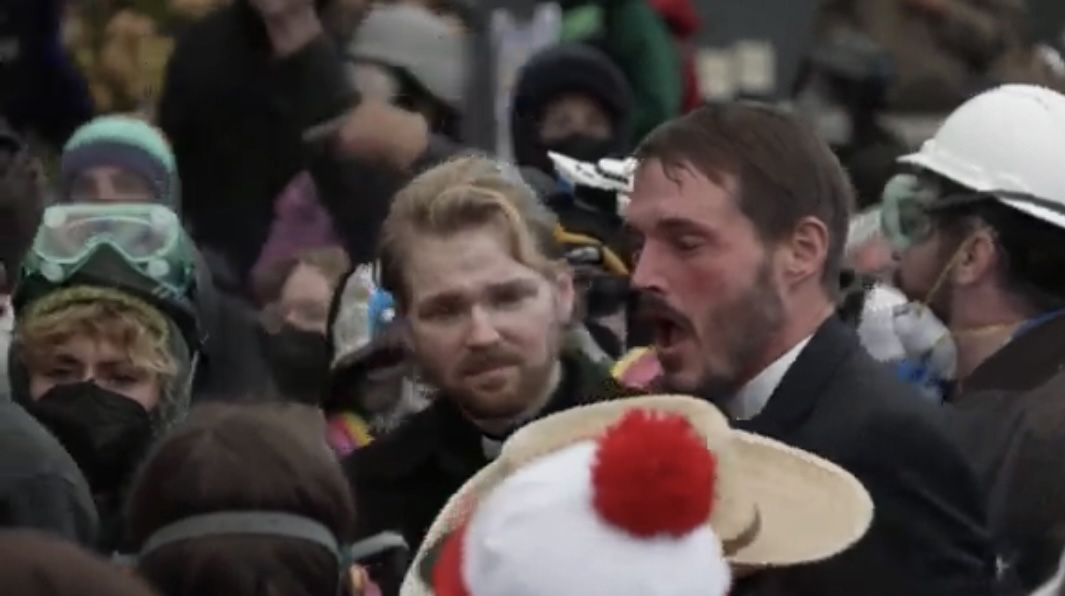
Michael Woolf (right) with David Black (left)
And it’s so important for us to gather there. We have to challenge dehumanization at every single point we find it as people of faith. It’s so vital that we do that.
History is not going to look kindly on what’s happening at Broadview. I firmly believe in 10 or 20 years, there’s going to be a plaque there for the people who resisted what happened at Broadview and people are going to really remember it in the same vein as the Civil Rights protests.
MRB: This brings up something for me. We’re wrestling this with this in Dallas, and I had a conversation with another clergy person about this today. For some reason, the clergy in the Dallas area — I don’t know why this issue is not the most important thing for them right now, but we are having a hard time getting clergy to commit to showing up regularly to these spaces. And there’s a handful of us that are, but I am just struggling to understand why it is not front and center. Any thoughts on that as another clergy person in a different space?
MW: Yeah, I have some thoughts on that. I think they (the government) — what they want to do is they want regular people to think it’s dangerous to go to these places. That you will get hit by pepper balls, that you could get arrested. And they want people to know there’s a cost to pay. And if you serve a purple church, for instance, there’s going to be a cost within your congregation, right? That there’s going to be people who say, “What are you doing?” At same time it’s about moving people and moving the needle on being willing to risk something.
What’s happening here is we’re in 1930s Germany in some respects. Not in others, but in some respects, I think we are. We’re in the middle of the Civil Rights movement. And there are a lot of people in civil rights — you know, 40, 50, 60 years on — people think it was great. But Martin Luther King Jr.’s approval rating was like 13% or something at the time he was killed. Now he’s a national hero.
“This is where people find out what kind of Christians you are. This is where people find out who you are.”
I think it’s just about communicating. This is where people find out what kind of Christians you are. This is where people find out who you are. Whether you’ve got spirit and courage and metal to meet the moment. And it’s vital that you be out there.
You have to be out there for your neighbors. You have to be out there for the people being kidnapped in your community, but you also owe it pastorally to people to say the church is relevant. It cares. Jesus Christ didn’t come to create a political social club where everybody felt comfortable. That is not why Jesus Christ lived and died.
And that it’s, it’s just about those conversations. You know, I think in Chicago there’s a lot more progressive clergy who are perhaps closer to saying yes to this kind of thing. But it takes persuasion. It takes people realizing the stakes and not sort of saying, “Well, I’m just going to turn off the TV because I don’t want to think about that right now.
MRB: So you are encountering some resistance — some clergy not willing to step forward out there?
MW: Of course. I mean, there’s people who are scared to go down to Broadview and I have those conversations all the time. But more and more people — the people I never thought would go down to Broadview — are going down to Broadview.
My church people are going down to Broadview and they’re a radical bunch, and that’s fine, but clergy I never thought would are too. I have the benefit that my church people love this so I don’t face those repercussions. But I have compassion for it.
At the same time, don’t get into this line of work if you lack moral courage. I’m sorry, but it’s a bad job to be in if you lack moral courage. It’s just a bad job for you. It’s not the right profession. It’s not the right calling. But there’s people who I never thought would say, “Yeah, you know, I want to risk arrest. I’m down. What’s happening there is evil.”
You know what? What we’re really fighting is — we’re fighting the Devil down there. There’s nothing more clear about it. Paul talks about how it’s not against flesh and blood, but it’s against the powers and it’s against the principalities. And it’s against those things very much so in Broadview and very much so in Dallas and wherever these concentration camps are.
It is that fight. It is at that level.