

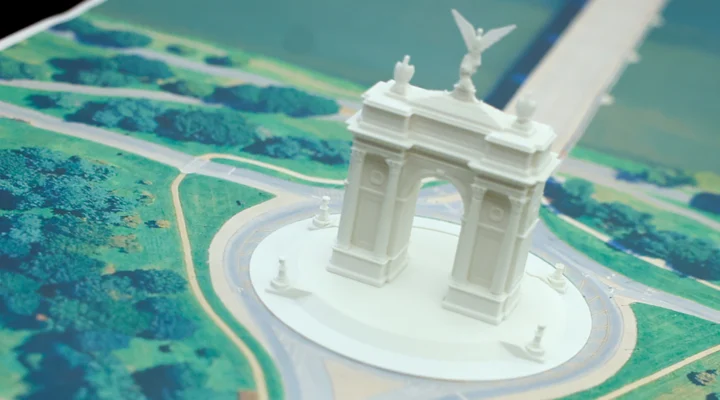

Authoritarian regimes use architecture to reshape what the public believes by saturating public spaces with political symbols, edifices and monuments. President Donald Trump’s plan to add a Roman triumphal arch to the Washington, D.C., cityscape near the Lincoln Memorial is not just an expression of his outsized ego, but a visual statement by MAGA intellectuals to lend authority to Trump’s actions and legitimize their white Christian nationalist agenda.
By cloaking this agenda in the classical architecture of the Founders, they strive to cast Trump as a “Red Caesar” and channel a white supremacist appropriation of ancient history. The president himself pushes the Roman imperial overtones even further with the construction of his extravagant ballroom.
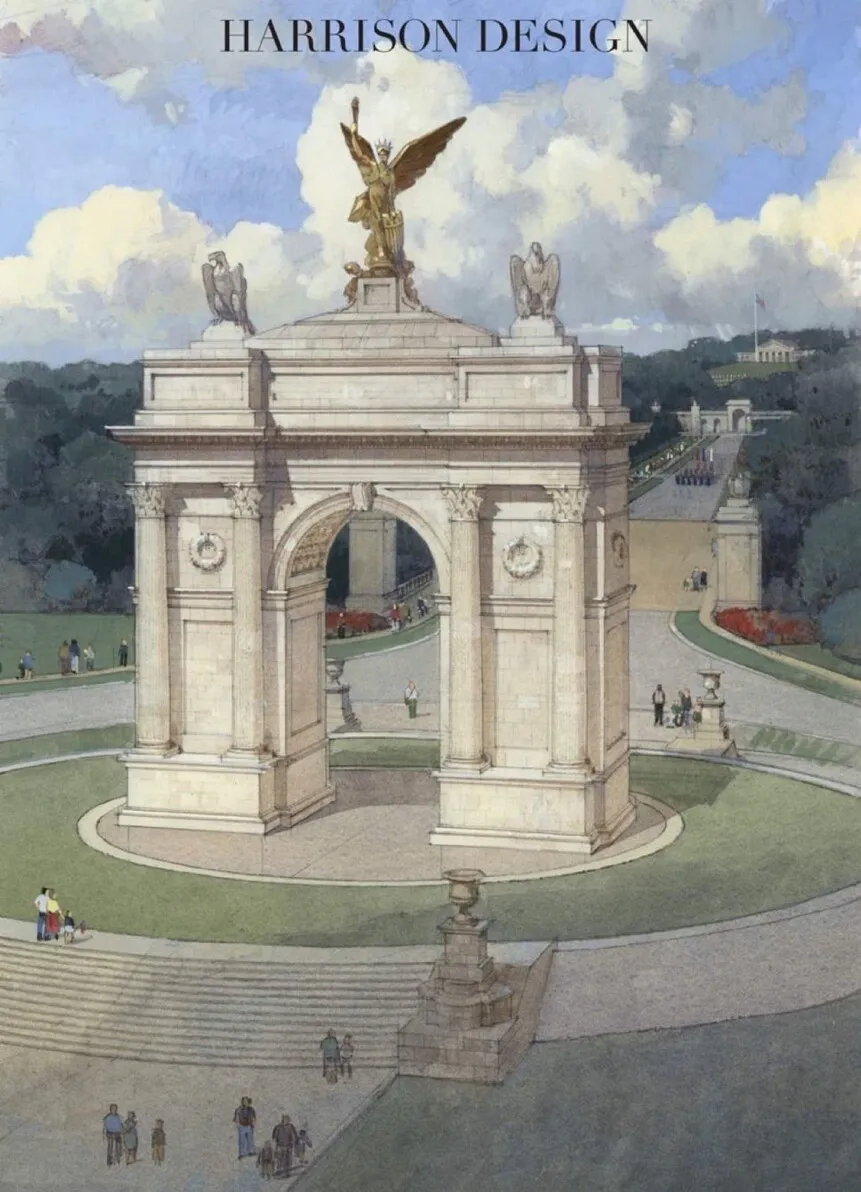
To commemorate the country’s 250th birthday, Trump has commissioned the building of an enormous triumphal arch in Memorial Circle, the roundabout in front of Arlington National Cemetery across the Potomac River from the Lincoln Memorial. The monument proposed by Harrison Design, an architecture firm known for its work for the Catholic Church, will stand at least as tall as the Lincoln Memorial and resemble the Arch of Titus in Rome. A gilded statue of the winged Roman goddess of victory, flanked by two eagles, will adorn the top.
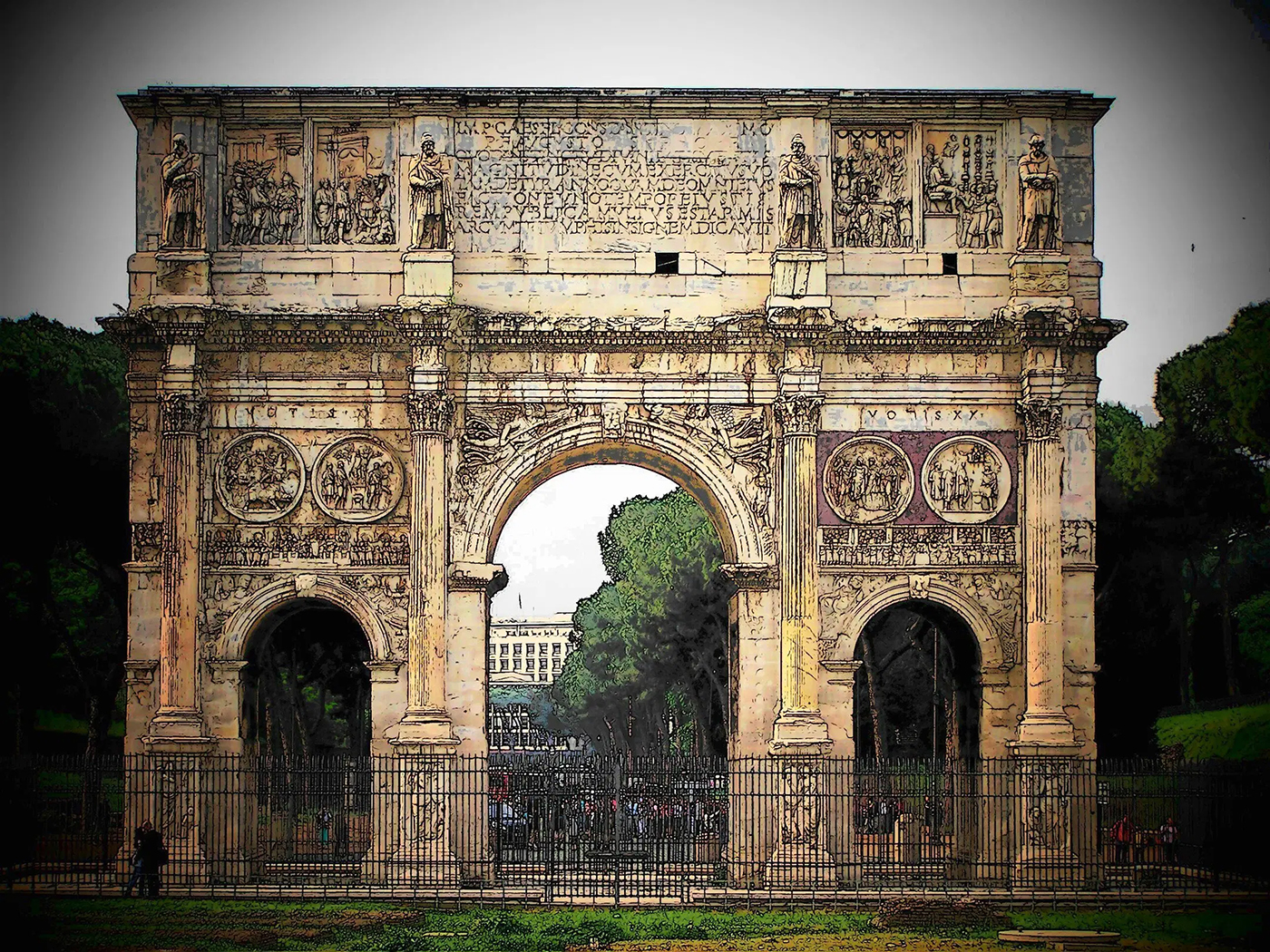
Arch of Titus
Also the inspiration for the Emperor Napoleon’s Arc de Triomphe in Paris, the Arch of Titus celebrates the general’s suppression of the Jewish revolt in 70 C.E. and depicts the looting of the Temple in Jerusalem. The Romans constructed triumphal arches across the empire to serve as imposing physical reminders of their military might and vehicles of imperial propaganda. Sculptures and reliefs on triumphal arches portrayed historical and allegorical events, scenes of battle as well as the general’s “triumph” or victory parade.
Not a new idea
While Trump certainly has no qualms about embracing his inner emperor, the triumphal arch for Memorial Circle originally was proposed by conservative architecture critic Catesby Leigh. In a December 2024 article for City Journal, followed by another in April 2025 in the Claremont Institute’s journal The American Mind, Leigh argued the president should issue an executive order to create a triumphal arch for the nation’s birthday. Triumphal arches, Leigh says, “enriched towns and cities across the Roman empire, from Spain to Syria.”
Just how “enriched” subjugated peoples felt under the boot of the Roman empire is not a question that concerns Leigh, who goes on to say America “has had enough of sackcloth and ashes, whether in the form of wokedom’s historically illiterate memes or modernism’s aesthetic anorexia.”
State monuments do not simply preserve the past, they amend and shape it into the contours of a ruling regime’s message. No doubt the carvings on Trump’s arch will continue the administration’s abandonment of inclusive narratives and will gloss over the unsavory elements of the nation’s 250-year history, such as slavery, misogyny, racism and jingoism. By directing the country’s focus on this sanitized version of the past, Trump’s own corrupt schemes also receive a coat of whitewash. As the country’s Antebellum plantations attest, classical architecture adds a veil of civility to even the most unspeakable horrors.
“Classical architecture adds a veil of civility to even the most unspeakable horrors.”
Because of its association with the institutional power of the Roman Empire, classical architecture long has been the tool of regimes seeking to assert their authority and project stability while simultaneously coercing compliance and overturning precedent. Both Hitler and Mussolini modeled their fascist building projects after those of the ancient Romans.
Trump and classical architecture
In August 2025, Trump issued the executive order “Making Federal Architecture Great Again.” It states that any new federal building, including U.S. courthouses outside Washington, D.C., must be constructed in the classical style of ancient Athens and Rome embraced by Founders like George Washington and Thomas Jefferson. While there’s nothing objectively wrong with classical or neoclassical architecture, when a government seeks to define what is legitimate and what is degenerate with regard to art, architecture and culture, it isn’t long before it begins to do the same with its people.
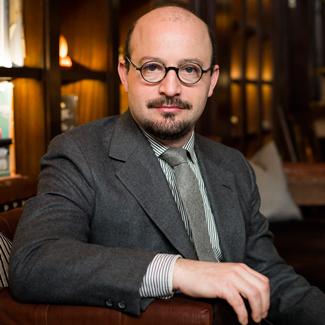
Justin Shubow
Trump’s executive order on architecture is the handiwork of Justin Shubow, former chairman of the U.S. Commission of Fine Arts in Trump’s first administration and current president of the National Civic Art Society. (Of note, Catesby Leigh is the founding director emeritus of NCAS, which was established in 2002.)
Defending the mandate for classical architecture while standing on the National Mall, Shubow said, “This is a city inspired by Ancient Rome — meant to be a new Rome — a timeless republic that will never die.”
It was Shubow who presented Leigh’s idea of a triumphal arch to a receptive president earlier this year. He has spoken at the National Conservatism Conference and made the rounds on MAGA-friendly podcasts like those of Ben Shapiro and Aaron Wrenn. Shubow aspires to be the administration’s new head of the National Endowment for the Arts.
Another who shares Shubow’s view of conservatism and classical architecture is NCAS board member Thomas D. Klingenstein. A New York billionaire, blogger, occasional playwright and fervent Trump supporter, Klingenstein is the chairman of the Claremont Institute. Having given the organization more than $19 million, he is the think tank’s largest individual donor. In 2024, Klingenstein donated $10.5 million to Republican campaigns and PACs. Believing multiculturalism is an “existential threat,” he delivered a speech at this year’s National Conservatism Conference in September titled “The Problem of Our Time: White Guilt.”
Klingenstein says the country is currently in a “cold civil war” between conservatives and “woke communists” and conservatives “need political generals who will fight as if the choice were between liberty and death.”
Red Caesar

Michael Anton
Claremont Institute Senior Fellow Michael Anton, who has served in both Trump administrations, echoed this life-or-death sentiment in his 2020 book, The Stakes: America at the Point of No Return. The book suggests that in our post-constitutional age, takeover by a right-wing Red Caesar might be necessary to save America from a dysfunctional deep state. Such a figure, he says, would come to power legally and then float the idea of running for a third term. If the courts objected, this Caesar would quote Andrew Jackson and tell them, “You’ve made your ruling, now let’s see you enforce it.” This is, of course, precisely what Vice President JD Vance encouraged Trump to say to any court that opposes him.
Vance also has pushed the narrative that the country is “in a late-republican period,” a time of factionalism, extreme wealth disparity and civil war that preceded imperial rule in Rome. It was then that Julius Caesar, fearing retribution by his political enemies, defied the Senate and led his legion across the Rubicon River to seize control of Rome through a military coup. Alluding to this event, the white supremacist group Patriot Front posted on its website in 2017: “The time of the Republic has passed in America. … Democracy has failed. … Now the time for a new Caesar to revive the American spirit has dawned.”
That same year, marchers at the Charlottesville “Unite the Right” rally brandished flags depicting symbols of the Roman Empire.
The culture of ancient Greece and Rome has sadly become synonymous with white nationalism in many conservative circles. In the weeks prior to the January 6 attack, Trump’s supporters compared him to Julius Caesar, and on the day of the insurrection, participants held signs with Trump’s head superimposed on the body of the protagonist of Gladiator, a favorite film of white supremacists.
The signs encouraged Trump to “Cross the Rubicon” and stage his own military coup to stay in office. Other rioters at the Capitol dressed up as Roman soldiers or as Greek Spartans from the movie 300, another Hollywood film coopted by white supremacists.
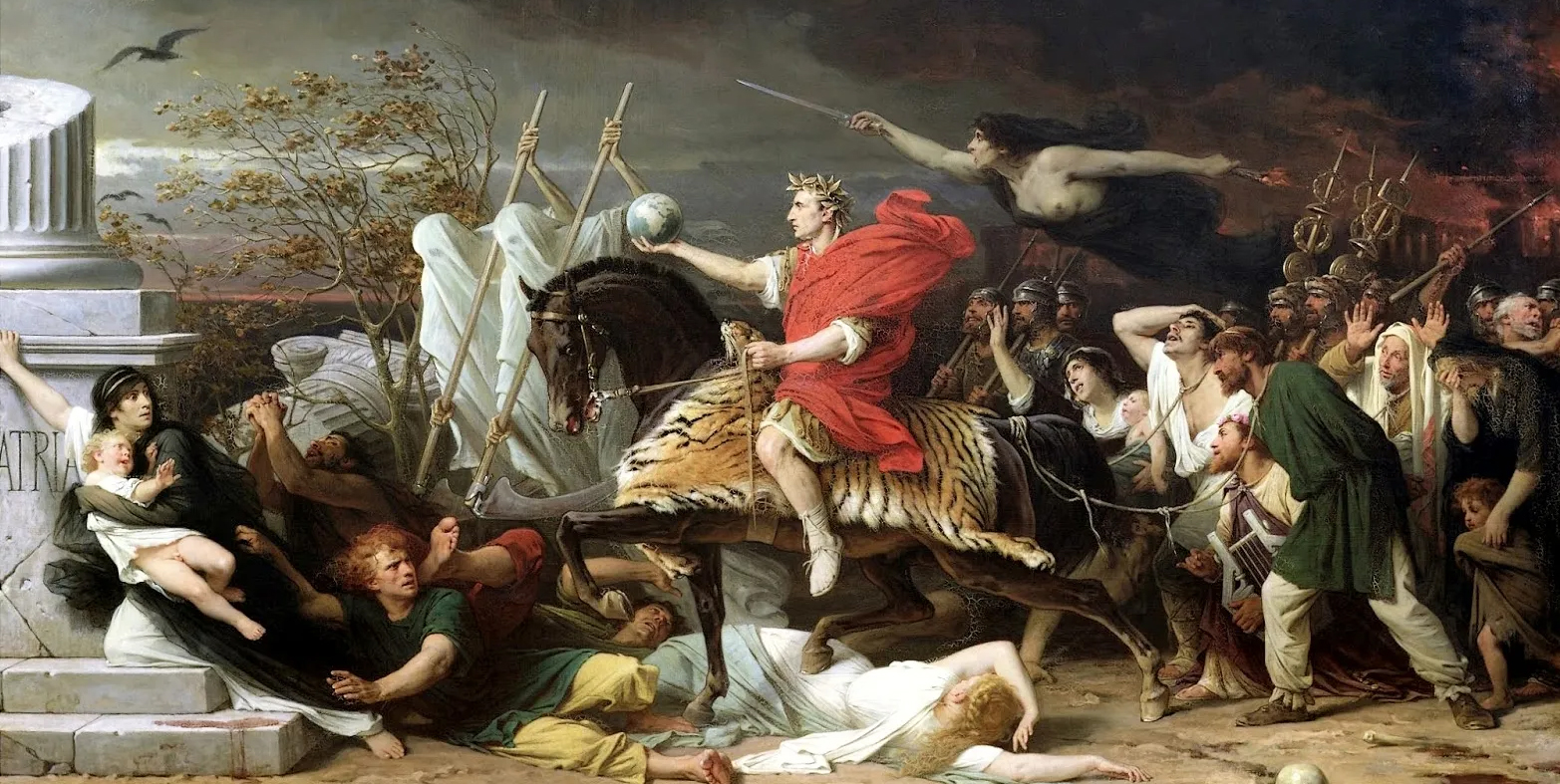
“César franchit le Rubicon” by Adolphe Yvon (1875). Public domain, via Wikimedia Commons.
Just recently, outspoken antisemite Nick Fuentes told Tucker Carlson he sees negativity toward the ancient Roman Empire, and specifically the Arch of Titus, by contemporary Jewish people as evidence that they are hostile to Europe and unable to assimilate.
Both MAGA foot soldiers and the apologists at the Claremont Institute are hard at work propagating the myth that the ancient Greeks and Romans were white and their cultural and military achievements evidence white superiority. Nothing could be further from the truth.
The ancient world was a diverse place, the Roman Empire especially so. Roman citizens were Greek, Syrian, Judean, Gallic, German, Spanish, Numidian, Nubian, Ethiopian and Egyptian. Shubow’s beloved fluted columns graced Egyptian temples long before the Greeks installed them in their own. The stark white marble statues and reliefs, revered for their reflection of racial whiteness, originally were kaleidoscopes of color and pattern, including those on the Arch of Titus.
Although Steve Bannon delivers his podcast alongside a bust of Julius Caesar, what the right really wants, according to alt-right blogger and financial enabler Charles Haywood, is a Red Caesar in the mold of Caesar Augustus who will implement authoritarian rule and radically transform governing and cultural institutions. Julius Caesar’s great nephew and adopted heir, Augustus, was a master of propaganda who installed himself as a dynastic autocrat, all while speaking of the restoration of the Republic. In addition to self-aggrandizing architecture, including several triumphal arches, Augustus worked to win over Roman hearts and minds by restoring temples, improving public facilities and making performative donations from his great personal wealth.
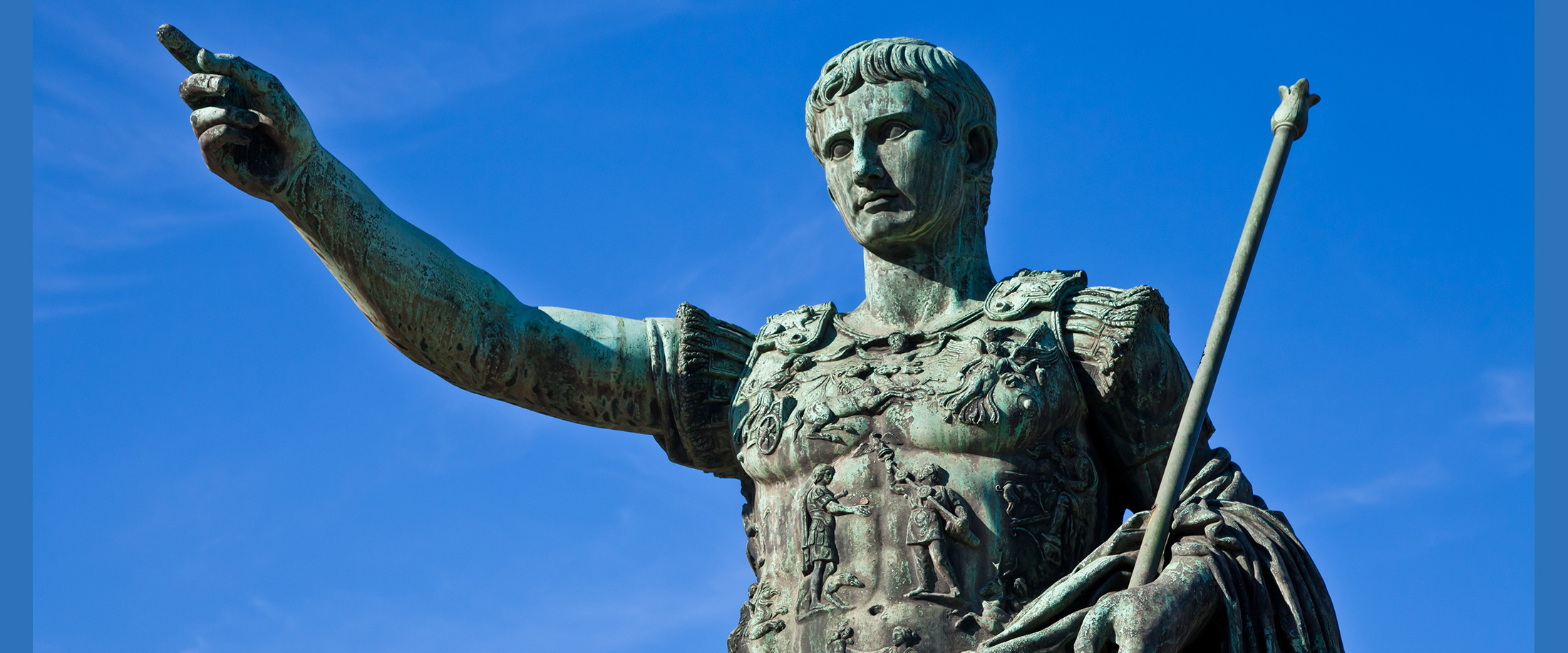
Gaius Julius Caesar (123rf.com)
Augustus connected himself to the mythic narrative of Rome’s founding and subsequent glory in much the same way Trump’s executive order seeks to situate his presidency with the likes of Washington’s and Jefferson’s. However, this is where the similarity ends.
Haywood, who “loves the idea of a Red Caesar, an Augustan system,” laments that Trump is too undisciplined for the role. He and the Claremont Institute hoped for an Augustus who would lead them into their new golden age. Instead, Trump embodies the excess, corruption and cruelty of Nero.
Draining the swamp
The great-great-grandson of Augustus, Nero came to power promising to drain the Roman swamp, only to wallow in it. He was susceptible to flattery, demanded loyalty from office holders and bribed Olympic judges to award him the winning crown. Nero lived extravagantly, as did the aristocracy, which grew wealthier under his reign. However, according to the ancient biographer Suetonius, “There was nothing in which he was more ruinously prodigal than in building.”
When a catastrophic six-day fire decimated parts of the city and destroyed his new palace, Nero confiscated the land where private homes, sacred temples and civic monuments had once stood to construct a new, even larger villa. His “Golden House” was an edifice that would make Trump envious with its gold leaf-covered walls. For the entrance of his Golden House, the emperor commissioned a colossal gold-plated statue of himself. The work was so large it could have stood eye to eye with the Statue of Liberty.

US President Donald Trump and Crown Prince and Prime Minister Mohammed bin Salman of Saudi Arabia during a bilateral meeting in the Oval Office of the White House on Tuesday November 18. (Photo by Demetrius Freeman/The Washington Post via Getty Images)
Trump is rapidly turning the White House into his own Golden House. He’s already gilded the Oval Office, emmarbled the Lincoln Bathroom, and paved over the Rose Garden to transform it into the “Rose Garden Club” where, like Nero on the lyre, Trump DJs for captive diners.
Yet, the president’s most significant addition to the White House will be his ballroom. In contrast to the sesquicentennial triumphal arch designed to position Trump as a Red Caesar representing the ideals of the Roman Republic and the founders, the 90,000-square-foot ballroom is Trump’s attempt to eclipse his predecessors and remake the presidency in his own image.
Twice the size of the historic White House, the bloated, baroque ballroom designed by architect James McCrery barely masks the excess of Trump with a classical façade. Since it disrupts the classical balance of the White House, one wonders if it would pass Trump’s executive order if anybody dared to pursue the matter.
 McCrery, who believes modernist architecture is “ungodly” and “counter to God’s creation,” also was co-founder and former board member of the NCAS. Trump appointed McCrery to the U.S. Commission of Fine Arts during his first term, along with Shubow.
Without review from the Commission of Fine Arts, the National Capital Planning Commission or even an asbestos inspection, Trump demolished the East Wing of the White House. He told Republican senators, “You probably hear the beautiful sound of construction in the back. … When I hear that sound, it reminds me of money.”
And no wonder. In possible violation of the Anti-Deficiency Act, the ballroom is being bankrolled by private businesses and individuals hoping to curry favor with the president. Construction of the $350 million ballroom has not even begun, and yet the cost continues to rise, perhaps to accommodate more donors.
Donors to the Trump ballroom include the usual suspects: Apple, Amazon and Meta (all of whom have antitrust cases pending), Microsoft, Booz Allen Hamilton, Palantir and Lockheed Martin (who would like to keep their lucrative government contracts), Comcast and T-Mobile (who have mergers on their minds), investment giant BlackRock (who wants a piece of the Panama Canal), TikTok’s Jeff Yass (who wants to keep the app in the U.S.) along with several sketchy crypto companies. Google also is donating $22 million to the ballroom as part of a legal settlement.
Sen. Elizabeth Warren and House Member Robert Garcia are proposing a bill that would end what Warren calls “bribery in plain sight” by requiring disclosure of the amounts donated and the names of those who remain anonymous. However, Trump is unlikely to sign such a bill.
To pay for his Golden House, Nero taxed the Eastern provinces of the empire and skimped on the silver in the denarius, which weakened the currency and caused inflation. Grain prices also increased. However, instead of shipping more grain from Alexandria, Nero used the barges to import sand for his private wrestling arena. Burdened by the downturn in the economy and incensed over Nero’s property seizure, Rome’s residents accused him of purposely setting the fire.
“Burdened by the downturn in the economy and incensed over Nero’s property seizure, Rome’s residents accused him of purposely setting the fire.”
In response, he shifted the blame to a group of immigrants from the East. Distrusted by the populace and viewed as a threat to the empire, Christians proved easy to scapegoat. Motivated by cruelty more than public welfare, Nero rounded up believers, charged them with arson and burned them alive to illuminate late-night banquets at his Golden House.
At present, Trump is touting the ballroom as a “gift to the American people.” However, polls show most people oppose the addition of a ballroom to the People’s House. They would prefer the president turn his attention to affordability. In one October poll, 71% of American adults reported spending more on groceries than they did a year ago. In addition, 59% blame Trump for the current increase in inflation.
Without the renewal of ACA subsidies, health care costs also are projected to rise in the U.S. While these prices are increasing, the aid available to help families in need is decreasing. Trump’s “Big Beautiful Bill” cut $186 billion in funding for SNAP over the next decade, cut more than $1 billion from WIC and eliminated the Low-Income Home Energy Assistance Program. The bill also provided $45 billion for what will be the president’s most expensive and most totalitarian construction project: new immigration detention centers.
Authoritarian architecture invades public spaces and imposes the state’s message in a manner that brooks no discussion. However, in a democracy the people can still critique, reinterpret, revise or remove statuary that no longer reflects their values. Many communities in America have torn down Confederate monuments celebrating white supremacy.
Even the Roman elite eventually grew tired of Nero’s greed. After his forced death, his successors razed Nero’s Golden House and repositioned and remade his giant gilded statue into one of the god Sol. Some Democrats have proposed knocking down Trump’s ballroom once he leaves office. That may well be possible. Reversing his decimation of the federal government will prove more difficult. Authoritarianism itself is always harder to remove than architecture glorifying it.
Kristen Thomason is a freelance writer and journalist living outside Edinburgh in the United Kingdom. She has produced educational and promotional media for national and international religious organizations and public television. Kristen also worked with local churches in Metro D.C. and Toronto, Canada. With a master’s degree in communication and undergraduate degrees in media studies and classics, she is interested in the intersection of politics, religion, history and the arts.