


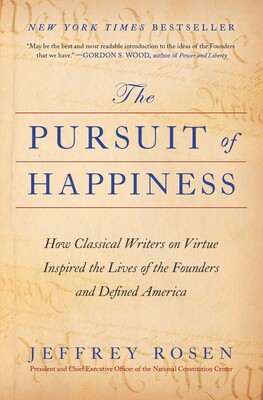
Jeffrey Rosen is president and CEO of the National Constitution Center, professor of law at George Washington University, and the New York Times bestselling author of The Pursuit of Happiness: How Classical Writers on Virtue Inspired the Lives of the Founders and Defined America and the new The Pursuit of Liberty: How Hamilton vs. Jefferson Ignited the Lasting Battle over Power in America.
Greg Garrett: This is not your first Pursuit book. The earlier book addressed the pursuit of happiness and the larger question: What is happiness? I was listening to a conversation you did with The Atlantic. One of the things I loved about that conversation was you were talking about John Quincy Adams, whom you described as the most important founder.
In the new book, we’re talking about Jefferson and Hamilton — John Quincy Adams doesn’t come up all that often. There’s no John Quincy Adams musical, to the best of my knowledge. So I wonder if you could talk a little bit about that earlier book and why you thought of John Quincy Adams as somebody so essential?

Jeffrey Rosen
Jeffrey Rosen: Well, in The Pursuit of Happiness, I think I said John Quincy Adams wasn’t the most important founder, but he was the most virtuous founder, the founder who struggled the most mindfully to use his powers of reason to overcome his passions and emotions so he could achieve the calm tranquility that defines justice and the connection to the divine, that defines the pursuit of truth, at least in the Classical and Enlightenment sense.
Quincy is raised by his parents, John and Abigail Adams. They’re constantly exhorting him to master himself, to devote himself to self-improvement and character improvement. It creates a constant sense in him that he’s making a hash of things and not fulfilling his potential. He upbraids himself for squandering time and for failing to end war and slavery, a very high bar he sets for himself.
He then suffers two great tragedies. He loses his reelection for president of the United States in 1828, and in the following year, his son, George Washington Adams, dies by suicide because he can’t take the pressure from his dad. Quincy uses this for deep spiritual growth and introspection.
He spends a year rereading Cicero’s Tusculan Disputations, the book that inspired Franklin and Jefferson (and all the Founders really) to define happiness as being good, not feeling good, the pursuit of virtue rather than immediate pleasure, and then he sponsors a constitutional amendment on slavery and opposes the gag rule that forbids the reading of abolitionist petitions.
He dies on the floor of Congress, murmuring, “I am composed,” a phrase he gets from Cicero himself about how the perfect self-composed man is the one who’s achieved virtue. So he’s a remarkably symmetrical and mindful and inspiring example of self-mastery, praised by Frederick Douglass as the greatest white abolitionist of his age.
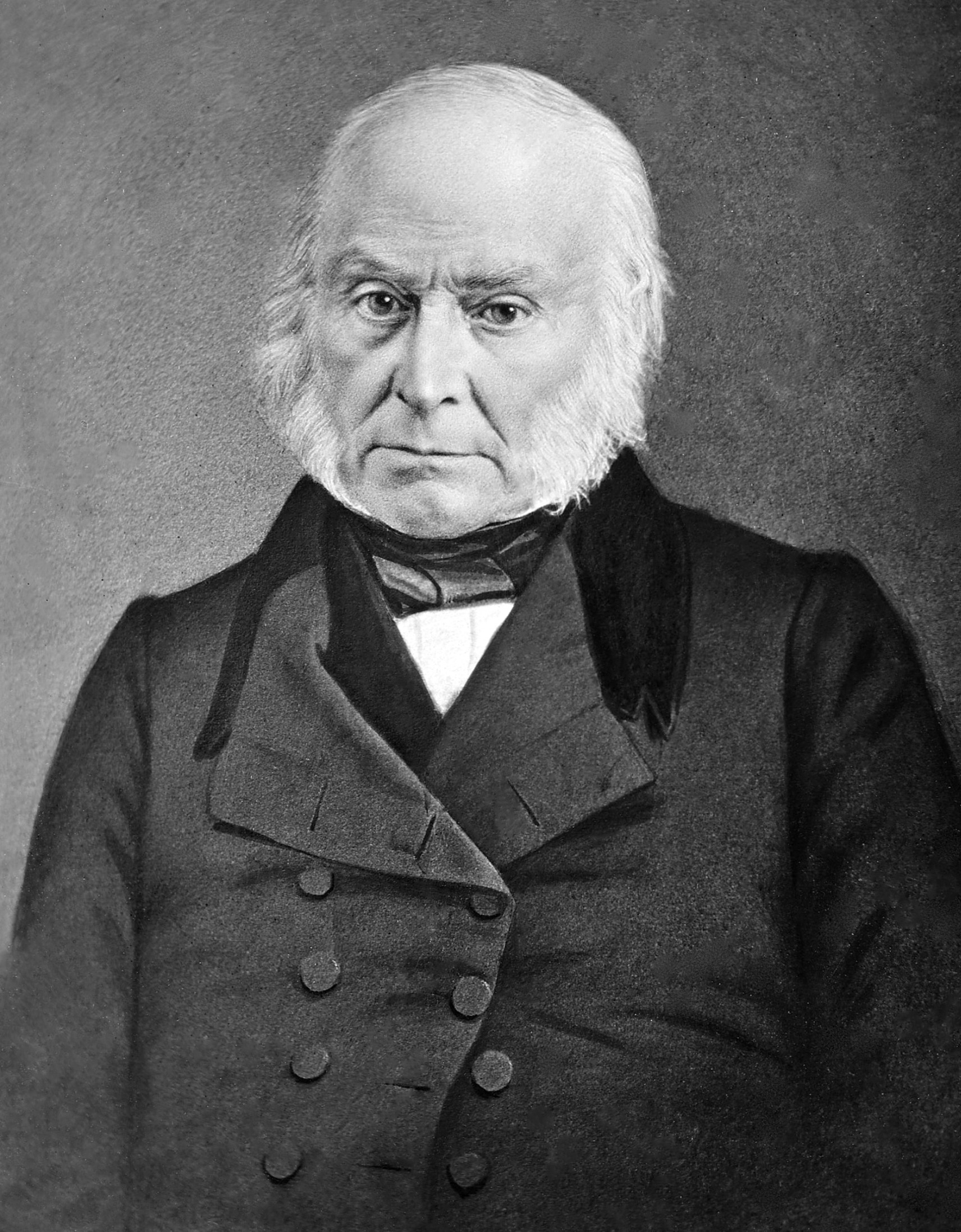
John Quincy Adams (Wikipedia)
He does feature in the sequel The Pursuit of Liberty, since Quincy Adams, among American historians, was the first to trace the battle of America’s first political parties back to Hamilton and Jefferson’s battle between national power and states’ rights, and he does that in his “Address on the Jubilee of the Constitution.” He’s the first of historians who also happened to be president to trace our politics back to that essential battle.
It was Quincy Adams and Martin Van Buren who inspired me to look at other historians who’ve described the battle, and it turned out that at crucial turning points in American history, historians, often bestselling historians, have redefined the relative stature of Hamilton versus Jefferson by deep writing about history. That kind of sparked this most recent book.
GG: One thing I took away from the new book is the idea that this rivalry we see dramatically depicted in Lin Manuel Miranda’s Hamilton is America’s political origin story, played out across the generations. In your chapters, you’re looking at people leaning into Jefferson or leaning into Hamilton over the years. I am wondering if you could maybe summarize for my readers what you find most compelling in Jefferson and from Hamilton?
JR: Well, the most salient features of each of them are some basic battles over the relationship between liberty and power. Broadly: For Jefferson, every increase in power threatens liberty, but for Hamilton, increases in power can help to secure liberty. It plays out in the philosophies of Hamilton and Jefferson across a couple of different axes. There’s the battle between national power and states’ rights. There’s the battle between democracy versus rule by elites. There’s the battle between executive power versus judicial power, and the battle between liberals versus strict construction of the Constitution.
“It really is the battle that explains everything.”
Those essential battles, which have been traced back to Hamilton and Jefferson, turn out to define not only our political history, but also our intellectual, constitutional, economic and social history. It really is the battle that explains everything. Now, what makes it such a useful framework for all these different battles is that the categories are so incredibly malleable, and both Hamilton and Jefferson are Protean figures who can be invoked on behalf of any position you please.
Throughout American history, politicians and justices and citizens have invoked either Hamilton or Jefferson to justify their political positions, and often the images cross, and sometimes they switch, and sometimes they flip. But they’re the eternal and enduring framework, and that’s what makes them such a great framework for a book.
GG: One of the things they had in common was their fear and distrust of the idea of a demagogue. The New York Times editorial board wrote a piece talking about the Trump administration. Here’s their sentence that resonated with me in the context of your book: What is going on in the Trump administration “is an expansion of presidential power and a weakening of the legislature that should alarm anybody who shares the American Founders’ suspicion of centralized power.”
JR: Well, as you say, both Hamilton and Jefferson feared demagogues, and Hamilton fears the Julius Caesar, who will arise from below, flattering the masses and persuading them to exchange their liberties for cheap luxuries, and then will consolidate power and set himself up as a dictator. Jefferson fears the Caesar-like character who comes from above and crosses the Rubicon and imposes military dictatorship by persuading the Senate to abandon its prerogatives and consolidating power in his own hands.

Aaron Burr (Wikipedia)
Both believe they found such an embryo Caesar, as Hamilton put it, in Aaron Burr, whom they rightly suspected of trying to lead a secessionist movement in Spanish Louisiana and set himself up as Emperor of Mexico. So Burr is the emblem of the embryo Caesar, who calls off democratic elections and wants to install himself as a king.
They disagree about the nature of executive power. Hamilton’s solution is a life term for the president, so he won’t be tempted to flatter the people and will tend to the common good. Jefferson wants a one-year term limit. In the end, there are no term limits, because Jefferson ends up as president, following Washington’s example, in stepping down after two terms.
Both Hamilton and Jefferson fear demagogues and believe in the separation of powers and don’t think all power should be consolidated in the president. But the consolidation of power in the president precedes Donald Trump. It was during the Progressive era that Woodrow Wilson and Theodore Roosevelt both defended the idea of the president as a steward of the people who could directly channel popular will, and the presidency begins to be transformed into what Arthur Schlesinger called the Imperial Presidency, which dwarfs the other branches. Then further structural changes in the 1980s and 1990s led Congress to become supine and to stop checking presidents of its own parties, which was neither Hamilton’s nor Jefferson’s view or hope.
GG: In reading your book, I was particularly interested to learn the connections between Hamilton and Judaism. Also, some years ago I was at the Library of Congress and I saw the Jefferson Bible, where he took the scissors to every part where there were miraculous or supernatural elements. Could you talk about Hamilton and Judaism, Jefferson and the Jefferson Bible and the larger question about where faith and politics fit together these days?
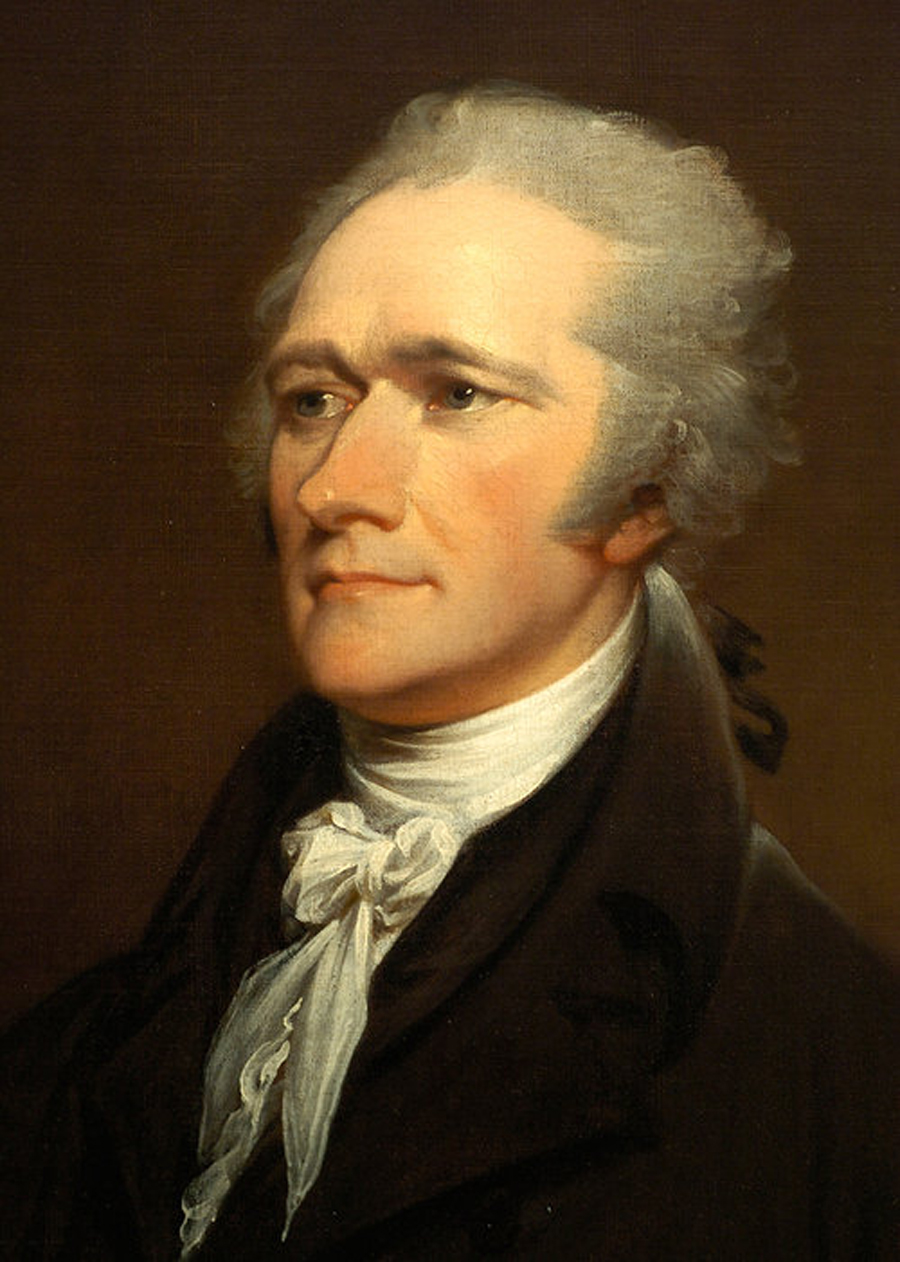
Alexander Hamilton
JR: What a fascinating and important question. It’s true that Hamilton may have been Jewish. Andrew Porwancher notes his mom married a Dane who probably was Jewish and she may have converted to marry him, and that’s why Hamilton attended a Jewish school on Nevis. If she did convert, then Hamilton would have been considered Jewish, which might explain why he didn’t take Communion and didn’t conventionally observe organized religion until his deathbed.
Jefferson was a deist who believed in the moral teachings of the Christian Bible but not the divinity of Christ and miracles, and viewed the pursuit of happiness as an obligation to align with divine reason, and thought there was a complete compatibility between faith and reason. In terms of how it shaped their positions about government, we have to think about freedom of conscience. Here, Madison is the crucial figure along with Jefferson.
Jefferson and Madison considered conscience to be an unalienable right, the first of the unalienable rights or liberties recognized by the Declaration of Independence. The first object of government, Madison said, is to protect freedom of conscience. He means not only the rights of private judgment in matters of religion, but he thinks public opinion has to be refined and enlarged in conversation with government by discussion, and he says, along with Jefferson, truth has nothing to fear from error as long as reason is free to combat it. He gets that from John Milton (Areopagitica), who they both read.
Milton is reacting to an older version of truth, the view of St. Augustine and Thomas Aquinas. Truth is produced by deference to authority, to kings or popes or priests, and divinely revealed reason is the property of a select few, and everyone else has to defer to them. Milton disagrees and says truth can only be produced in combat with error, and Madison and Jefferson embraced that.
 Madison and Jefferson believe it’s only in conversation with others, by testing our private opinions, that we can arrive at religious truth as well as political truth. They see a complete compatibility between faith and reason. But it’s a view that the state should not monopolize religion and theocracy should be banned.
Where does Hamilton stand on this? Jefferson and Hamilton were both religious liberals who believed in freedom of conscience and religious pluralism, and they ultimately enshrined that in the Constitution.
GG: What is exciting you when you get out of bed in the morning?
JR: During COVID, I started on this unusual COVID-era reading project to read the moral philosophy that inspired the framers. And I spent a year following Thomas Jefferson’s schedule, waking up two hours before dawn, reading moral philosophy, watching the sunrise, writing sonnets to sum up the wisdom and then going on with my day. This transformed my life.
It changed how I think about how to be a good person and a good citizen. I came to understand that for the Founders, happiness was being good, not feeling good. But my takeaway from the project is to develop new habits of deep daily reading in the morning. And I now have a rule that when I wake up, I have to read books before I browser surf, and it’s been a total life-changer.

Greg Garrett
Greg Garrett is an award-winning professor at Baylor University, where he is the Carole McDaniel Hanks Professor of Literature and Culture. One of America’s leading voices on religion and culture, he is the author of 30 books, most recently the novel Bastille Day and The Gospel According to James Baldwin: What America’s Great Prophet Can Teach Us about Life, Love, and Identity. He is currently administering a major research grant on racism from the Eula Mae and John Baugh Foundation and finishing a book on racist mythologies for Oxford University Press. Greg is a seminary-trained lay preacher in the Episcopal Church and Honorary Canon Theologian at the American Cathedral of the Holy Trinity in Paris. He lives in Austin with his wife, Jeanie, and their two daughters.
Related articles:
Understanding our imperial president’s triumphal architecture | Analysis by Kristen Thomason
The First Amendment is for we, not just thee | Opinion by Mark Wingfield