

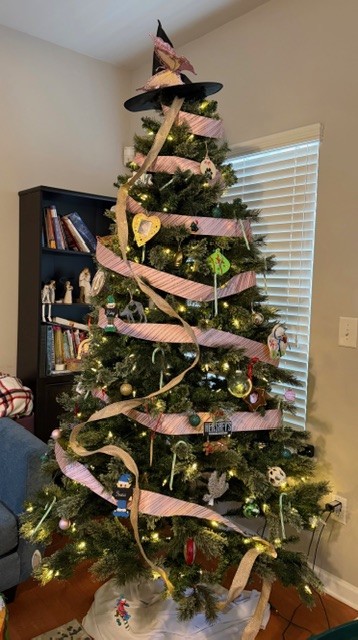
An unconventional Christmas tree sits in our living room this year. Sparkly pink trimming wraps around its breadth. Green and white striped candy canes hang from the branches, and twinkling jade lights glow in their midst. A thin gold ribbon winds from the floor to the top like the yellow brick road until it ends at the climactic tree-topper: A black witch’s hat adorned with a pink butterfly.
Our family wanted to design a Wicked themed tree, in honor of one of our favorite musicals turned movies that came out this holiday season, and so we did.
 I love the tree, but as a former evangelical, my overly tuned conscience pinged me as I thought about how some Christians would condemn our Christmas decorations as inappropriate, blasphemous even.
“Christmas should be holy, not wicked,” they might say. I can almost hear their accusations: “You are a Bible professor and preacher, and you’re taking the Christ out of Christmas. Shameful!”
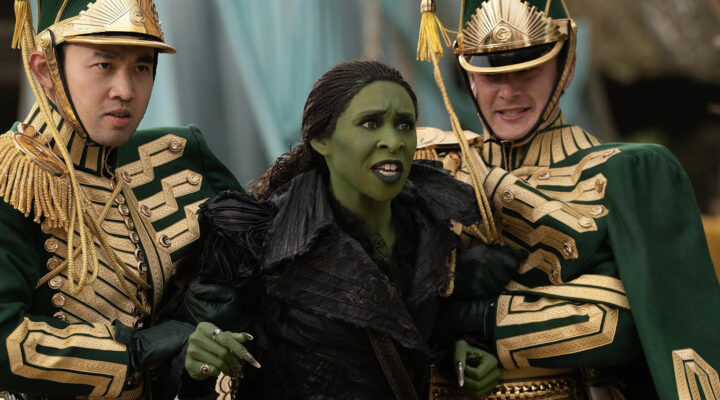
I have a ready answer for my would-be critics if they come at me, though. The story of Wicked is not anti-gospel or anti-Christ at all. It’s a scapegoat story, and that makes it a story about Jesus and about the incarnation.
René Girard, a French philosopher who developed Scapegoat Theory over his many years as a scholar of religion, argues that scapegoating is a practice almost all societies since ancient times have practiced. It is a hidden, sometimes unconscious, ritual that focuses the simmering violence of a society onto a singular victim or people group, usually people considered as “others” or outsiders. When a community accuses that victim, turns against them and eventually kills or expels them, it brings temporary peace to the community.
More often than not, scapegoats are innocent of the crimes they are accused of, but the community does not realize it. They believe in the guilt of the scapegoat because to accept the victim’s innocence would make them face the evil in which they are complicit, the violence that throbs at the heart of human society.
Scapegoating in Wicked and America
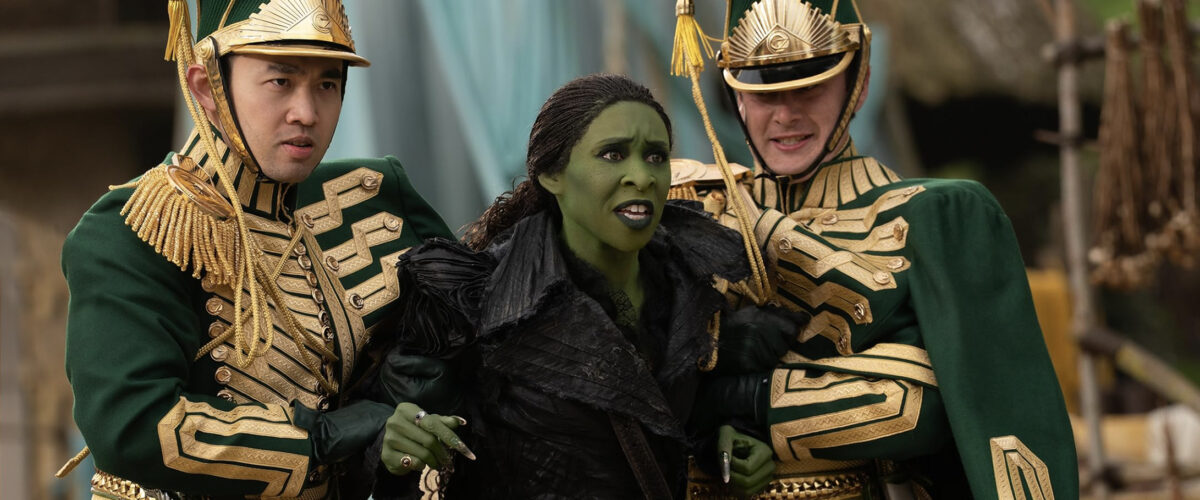
There’s no denying that Wicked: For Good is a story about scapegoating. Elphaba is a political scapegoat, targeted by the Wizard and Madame Morrible and blamed for the ills of society. Those in power instigate an honest-to-goodness witch hunt against her, intent on deflecting attention away from their fascist and oppressive policies against Ozians.
The talking animals receive the scapegoating finger as well when they are accused of violence and corruption by the government, which had been depriving them, slowly and systematically, of their rights, their status in society, even their literal voices.
This strikes a chord of grief and familiarity in American audiences when these scapegoats must flee Oz for safety rather than fight against the pervasive injustice in their community.
The movie’s comparisons between the treatment of Elphaba and the animals and the plight of refugees and immigrants in Trump’s America make it a story that draws attention to the suffering of innocent scapegoats. But a deeper level of anti-scapegoating work weaves its way through Wicked: For Good, one that reveals itself when we understand how the scapegoating cycle functions and how it has continued in history.
One of the key moves in the scapegoating process is when people with power — those in the center of society who often are complicit in corruption — accuse people on the periphery of a culture’s gravest taboos. Such accusatory campaigns usually occur during times of change or trauma, and it benefits the people in power because it deflects negative attention and criticism from them. They time their scapegoat accusations to appeal to the human craving for stability amid the storm.
“They time their scapegoat accusations to appeal to the human craving for stability amid the storm.”
It’s magisterial sleight of hand. Don’t look at this hand—look over here at this horrible person! They are the source of your problems (not us!). Then, when the populace turns their heads to the scapegoats, they become blind to the corruption of the people and structures that have exacerbated innocent suffering or even caused it to begin with.
The scapegoating cycle
A long-running example of this sleight of hand can be found in the witch hunts of Medieval Europe and Colonial America. The scenario often followed this pattern: A community faced a time of trial, unwelcome change or tragedy (think plague or drought or political upheaval), the tension and fear in the community would escalate, and then leaders in the church would find independent women who did not conform to the patriarchal norms and accuse them of abhorrent practices, like sorcery or sexual deviance with the devil. Such accusations would then rile up a community to form a mob, and the perverse woman (or women) would face execution.
After the purging death, tension in the community would ease for a while, the community’s sacrifice of the chosen offender having achieved a temporary peace. Leaders of the community could breathe a sigh of relief, too, because the people no longer would seek solutions to the original trial or ordeal. No one revolts, rebels or even remembers what was responsible for their plight in the first place.
Contemporary people may question how Medieval witch hunts could have had such lasting and widespread success. Who would believe such absurd accusations? Why would decent people kill an innocent woman without any proof of wrongdoing? How could a community be duped into blaming the wrong source for their problems?
The answer is one that should not be surprising to Wicked audiences, or any Americans living in 2025: Whoever controls the narrative controls the people. In Medieval Europe and Puritan America, the church firmly controlled the narrative. In the Catholic Church, the clergy held a monopoly on the reading and interpretation of Scripture; few others were literate, especially not in the Latin of the Bible.
“Whoever controls the narrative controls the people.”
The people then had little choice but to believe church leaders when they wrote treatises about how women were more susceptible to the seduction of the devil and the lures of witchcraft (see the ridiculous and disturbing Malleus Malleficarum, or The Hammer of Witches, one of the most widely published documents in 15th-century Europe). In Puritan New England, everyday folk could read the Bible, but the church leadership strictly constrained their interpretation of it. In both cases, the religious powers of the day regulated what the public believed about their reality. Whoever controls the narrative, controls the people.
When Girard studied the human inclination toward violence and scapegoating, he discovered the scapegoat mechanism — his name for the cyclical system of violence and scapegoating — functions not only because it maintains a power status quo, but because the mechanism operates under a veil. It’s an instinctual, self-propagating and largely hidden expression in human society. Most societies tell their cultural stories from the perspective of the victors, or the people in power. Such stories, or myths, cover up the scapegoat mechanism and the innocence of scapegoats. They silence the voice of the victim.
The Gospels tell a different story
Not so with the Gospels of the New Testament. According to Girard, the Gospel writers narrate the story of the victim, highlighting how the powers of society blame the innocent scapegoat. They tell Jesus’ story from the underside, not from the perspective of the religious or political powers of the day.
In the gospel story, we learn about a prophet and teacher who identifies with society’s victims and calls out the power structures that perpetuate violence. Jesus dies at the hands of those powers, and the Gospels reveal him not as a victim of God but as an innocent victim of violent humanity.
One of the most controversial aspects of Girard’s Scapegoat Theory is his view of atonement. When he interprets the Gospels through the lens of the scapegoat mechanism, he sees salvation differently than modern evangelicals do. It is not that Jesus’ death pays a price or penalty for human sin or that it appeases the wrath of God as a substitutionary sacrifice (the theory known as penal substitutionary atonement). Rather, Jesus’ death serves as a mirror for humanity, showing us how we let violence reign and how we achieve temporary peace by sacrificing innocent scapegoats to the forces of greed and power.
“Once we realize we are blaming innocent scapegoats, we can interrupt the cycle and admit our own complicity in the systems of violence.”
Once we realize we are blaming innocent scapegoats, we can interrupt the cycle and admit our own complicity in the systems of violence. When we awaken to the blame-shifting in our society, we can finally face and combat our own evil.
According to Girard, this revelatory story about Jesus’ life and death makes him the scapegoat to end all scapegoats. But it is not Jesus’ death alone that divulges the system of violence and the innocent scapegoat; it is the way Matthew, Mark, Luke and John tell Jesus’ story. They strategically highlight the conspiring of the religious powers and the murderous force of the Roman Empire while insisting on Jesus’ innocence.
Their stories about the scapegoat to end all scapegoats serve as the decryption key, the literary revelation of the truth about humanity and our violence. The most telling scapegoat disclosure comes in John 11:45-50:
Many of the Jews, therefore, who had come with Mary and had seen what Jesus did believed in him. But some of them went to the Pharisees and told them what Jesus had done. So the chief priests and the Pharisees called a meeting of the council and said, “What are we to do? This man is performing many signs. If we let him go on like this, everyone will believe in him, and the Romans will come and destroy both our holy place and our nation.” But one of them, Caiaphas, who was high priest that year, said to them, “You know nothing at all! You do not understand that it is better for you to have one man die for the people than to have the whole nation destroyed.”
Caiaphas discloses a truth that remained shrouded in myth for most of human history: Humanity would rather sacrifice innocent scapegoats than confront the evil and exploitative systems we create and perpetuate. Jesus’ defiance of those systems and his willingness to let those powers crucify him generates the mirror that reflects our scapegoating. The Gospel writers hold that mirror up for us so we can stop believing the myth and see the violent truth.
“Humanity would rather sacrifice innocent scapegoats than confront the evil and exploitative systems we create and perpetuate.”
Wicked: For Good holds up the same mirror for 21st-century audiences as the Gospels did for their first-century audiences. The movie offers a revelatory corrective to a familiar story Americans hold so dear. Frank L. Baum’s 1900 book, The Wonderful Wizard of Oz, and the subsequent Wizard of Oz movie (1939), have narrated simple, comforting realities to the American public for the last century. Some of these truths are:
- The qualities we want for ourselves (brains, heart, courage) already are within us, so we don’t need to seek them elsewhere. This positive humanism encourages a self-focused autonomy that can overlook the realities of human need for diversity and the divine.
- The dreams you dare to dream don’t come true somewhere over the rainbow; they are fulfilled right here at home. At the end of Wizard of Oz, Dorothy states the moral of her journey plainly, “If I ever go looking for my heart’s desire again, I won’t look any further than my own back yard; because if it isn’t there, I never really lost it to begin with.”
- Good and evil are easy to identify. The quaint, hardworking people of America pursuing their dreams are the good guys (Dorothy and her entourage) and the witchy woman whose very skin is different than ours is surely the bad guy.
These messages fit lock and key into the whitewashed version of the American Dream, the myth that wealth and happiness are universally attainable for good, hard-working Americans. In that long-running myth there are clear good guys — white, European immigrants who made this country — and obvious bad guys — the immigrants with darker skin who come to sell drugs and steal jobs. That version of the American Dream is a myth that rewrites history to conceal our country’s systemic racism, ignore historical injustices and deny the unique struggles minorities face.
In this way, the whitewashed version of the American Dream functions as part of the scapegoat mechanism. American society will continue to marginalize and scapegoat minority groups as long as we convince ourselves we are the real Americans and the “outsiders” in America deserve our blame.
Wicked: For Good retells the story from The Wizard of Oz in a way that exposes the scapegoat mechanism at work. We hear it straight from the Wizard’s mouth when he declares, “The best way to bring folks together is to give them a real good enemy.” Similar to the statement Caiaphas makes in John, these words unveil the truth about those in power: They scapegoat people who already are on the margins, those who look different, who are considered outsiders, so they can maintain their control over the masses.
The message to American audiences is blatant: If you stand against the undeserved treatment of Elphaba and the talking animals, then you also should oppose the scapegoating of immigrants, refugees, the LGBTQ community and other minority groups today. The movie reminds us of the truth spoken by an American prophet, Maya Angelou: “Do the best you can until you know better. Then when you know better, do better.”
This Advent season, when you watch Wicked: For Good, let it remind you of Jesus’ scapegoat story, because telling and retelling scapegoat stories is one way to participate in the spirit of the incarnation.

Jennifer Bashaw
Jennifer Garcia Bashaw serve as a professor at Campbell University and is an ordained Baptist minister. She holds a Ph.D. in New Testament from Fuller Seminary and is the author of Scapegoats: The Gospel through the Eyes of Victims and John for Normal People: A Guide through the Drama and Depth of the Fourth Gospel. You can pre-order her newest book, Serving Up Scripture: How to Interpret the Bible for Yourself and Others.