

Advent teaches us how to live inside a promise that hasn’t yet finished unfolding.
The light is thinner. The nights arrive early. We find ourselves listening more carefully, because certainty has loosened its grip. Scripture doesn’t rush to resolve this space. Instead, it gives us a song.

Jason Edwards
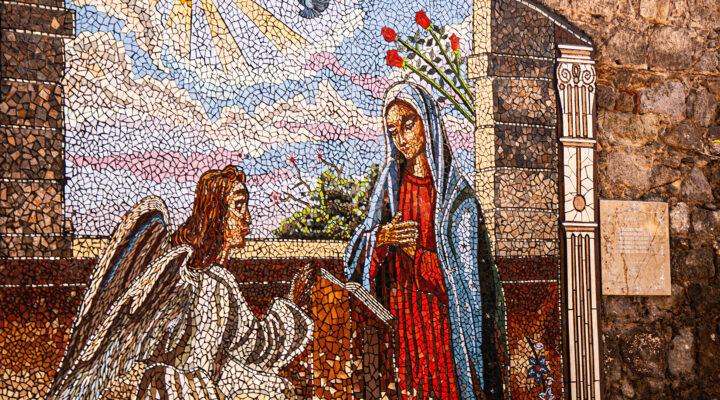
Mary’s Magnificat rises from a life interrupted by divine possibility. Luke presents her neither as an abstraction nor as a symbol floating above history. She’s a young woman whose body has become the site of God’s future. Her song is shaped by memory, longing and covenant. When she sings, she gathers centuries into her voice.
The final line of the Magnificat tells us how to hear everything that comes before it. Mary praises the God who has helped Israel and remembered mercy, “as God spoke to our ancestors, to Abraham and to his descendants forever.” This is not a pious flourish. It’s a theological claim. Mary understands her story as continuous with Abraham’s. The promise that once arrived as a word spoken under the stars now arrives as life growing within her.
“This is not a pious flourish. It’s a theological claim.”
Abraham trusted God with a future that exceeded his circumstances. Landless, childless and dependent, he stepped forward with nothing but a promise. Mary stands in a similar place. Her trust is quieter, more intimate, no less risky. What Abraham received as promise, Mary receives as presence. Luke invites us to see her as a threshold figure, one who stands at the headwaters of a renewed covenant people.
This covenantal continuity is not smooth or sentimental. Between Abraham and Mary lies the long, bruised history voiced by Isaiah who speaks to a people who fear the promise has failed. Exile, violence and imperial domination have pressed hard against the covenant. Isaiah refuses despair. Again and again, he locates God’s future in unlikely places: a remnant, a servant, a child, Daughter Zion addressed tenderly in her grief.
Isaiah reshapes Abraham’s promise so it can survive catastrophe. Blessing is refined through judgment and mercy. Hope is narrowed until it can fit inside fragile lives. By the time Mary sings, Isaiah’s imagination has prepared Israel to expect salvation to arrive quietly, vulnerably and embodied.
Mary stands at that convergence. Her Magnificat sounds like Daughter Zion finally speaking in her own voice. She sings of hunger and fullness, of pride undone, of mercy remembered. These are not abstractions. They are the lived hopes of a people who know displacement and precarity. Mary becomes Israel-in-miniature, carrying both promise and pain.
The early church sensed the weight of this moment. Irenaeus of Lyons described salvation as recapitulation, God gathering the whole human story and carrying it forward in healed form. Within that vision, Mary’s obedience marks a turning point. Humanity’s long story of mistrust begins to bend toward trust again. Abraham stands at the beginning of the covenant people. Mary stands at the beginning of their renewal.
Modern theologians have helped us see what this means on the ground. Elizabeth Johnson emphasizes Mary as a figure of Spirit-filled discipleship whose significance lies in her consent to bear God’s future within conditions of powerlessness. That consent is neither passive nor idealized. It is historically situated, embodied and costly. Mary receives the promise the way Abraham did, without control over its outcome.
“Isaiah reshapes Abraham’s promise so it can survive catastrophe.”
Theologians of liberation and womanist scholars deepen this reading by attending to survival and embodied hope. Delores Williams reminds us God’s redemptive work unfolds alongside strategies for life under constraint. Mary does not seek suffering, yet she navigates danger and uncertainty while trusting God’s commitment to life. Her Magnificat names a God who feeds, lifts and remembers, a God whose blessing resists systems that diminish human flourishing.
Isaiah’s vision of Daughter Zion finds renewed resonance here. Wil Gafney has shown how prophetic texts place women’s bodies and voices at the center of divine promise. Mary stands squarely within that tradition. She gives voice to a people whose hope has survived conquest and exile. The covenant continues through bodies the world overlooks.
Even the language Luke chooses supports this reading. When Mary speaks of being called “blessed,” she uses words associated with generational memory and public significance. When she names Abraham’s descendants, she invokes the language of seed, a word that carries both Genesis 12’s promise of blessing and Genesis 3’s hope for healing. Luke trusts the reader to notice that the promise to Abraham’s seed and the hope carried by the woman’s seed now rest within Mary’s life.
This is Advent’s quiet claim. God’s faithfulness moves patiently through history, reshaped by judgment, sustained through trauma, entrusted to ordinary lives. Abraham began the story. Isaiah insisted it could survive collapse. Mary receives it into her body and carries it forward.
Advent doesn’t ask us to manufacture hope. It invites us to receive it where we are. Mary shows us how. She stands at the threshold of God’s long work, singing before the outcome is known, trusting mercy remembered will become mercy embodied. The blessing promised long ago continues its journey, generation after generation, still looking for willing lives through which to pass.
Jason G. Edwards is a pastor and writer from Liberty, Missouri, where he serves Second Baptist Church, a congregation learning to make room by the fire for everyone. Find his poetry, prose and blessings at jasongedwards.com.