


I recently spoke with Gen. Ty Seidule and Connor Williams about their co-authored book A Promise Delivered: Ten American Heroes and the Battle to Rename our Nation’s Military Bases. These two respected historians spearheaded the Naming Commission authorized by Congress to redesignate American military bases commemorating Confederates. Their recommendations were accepted and implemented; the Trump administration then re-renamed most of the bases in 2025 upon returning to power. That battle continues. I am grateful for this conversation with Connor and Ty (condensed for publication), for their witness to the broad spectrum of American heroes worthy of remembrance, and their witness to fighting the good fight.
Greg Garrett: The committee you described in A Promise Delivered was bipartisan in its composition and spread out across the different military services. From the book, I got the sense that in its tasks and in its makeup the commission reflected American diversity at its very best. Could you talk a little bit about the commission’s work, which despite recent setbacks, feels hopeful given the stark divisions we’re facing at this moment?

Ty Seidule
Ty Seidule: Congress passed the National Defense Authorization Act, which gave us the mission. President Trump vetoed the entire nearly $800 billion act mainly because he didn’t want to change the names, and particularly (those) of Robert E. Lee and other Confederates. Congress overrode that veto by a supermajority in a Republican-led Senate. The American people through elected representatives directed us to rename, remove or modify everything from paraphernalia unit crests to those base names.
I was appointed by the secretary of defense. Michelle Howard was our chair, the first woman to be a four-star admiral, the first Black woman to be a four star in any service, and the finest leader I’ve ever worked for. I was the vice chair. Three Republicans, one Democrat and four retired military. So that’s who we were.
Connor, why don’t you talk about the mission and how we did it?
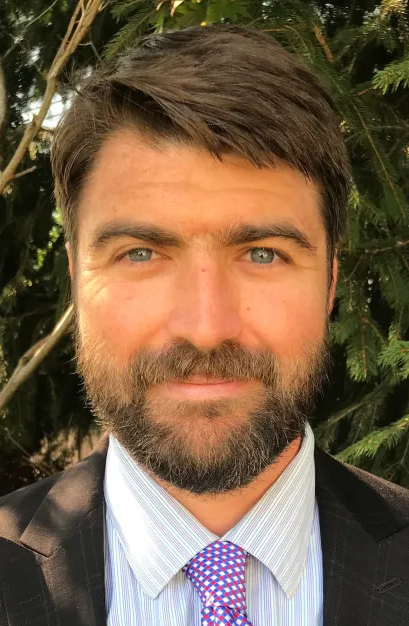
Connor Williams
Connor Williams: The law said we had to submit a plan to remove, replace or modify any asset, name, display, monument, paraphernalia, symbol that commemorated the Confederates or any person who voluntarily served in the Confederacy. For paraphernalia, they got down to napkins and fire engine rails. Congress really meant business. If it said “Fort Bragg,” the plan needed to have a way to change it so the name no longer commemorated them.
I signed on to the commission about three months after Ty did. By that point, the commissioners had already had a lot of important discussions and came up with criteria for who new names should be. Ideally, a person had to be in the Army or connected to the service. Ideally, the person would have a connection to the post itself, had served there, been stationed near there. The main job the post did was connected to that person’s career or they would have a connection to the kind of service done there.
The commissioners chose not to use substitute names. When Fort Bragg needed to be renamed, a lot of people did a little bit of Googling and found out that Braxton Bragg had a cousin, Edwin Bragg, who was a United States general in the Civil War. And they would always say, well, you can just rename it to Edwin Bragg, his cousin, and you could save a lot of money.
The last thing they said is they wanted the final list of candidates, not the final names, but the list the historian gave them after hearing from all Americans, to represent the current composition of the armed forces of America. There were no quotas, but they said, “We want these names to represent America’s military today.”
As we thought about why these names inspired us, we were struck by the fact that these were American heroes — really no other way to say it — that brought eight people together from all different walks of life, all different backgrounds, political, military, civilian, all these aspects. But these were names that organically rose to the top of every conversation.
“We were struck by the fact that these were American heroes that brought eight people together from all different walks of life.”
Now, there were plenty of heroes. We could have done this process 10 times and had 10 other lists. But as Ty and I were thinking about turning this commission work into a book, there were certain parts of these people’s lives they just literally did better than anything we can imagine.
Charity Adams knew how to run African American women as a unit and deliver the mail and bring hope to 7 million soldiers in the European theater. Henry Johnson knew how to survive and fight in Jim Crow America. We found ways to ask, “What is the essence of this person’s life that really nominated them for this honor of being commemorated? Let’s give ourselves the freedom to look at their broad stories.”
To get back to that fact of bipartisanship: This was a really incredible moment for how it used American history to bring people together. Oftentimes we fight about our history: What parts do we tell? What parts do we not tell? But this brought people together by telling all our history in the sometimes messy, sometimes heroic, sometimes tragic way it unfolds. That gave us really great stories that, again, not just the commission, but all Americans can be proud of.
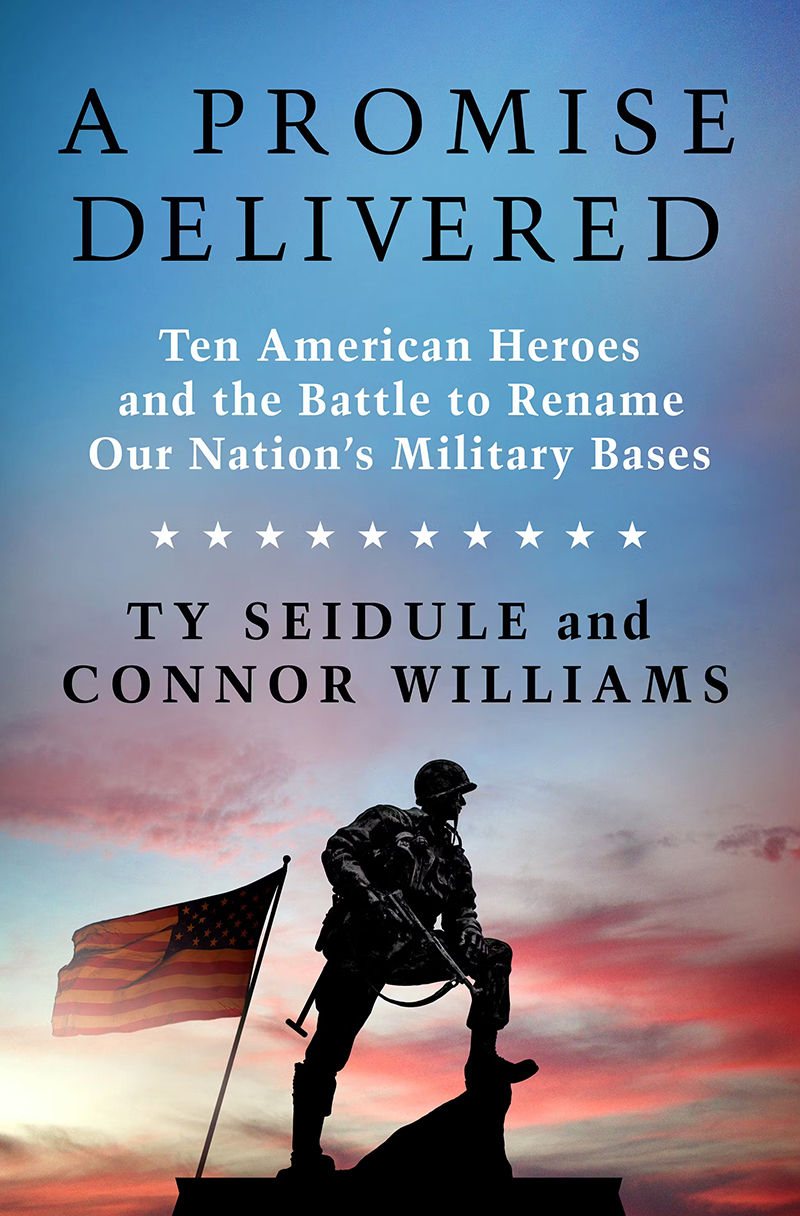 GG: A Promise Delivered is the story of these particular heroes, but it’s also, as you were saying, the story of America. And so we encounter the Trail of Tears and the Texas War for Independence and women’s suffrage and casualty telegrams and Jim Crow laws. I’m wondering if there’s anything further you’d like to say about the choices you made and the way you chose to tell their stories.
TS: It was a joy to spend time with these people. It really was. But you could not tell their stories without telling the story of America. Lt. Gen. Arthur Gregg joined a segregated Army in 1946 and rose to three-star general in that same army. It is a remarkable story that talks about the problems of American history, but also the promise of American history.
None of these people’s parents had a college education. None of them came from wealth. They are true Americans in the sense that they rose through a meritocracy to do what they did. There’s no way we as historians would ever write any biography without having the context of their lives.
CW: The other thing this process showed us was that these stories resonated with people because you had to tell the hardship for the story to make sense. Two African American men were awarded the Medal of Honor in the First World War, both posthumously. Sgt. Henry Johnson (Pvt. Henry Johnson, when he did the actions for which he received his medal), and Cpl. Freddie Stowers. Stowers was killed leading a charge.
Johnson returned to the United States during the Red Summer of 1919. He was facing Jim Crow discrimination, and whatever celebrity he got was literally taken from him. For a long time, there was no recognition whatsoever. People thought he was buried in a pauper’s grave. And then in the 2010s, a second effort to recognize him started with a lot of people, grassroots people in Albany, N.Y., where Henry Johnson lived — Sen. Chuck Schumer, a number of folks — and it ended with President Barack Obama giving the Medal of Honor to Johnson, who had no next of kin, to the sergeant major of the New York National Guard, the exact same organization Johnson enlisted in almost a hundred years earlier.
The commissioners certainly wanted to go, the soldiers wanted to go to those harder parts of our history while also being aware we have changed. I mean, that’s the big balance. I think people from one side of the aisle often say America’s history is nothing but bad things and tragedy and exploitation. And people from the other say we’re the greatest nation on earth. Get those two people in the room and they’re going to butt heads. But both people can agree, hey, sometimes there are really hard times and people persevere through them. And that was a really powerful formula.
“It’s never ever too late to do the right thing.”
TS: Just one other thing I’d say: It’s never ever too late to do the right thing. In recognizing some of these soldiers, we got a chance to recognize great Americans. And by doing it in some cases, like Henry Johnson nearly a century after, or certainly 80 years after he died, it’s still doing the right thing. It makes me feel good as an American to know that.
GG: What does it feel like when you see this administration doing their best to erase the gains we’ve made around diversity and to re-curate our history?
TS: The first thing I think is we delivered on our promise Congress told us to do, which is to change the names. What we did was through the American people, through their elected representatives who gave us this mission. We historians have a perfect track record of predicting the future. We’re always wrong! But I do believe that these names will go back.
Just in the Congress, the House of Representatives said to put all the names back. In the latest defense authorization bill, the Senate said the three Virginia bases had to go back. None of that made it into this bill, so none of them are going to change this year. But the fact that there was so much fight and there is so much fight, and I’m not alone in this. I am energized to keep fighting for what I believe in and for what I think is the best for the American people in the way I can do it.
Everybody has their own issue they can fight. The fight for the rest of my life is to continue to tell the stories to ensure the America my grandchildren have is not the America I grew up in with the Lost Cause myth.
“I’m disappointed, but I’m not forlorn.”
There’s plenty of work to do. I’m disappointed, but I’m not forlorn. I am energized to fight.
GG: “I am disappointed, but I am not forlorn.” That will preach.
CW: There’s a WH Auden poem on “September 1st, 1939.” It ends with the idea that “Defenseless under the night/Our world in stupor lies,” just this black dark night. You can’t see anything. But then he points out, what happens next? Well, he calls out “ironic points of light,” not ironic in the sense of bad irony, but unexpected, these stars in the nighttime and he says:
May I, composed like them
Of Eros and of dust,
Beleaguered by the same
Negation and despair,
Show an affirming flame.
You don’t need to see the end goal, but you need to have faith that what you can do matters and it’s worth sacrificing your comforts for. I hope we never end up in a frontline trench of any war, but whether it’s a frontline soldier or someone delivering the mail or someone healing the wounded or someone consoling the bereaved, all these people (in our book) were united by the idea that I can do something to make this better than it is right now, and that it’s worth doing not for my own safety or comfort, but for the betterment of mankind as I understand it.
GG: Connor, that was beautiful.
CW: Thank you. I appreciate it. Not beautiful in the sense we use “beautiful,” but in terms of having a real human emotion and desire and aspiration, A Promise Delivered was a beautiful book to write.

Greg Garrett
Greg Garrett is an award-winning professor at Baylor University, where he is the Carole McDaniel Hanks Professor of Literature and Culture. One of America’s leading voices on religion and culture, he is the author of 30 books, most recently the novel Bastille Day and The Gospel According to James Baldwin: What America’s Great Prophet Can Teach Us about Life, Love, and Identity. He is currently administering a major research grant on racism from the Eula Mae and John Baugh Foundation and finishing a book on racist mythologies for Oxford University Press. Greg is a seminary-trained lay preacher in the Episcopal Church and Honorary Canon Theologian at the American Cathedral of the Holy Trinity in Paris. He lives in Austin with his wife, Jeanie, and their two daughters.