

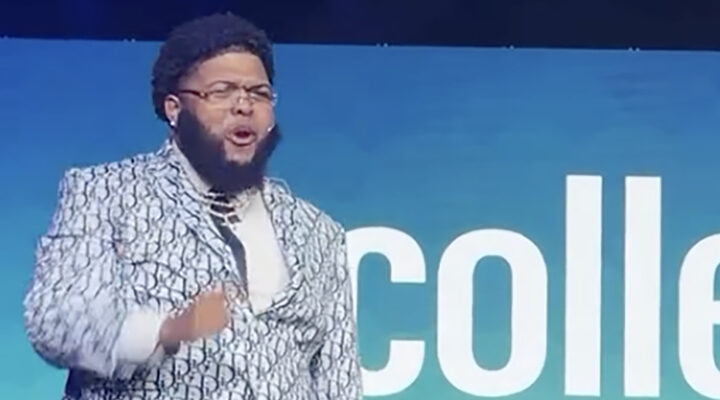
For some of us, watching Druski’s recent megachurch parody is hitting a nerve because it’s holding up a mirror.
Druski is a comedian and cultural commentator known for using humor to reflect everyday truths about Black life, power and performance, often saying out loud what many people feel but don’t name.

Joshua Liston-Zawadi
In this case, his viral skit Mega Church Pastors Love Money didn’t just land as comedy. As a Black minister, rooted in the church and deeply engaged in the community, I watched it not just with amusement, but with sober responsibility. If we don’t like what’s being reflected, we need to be honest about who helped shape the image.
This isn’t about religion being mocked; it’s about behavior being exposed. The problem isn’t faith. The problem is performance.
If the world sees the church this way, it didn’t come out of nowhere. It was learned. Observed. Repeated. It came from years of evidence and neglect. We have to own that.
“Right now, the gap between what we preach and what we practice is loud enough to become comedy.”
We’ve spent too much time arguing over optics, what a pastor’s wife wears, how someone worships, how much money is in the collection plate, while ignoring the deeper work of integrity, humility and service. We’ve protected the image while neglecting impact. And when image becomes the priority, hypocrisy becomes inevitable.
In moments like this, Druski stops being just an entertainer. He becomes an artist. And art has a responsibility.
James Baldwin said: “The role of the artist is exactly the same as the role of the lover. If I love you, I have to make you conscious of the things you don’t see.”
So the real question isn’t whether the joke went too far, the question is whether we’re brave enough to look at what it revealed. Here’s the question we need to sit with: What are we willing to change about how we represent the church when no one is laughing?
Because the world isn’t confused about our sermons, it’s confused why our actions don’t align to the God we claim we serve. It’s not watching our theology; it’s watching our character. And right now, the gap between what we preach and what we practice is loud enough to become comedy.
Let’s not waste this moment defending what no longer serves us. Let’s use it to return to the work that actually matters: loving people well, serving without spectacle, leading with humility instead of ego. The church doesn’t need better PR. It needs deeper integrity.
The mirror has been held up. The image is clear. Now the responsibility is ours.
Joshua Liston-Zawadi is an ordained minister and a Public Voices Fellow at The OpEd Project in partnership with the National Black Child Development Institute.