

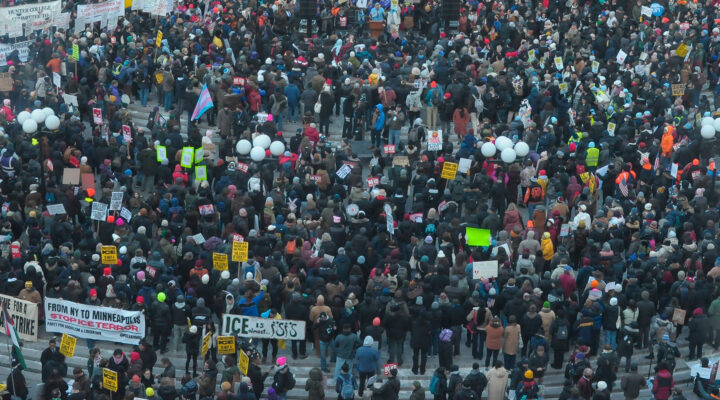
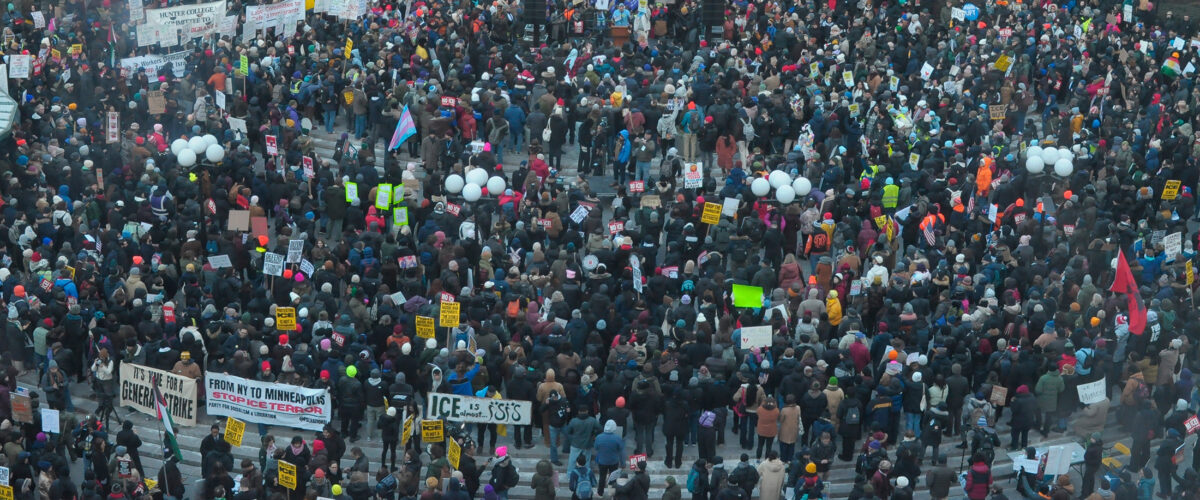
Last Friday, I joined what was estimated at 4,000 people in Union Square in New York City. We gathered to protest the murder of Renée Good and the detention of 5-year-old Liam Conejo Ramos.
But the purpose of the march reached beyond any single name. We were there to stand in solidarity with an occupied Minneapolis — and to voice concern for our own city, should similar forces be turned on New Yorkers if ICE were to flex its will here.
Christina Ray Stanton
I arrived early, filled with anticipation. I stood among elected officials, including Rep. Dan Goldman and former City Comptroller Brad Lander, listening to more than an hour of speakers and organizers. Yet I found myself most drawn to the faith leaders: a rabbi from Brooklyn, a woman representing the Hindu faith, a Muslim imam. One by one, they offered words of compassion, restraint and peace — language that grounded the crowd and unified it.
When the last speaker had finished, I realized my own faith — Presbyterian, part of the broader Protestant tradition — was nowhere to be found. That absence cut sharply.
I nearly stepped onto the stage myself to say what should not need saying: Murder is condemned by Jesus and mocking a dying image-bearer with words like “a fucking bitch” is a sin against God. But I didn’t. I wasn’t there to speak for my faith. I was waiting, silently, for it to show up.
“Too many ministers in my tradition avoid naming injustice as if truth itself were partisan.”
This silence has become normal. Too many ministers in my tradition avoid naming injustice — even in corporate prayer — as if truth itself were partisan. And as a congregant, that silence weighs heavily.
I am grieving over the state of my country. I come to church searching for hope. When a minister refuses to acknowledge what is breaking the hearts of the people in the pews, it does not feel neutral; it feels indifferent. Pastors are called to tend wounds, not avert their eyes. Silence in moments like this leaves the suffering to carry their grief alone.
And maybe that is why I showed up for the march. The comfort missing from the pulpit — the recognition, the shared lament — I hoped to find instead among strangers in the street, walking together in grief, searching for meaning and purpose in the pain.
As I waited for the march to begin, I reflected on my own history of raising my voice for justice. As a licensed New York City tour guide since 1995, I teach the city’s history, and peaceful demonstration — people publicly sharing concern, grief and moral urgency — always has been part of it. From the women’s suffrage marches to the 1882 Labor Day Parade of 10,000 workers; from the uprising of the 20,000 garment workers in 1909 to thousands crossing the Brooklyn Bridge on Juneteenth in 2020, New Yorkers have long taken to the streets to demand justice. These demonstrations are not relics of the past. They are living expressions of the city’s ongoing struggle for dignity and fairness. I never miss a moment to share the city’s proud history of bringing truth to power.
Fourteen years ago, I was actively involved in New York City’s “Right to Worship” movement. At the time, the Department of Education was prohibiting religious groups from renting public school space for weekend worship, while allowing other community groups — and even the KKK — to meet freely. A small coalition of us marched, rallied, wrote letters and traveled to Albany to press lawmakers.
After years of litigation, the Supreme Court declined to hear the case in 2015, but Mayor Bill de Blasio later fulfilled a campaign promise by changing the policy. The victory was nationally significant, and I remain proud to have been part of a movement that challenged open discrimination through peaceful protest.
But standing in Union Square this Friday, I looked around and realized that none of my former Right to Worship leaders were there. My faith — and my moral voice — was missing. And I was angry.
There is no righteous way to sideline a Christian response to murder and injustice, even if exit polls from the 2020 presidential election show that 75% to 81% of white evangelical Protestants supported Donald Trump and his initiatives. Those numbers are large but they do not represent all who call Jesus Savior and Lord. I knew my fellow twenty-five percenters were out there. And yet, even in the crowd of thousands, I felt alone.
Christianity in America has faced these crossroads before. During the AIDS crisis of the 1980s, thousands died without treatment or hope, marginalized and abandoned, while influential preachers like Jerry Falwell and Pat Robertson spread shame, even slander, claiming the stricken deserved their fate (does this sound familiar?). As activists flooded the streets demanding government action, too many Christian leaders remained silent. That silence deepened stigma, delayed compassion and left an already vulnerable community to suffer alone. It was one of Christianity’s darker eras.
“When the church is silent in moments of shared grief and moral crisis, people will seek truth, lament and solidarity elsewhere.”
And I wondered: Are we repeating that history? Is this another moment when leaders remain silent because their convictions are already aligned with a political narrative? I stood there consumed by frustration and loneliness, feeling the weight of silence pressing down.
When the church is silent in moments of shared grief and moral crisis, people will seek truth, lament and solidarity elsewhere — wherever suffering is named and dignity defended. Yet, in my frustration, I was reminded: It wasn’t a faith leader who first introduced me to Christ after 9/11. It was a Christian friend who showed up, offered love and pointed me to Christ. It was a lone, small voice, that melted my heart, not someone screaming from a megaphone. And when I responded, Christ completely changed my life. As I stood at the edge of Union Square, my anger began to shift. I was not powerless. I was not alone. I could act. I could witness. I could proclaim.
Before we turned to cross 14th Street, someone led a call-and-response: “Jesus loves immigrants!” — staccato, like a drumbeat. I practically yelled it back, thrilled to hear Jesus’ name spoken aloud in public. In that moment, I knew even though my faith tradition had been silent, Jesus was present. Jesus was acknowledged. Jesus was there. And in that presence, I had conviction and peace.
Even when leaders remain silent, we must speak. Even when the pulpit does not echo the grief and hope of the people, we cannot remain quiet. We act. We pray. We proclaim.
Faith calls us forward. Mercy demands we raise our voices. And Christ — the Great Comforter — gives us courage to stand, to witness, to hope. Silence does not define us. Presence does. Love does. Action does.
In speaking, marching and witnessing, we bear witness to a God whose justice, mercy and love are never absent.
Christina Ray Stanton wrote an award-winning book about surviving the Sept. 11, 2001, attacks, Out of the Shadow of 9-11: An Inspiring Tale of Escape and Transformation. Her faith articles have appeared in numerous publications all over the world. She also is the author of Faith in the Face of COVID-19: A Survivor’s Tale.