

I live and serve as a pastor in Moscow, Idaho, a town that is home to one of the largest and loudest Christian nationalist groups in the country right now. However, despite what you hear on the news, my town remains a beautiful and lively place with lots of kind and passionate citizens, many of whom are theologically and politically progressive.
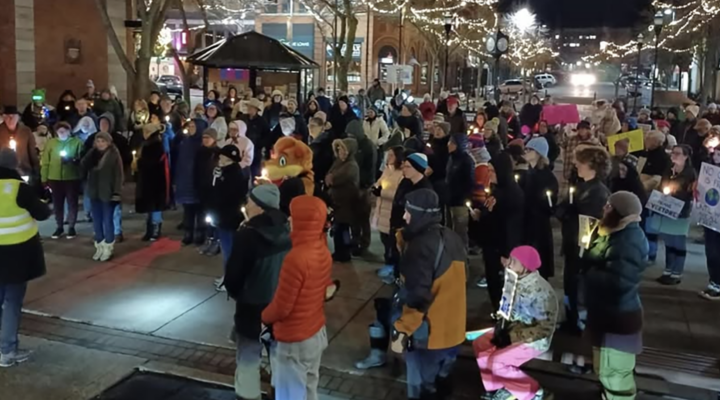
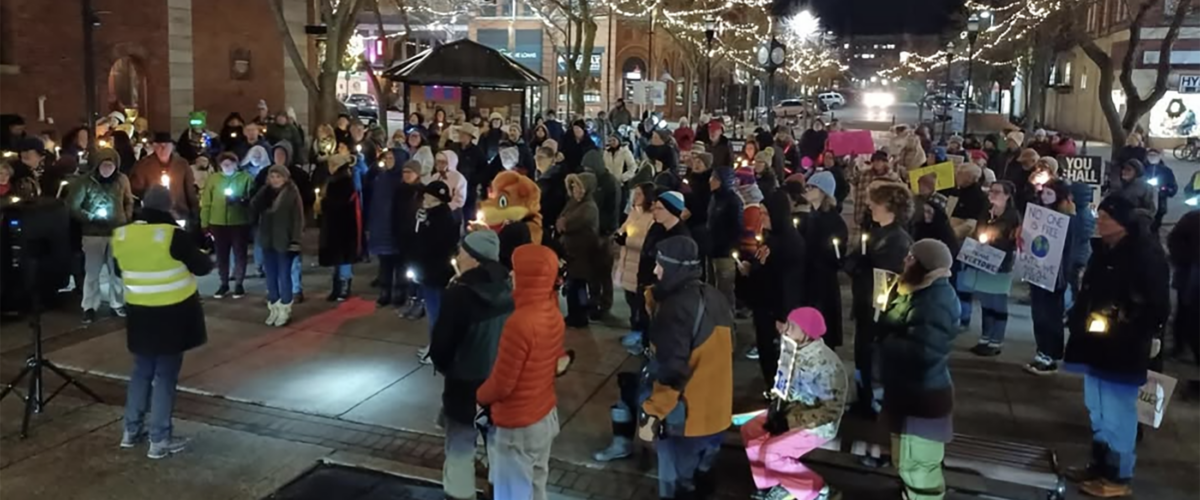
Recently, many of these citizens showed up to hold a candlelight vigil in recognition of Renee Good’s life and in protest of those who’ve been killed or taken at the hands of ICE agents. We gathered in the town square, listened to a local pastor call for hope and justice, lit candles, sang songs, huddled together for warmth in the freezing temperatures and marched around the downtown area. It was a rare moment of unity amid incredible polarization and hope in the midst of despair.

Hannah Brown
And unsurprisingly, in the middle of this beautiful moment, my Christian nationalist neighbors showed up to counter-protest.
They surrounded our group, blocking our path with massive posters covered in Bible verses and pictures of unborn babies. They made it difficult to move past them and impossible to ignore their shouting “murderers” at us while we were actively grieving the death of Renee Good and others.
Their counter-protest seemed entirely unrelated to our own. While we expressed concern over what ICE is doing in this country, they screamed their outrage about abortion. They seemed to presume that simply being anti-ICE means you are inherently pro-abortion, even though these are completely different conversations and not the focus of this protest.
But their calling me a murderer wasn’t the part that made me angry.
Their presence was frustrating, but there remains one moment from that night that perfectly illustrates Christian nationalist ideology: They sang the “Doxology” at us.
“This song was thrown in my face as if I had no relationship with it.”
Yes, the “Doxology.” A song many churches, including my own, sing frequently. A song whose words I know by heart. A song whose content I believe. And yet, this song was thrown in my face as if I had no relationship with it. As if I would find this song offensive. As if I couldn’t possibly believe their words because of my political opinion.
This is what it means to be a Christian nationalist. Conflating political opinion with a very narrow understanding of the Christian faith means anyone outside your political opinion is no longer just considered a poor citizen but also is inherently anti-Christian. It is this type of ideology that finds you hurling the words, “Praise God from whom all blessings flow” into the face of an actual Christian pastor.
They have no idea who I am or what I believe and yet, based on my support of a certain political agenda, they assume I find the worship of God offensive. They got in my face and screamed, “God hates murder,” as if this is not a statement I also believe. As if it is not for that reason I march in support of those who’ve been senselessly murdered at the hands of our government.
Christian nationalism is not about making America a Christian nation; it is about making America into a very narrow, fundamentalist, conservative version of the Christian faith and using political power to penalize anyone who falls outside of this perspective. And at least for Christian nationalists in my town, their version of Christianity deems fighting for the unborn a greater priority than fighting for the living who are actively being detained, harassed and killed at the hands of our government. Everyone including pastors and faithful Christ followers who disagrees with this prioritization is no longer regarded as Christians.
The separation of church and state is not just a good idea, it is an essential one. Because without this guiding principle, you may find your version of Christianity outside the acceptable limitations. Or worse, find yourself screaming the “Doxology” in the face of a pastor.
Hannah Brown serves as pastor of The United Church of Moscow in Moscow, Idaho. She earned a master of theology degree from the University of Edinburgh, a master of divinity degree from Baylor’s Truett Seminary and a bachelor of arts in ChristiansStudies from the University of Mary Hardin-Baylor. She shares about her experience as a Gen-Z pastor on Substack at hannahbwrites, on TikTok at hann.r.brown, and through co-hosting the “Preacher Handshake” podcast.