

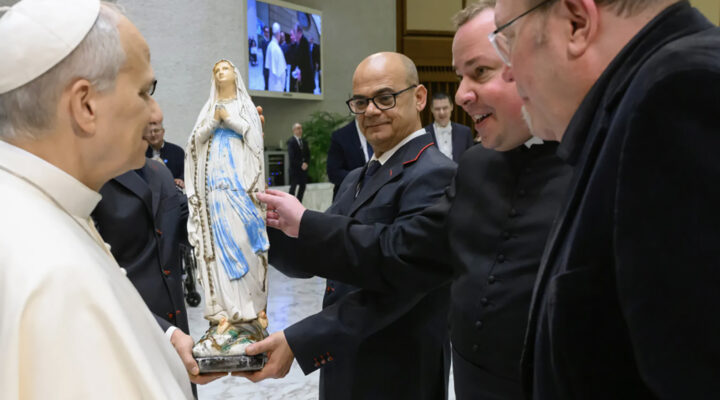
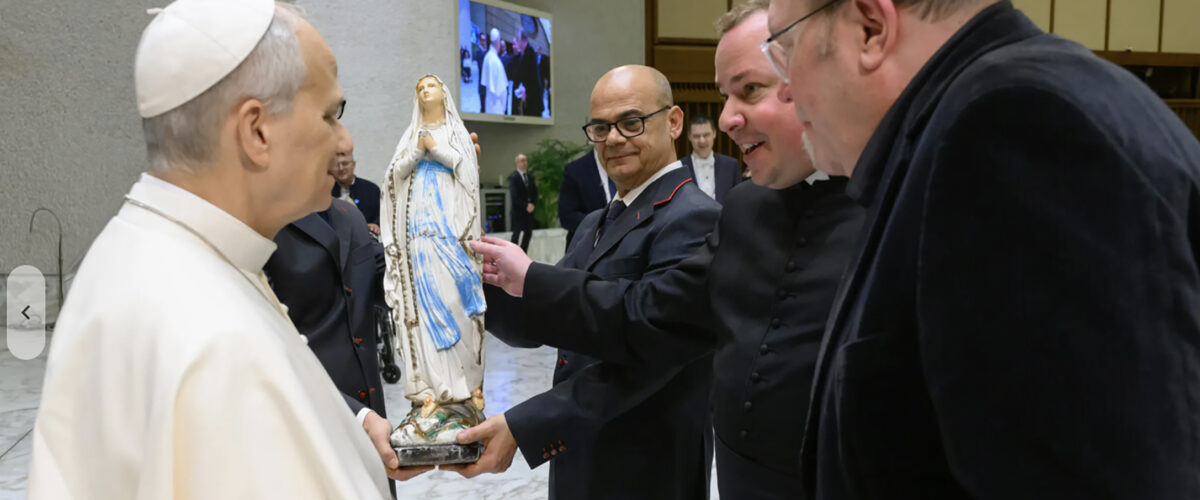
This past week, Pope Leo XIV bestowed a blessing on a chipped and half-broken statue of Mary, the mother of Jesus, which changed the life of the man who found it.
Pope Leo bestowed upon it the title, “Our Lady of the Broken.” The statue was found beside a dumpster in 2010 by Kevin Matthews, a radio personality who once had more than 10 million weekly listeners in his Chicago radio broadcast. He had been diagnosed with Multiple Sclerosis in 2008, and two years later when he saw her lying there, dirty, broken in half and chipped, he had a mystical experience that was a calling to take the statue and its meaning across the country.
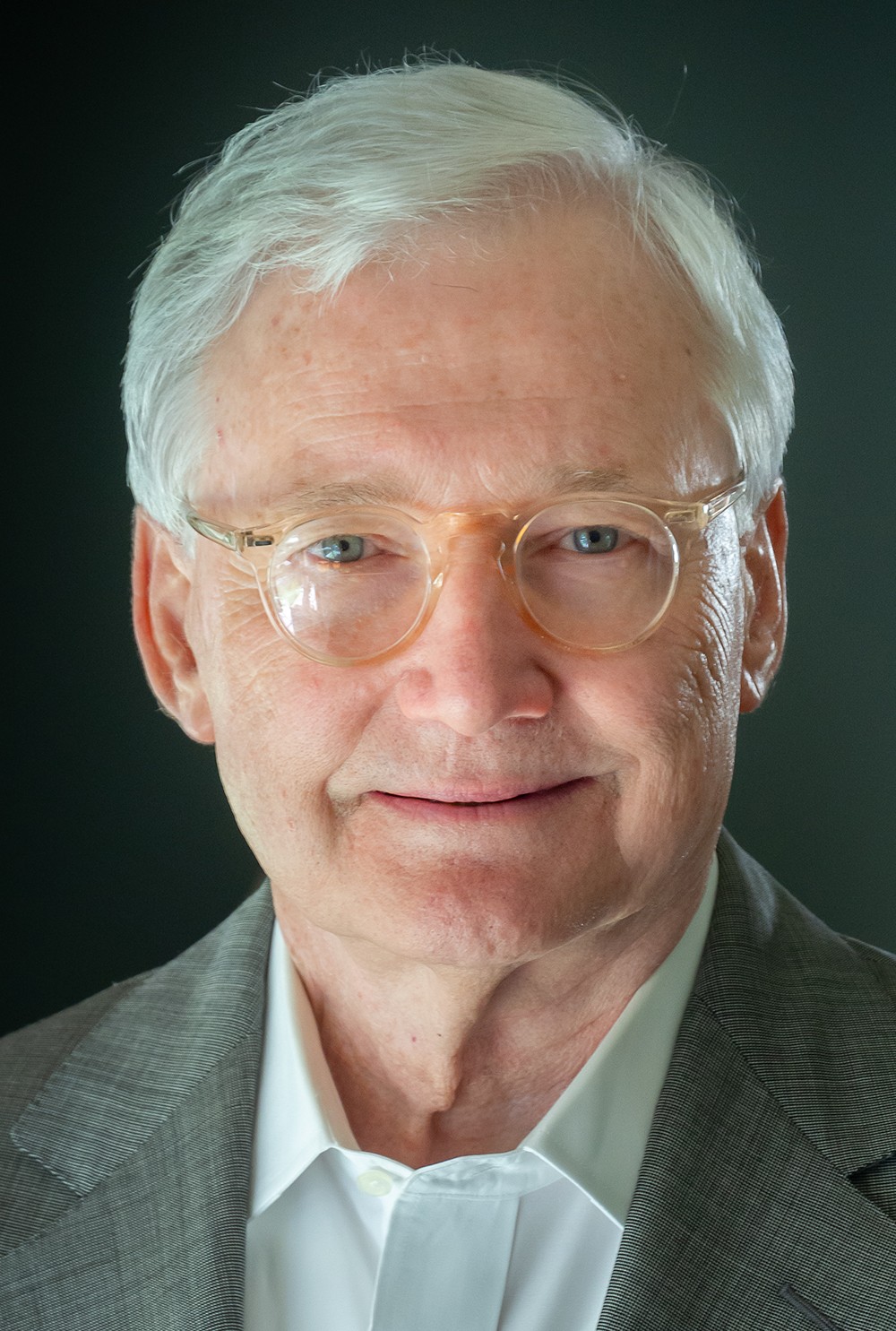
Stephen Shoemaker
His new life was about to begin.
Matthews took the statue to be repaired. The man who repaired her wanted to repaint her and restore her to her original wholeness, but Matthews said: “No, she is broken, just like me. We all are broken and in need of repair. She represents the broken.”
As Pope Leo blessed the statue, he said, “How many people — perhaps we ourselves — feel like they are worthless or broken. It is as if their light has been hidden. Jesus, however, proclaims a God who will never throw us away.”
Steven Harmon, a Baptist and ecumenical theologian, was an accredited journalist in Rome covering the papal conclave for Good Faith Media at the selection of Pope Leo XIV. His book on the experience has just been published, Encountering Pope Leo XIV : Baptist Reflections on the Beginning of a Pontificate. He told me the pope’s blessing was at one piece with his life as a priest given to the poor, especially in his extensive time as a missionary priest in Peru.
“Jesus, however, proclaims a God who will never throw us away.”
Mary often is seen as “Mary the Unbroken,” pure and perfect and untouched by the world. But the Gospels record her broken humanness. Luke’s Gospel reports the words of Simeon as he pronounced a blessing over the child Jesus. Mary and Joseph had taken him, as was the custom, to the temple to present him to the Lord and offer a sacrifice.
Simon said, “Behold, this child is set for the fall and rising of many in Israel.”
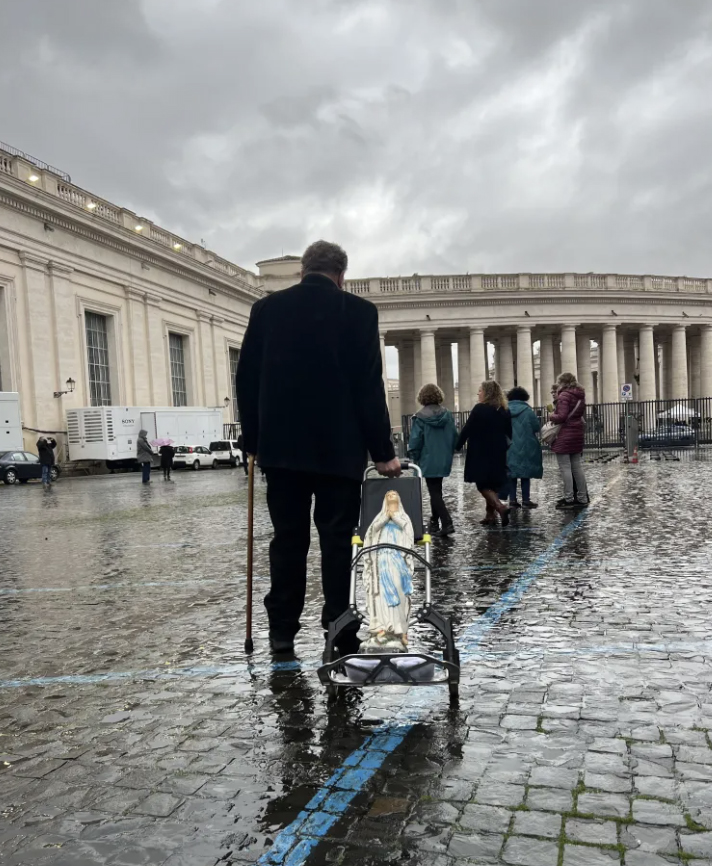
Kevin Matthews transports the broken Mary statue across a plaza at the Vatican. (Photo: Vatican News Service)
Then he said to Mary, “And a sword will pass through your own soul.”
There was the day when Mary and Jesus’ brothers came to him worried about him, trying to save him from himself and take him home. Jesus, hearing they had arrived, said: “Who are my mother and my brothers? Here are my mother, my brothers! Whoever does the will of God is my brother, and sister, and mother.”
His words had to have pierced Mary’s soul all over again. Then, as she watched her son dying on a Roman cross, no doubt her soul was crushed again.
Richard Rohr writes of the church’s “cult of innocence,” saying we come to church believing in our own inviolable innocence. There also is a “conspiracy of wholeness,” as we come to church and hide our brokenness.
The Apostle Paul knew his brokenness. Missionary preachers had come to Corinth preaching their gospel of health, wealth and success. (They always are among us.) They made fun of Paul’s weakness, believing such weakness disqualified him from being a true apostle. Paul called them with sarcasm “super apostles” and “false apostles” who preached “another Jesus” and “a different gospel.”
Paul had a public and humiliating weakness he called his “thorn in the flesh.” We can only guess what it was, but it was a torment and it threatened his apostleship. He prayed over and over for God to remove his thorn, but God did not answer Paul’s plea. Instead, God said to him, “My grace is sufficient for you, for my strength is made perfect in weakness.”
“To be sure, God can use our strengths, but God also can use our weakness and our brokenness.”
There it is, the mystery of the gospel, God’s strength made perfect in our weakness. To be sure, God can use our strengths, but God also can use our weakness and our brokenness.
God’s people are the broken on the road to healing but whose full and final healing is in the world to come. The kingdom of God is the kingdom of the sick and broken, the forgotten and dispossessed. When we pretend differently and embrace a gospel of health, wealth and success, we live a false existence short on mercy for ourselves and others, and we cut ourselves off from the Christ who waits for us in the least of these, the hungry and thirsty, the sick and unclothed, the immigrant and those locked in prison.
The church cannot be the church when the poor are missing. A broken Mary leads us into such a kingdom.
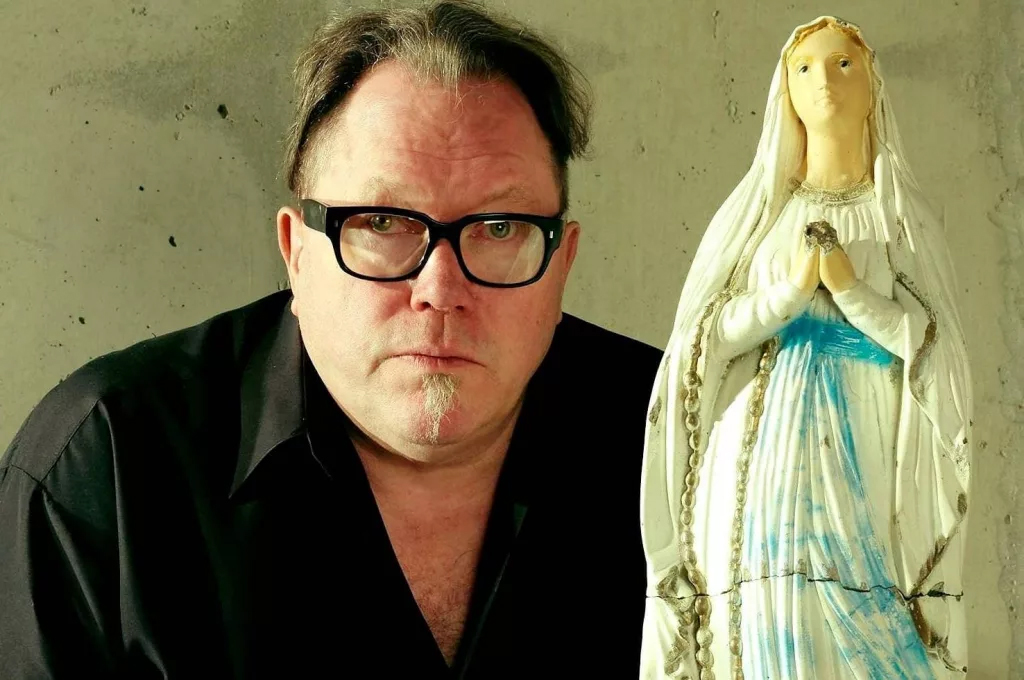
Kevin Matthews with the broken Mary statue
One of the most arresting images of ministry has come from Henri Nouwen in his book The Wounded Healer. His image comes from a rabbinic story. Rabbi Yoshua comes to Elijah and asks, “When will the Messiah come?”
Elijah responded, “Go ask him yourself.”
“Where is he?” the rabbi asked.
Elijah answered, “Sitting at the gate of the city among the poor, covered with wounds.”
Elijah went on: He binds and unbinds his wounds one at a time so he will be ready to help another at any time.
Bonhoeffer wrote in prison awaiting his execution that the church is only the church when it is a church for others. A broken Mary and a wounded Messiah lead us there.
Stephen Shoemaker most recently served as pastor of Grace Baptist Church in Statesville, N.C. He previously served as pastor of Myers Park Baptist in Charlotte, N.C.; Broadway Baptist in Fort Worth, Texas; and Crescent Hill Baptist in Louisville, Ky.