

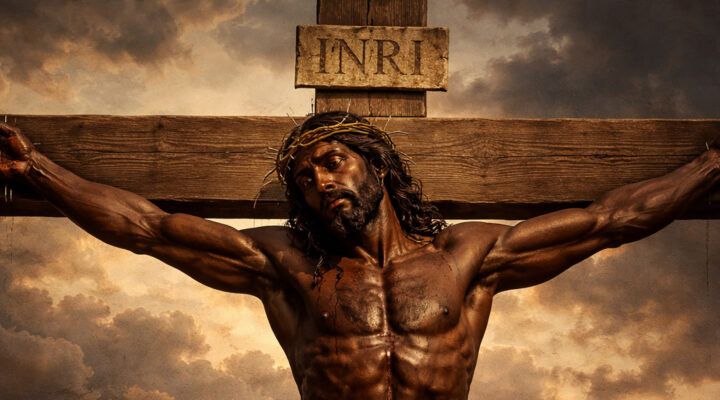

On Good Friday, many of the white churches move quickly. They acknowledge the Cross, they sometimes name the injustice, and — almost instinctively — begin inching toward Easter, toward hope, toward resurrection, toward resolution.
They quickly leave Friday and rush to Sunday morning.
However, in the Black Baptist Church, we stay. We stay at the Cross, we stay with the blood, we stay with the weight of it all. We don’t stay because we are stuck — but because we refuse to lie.

Braxton Wade
The tradition of preaching the Seven Last Words of Jesus is not about length or liturgical nostalgia. It is a theological refusal — a refusal to sanitize suffering and a refusal to rush past death in search of something more palatable.
I resonate so heavily with the Black Church at this moment because I still believe something many have tried to outgrow: The blood still works. And if the blood still works, then the Cross still matters. And if the Cross still matters, we cannot hurry away from it.
So the Black Church gathers. And we preach seven times.
Seven voices rise to proclaim the final sayings of Jesus from the Cross — drawn from the Gospels, but lived in the bodies of a people of color who know something about unjust suffering.
“Father, forgive them…”
“My God, my God, why have you forsaken me?”
“I thirst.”
“It is finished.”
These are not distant sayings; they are familiar. A man falsely accused. A system stacked against him. A public execution carried out by the state. For many Black Christians, the Cross never has been abstract theology, it always has been recognizable.
“The Seven Last Words service insists that it takes a community to tell the truth about the Cross.”
This is why one preacher is never enough. The Seven Last Words service insists that it takes a community to tell the truth about the Cross. Each preacher approaches their word not just as an assignment, but as testimony. Each bringing a different voice, different wounds, different encounters with the same suffering Christ.
Howard John Wesley, senior pastor of Alfred Street Baptist Church in Alexandria, Va., has often reminded the church that “Good Friday is an invitation to sit with what we would rather skip.” And in many Black churches, that invitation is not politely extended — it is embodied. We cannot skip it.
We linger at the Cross. We let each word breathe. We let the silence stretch. We let each preacher climb into the text until the text comes to life for each of us. And historically, this tradition has done more than shape worship — it has formed preachers.
In seasons when Black clergy were denied broader platforms, Good Friday became a sacred gathering space. Churches opened their doors, pastors shared pulpits, young preachers were given a word and a moment and told to handle it with care.
But beneath all of this — beneath the structure, beneath the history — is a deeper theological instinct: The refusal to rush.
In many of the progressive spaces today, there is discomfort with the language of blood. With atonement. With suffering that is not easily explained or resolved. Some have traded the Cross for conversation, the Crucifixion for commentary. But the Black Baptist Church has held on. We use this not uncritically without wrestling, but faithfully.
“We cannot talk about resurrection without talking about what had to die.”
We cannot separate suffering from salvation. We cannot talk about resurrection without talking about what had to die. We cannot celebrate victory without naming the cost. We cannot experience the joy of Sunday without the suffering and sorrow of Friday.
And so, year after year, we return to the Cross. We return not as spectators but as active participants, some may even say witnesses.
The Seven Last Words is not just about what Jesus said. It is about what suffering sounds like when it refuses to be ignored. It is about what faith looks like when it does not have easy answers. It is about a people who have learned that God does not always remove the cross — but God is somehow present in it.
And so on this Good Friday, don’t rush. Don’t clean it up. Don’t tie it in a bow. Let it be what it is. Blood dripping. Sky darkening. A Savior speaking from a place most of us would not survive and listen.
Because somewhere between “Father, forgive them” and “It is finished” there is a word for you and me.
A word for every time we’ve been misunderstood. A word for every system that tried to crush us. A word for every prayer that felt like it hit the ceiling and came back down. A word for every person of color. A word for every person identifying as LGBTQ.
And if you stay there long enough — if you don’t rush past it — if you let every preacher take their turn, if you let every word do its work — you’ll hear it. Not just what Jesus said, but what God is still saying.
That the Cross was not the end, that the blood was not wasted, it was working. Working when they whipped him, working when they mocked him, working when they nailed him, working when he breathed his last. And if it was working then — beloved, it’s still working now.
Still reaching into broken places, still speaking into silent suffering, still holding together what the world keeps trying to tear apart. Still reaching to every mountain and flowing to every valley, the blood, the blood, the blood, as my great grandfather used to sing every Sunday, never loses its power!
So we preach seven times. Not because we have more to say — but because the Cross is still speaking.
Braxton Wade is a Clemons Fellow with BNG. He is a graduate of the University of Richmond and Chicago Theological Seminary and lives in Richmond, Va.