

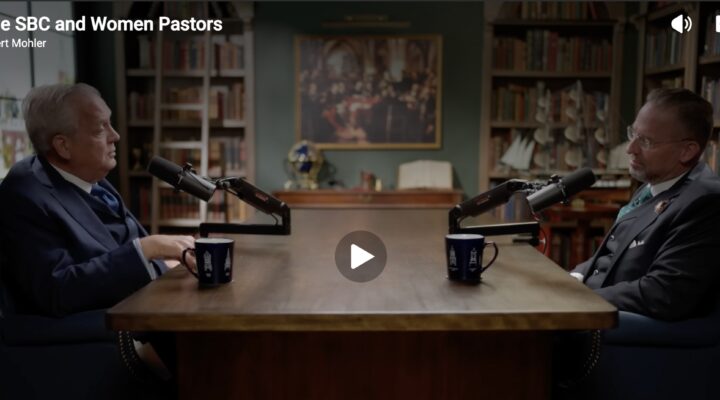
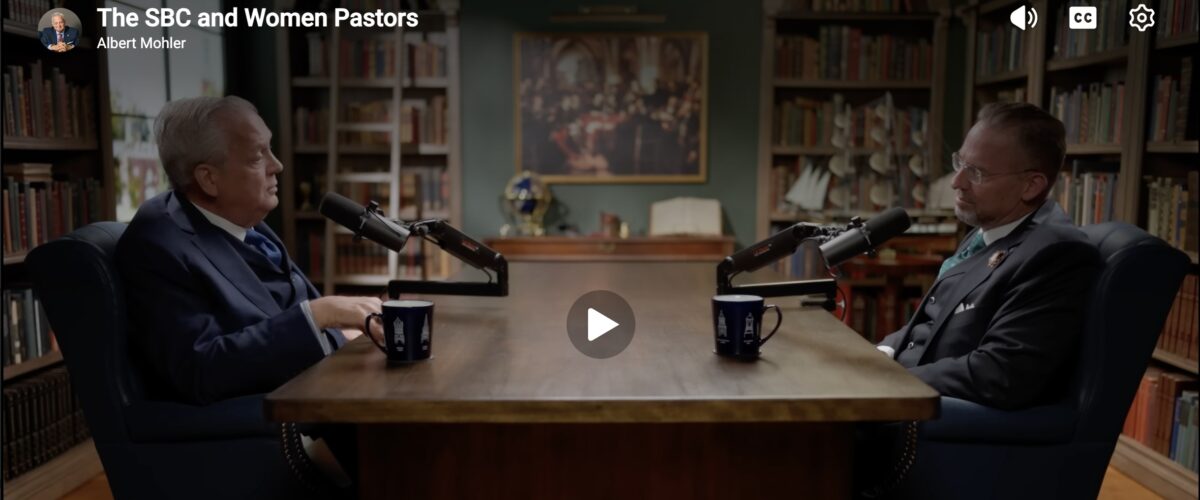
Conservatives were “inches from losing the Southern Baptist Convention” before the “conservative resurgence,” Al Mohler told SBC President Clint Pressley in a new podcast.
Mohler, president of Southern Baptist Theological Seminary in Louisville, Ky., has been a standard bearer for conservative and Reformed theology in the SBC for more than three decades. Academically, he is a product of the old Southern Seminary that he now claims was a bastion of liberalism. After being named president at his alma mater in 1993, he launched his own reformation that led to an exodus of faculty and a dramatic shift in the student body.
He and Pressley discussed that history in a new episode of Mohler’s “In the Library” podcast.
Books and documentaries have been produced about the “conservative resurgence,” yet when Pressley asked Mohler if that story had been told enough, he replied: “No, and I think it’s mistold. So I’ve heard people say the larger problem was neo-orthodoxy. Yet, that’s not even true. It was far more liberal than people understand.”
“It was genuinely liberal” Pressley replied.
Clint Pressley (Photo screencap from video)
“It was genuine Harvard Divinity School liberal,” Mohler continued. “And I could give you chapter and verse. And if I get to write a memoir, I’m going to put in all the chapters and verse. … And by the way, the problem was not just people who were making such liberal affirmations. I mean, we had professors who were members of the Jesus Seminar. And they weren’t even certain that Jesus has said any of this. I mean, we had faculty members, one of whom was a founding member of the Religious Coalition for Abortion Rights.”
One of the primary expressions of “liberalism” in the SBC of the past was a growing acceptance of women in ministry, Mohler asserted.
“Where are we right now on the issue of women as pastors?” he asked Pressley.
“I think that overwhelmingly, if you take the Southern Baptist Convention overwhelmingly … our pastors are overwhelmingly, genuinely complementarian,” Pressley said.
“Our churches are as well,” Mohler added.
“Our churches and pastors,” Pressley agreed. “And so when we show up and it comes to the floor and we have a vote, it’s overwhelming.”
And yet, last summer an effort to pass the so-called “Law Amendment” that would have enshrined the no female pastors rule in the Constitution failed a second time to get the supermajority vote needed to advance it.
Despite the appearance of a strong position against women as pastors, there are “some who want to say that very softly and want to redefine it,” Mohler said.
“We need to not equivocate and redefine and soften the edges of it.”
“And we need to not equivocate and redefine and soften the edges of it,” Pressley agreed.
Mohler said he strongly favored the Law Amendment.
“The word ‘pastor’ is to be applied only to men,” he said. “As qualified by Scripture, or the Baptist Faith and Message. We shouldn’t need (the amendment), but obviously we do. Experience says we do.”
Pressley said he was “shocked … that this issue’s come back up for discussion. It felt like that was settled by the conservative resurgence.”
The reasons the issue is being debated again today, Mohler said, are multiple: “No. 1, theological and biblical atrophy given the pressure of the world. There’s this enormous egalitarian pressure. And part of it is now in the form of representation. That argument’s not something I heard in the 1970s or ’80s. And it’s now that women need a seat at the table.”
That’s not the biblical model, Mohler asserted.
“Who has a seat at the table? Well, the fact is that the Apostle Paul, I think, and the apostolic witness is just really clear about how that leadership is to come together. And that’s not an insult to women. It’s just a basic biblical fact going back to the patriarchs of the Old Testament. This is how God has chosen the leadership of his people. And once you’re awkward about that, then you’re going to try to find some way to qualify to the edges.”
“That’s not an insult to women. It’s just a basic biblical fact going back to the patriarchs of the Old Testament.”
Also, some Southern Baptists attempt to distinguish between the senior pastor and other staff members who carry various titles with the word “pastor” included, Mohler said. This distinction has been a major point of debate in the SBC recently as some churches employ women as “children’s pastor” or “youth pastor” or “executive pastor.” Other variations include the word “minister” as a substitute for “pastor.”
This parsing of the titles is a new development, Mohler and Pressley concurred.
But the 2000 revision of the Baptist Faith and Message doctrinal statement was intended to settle this debate before it happened, said Mohler, who served on that committee.
“When we were modifying the Baptist Faith and Message in the committee of 2000, where we put the language in, the office of pastor, it’s to be held by men as qualified by Scripture. So that was office and role and title all together. It’s function, office, title.”
To use the word “pastor” to mean anything else is confusing, he said. “And by the way, if you’ll notice, the argument is representation.”
Al Mohler (Photo screencap from video)
It’s not that complementarians don’t have “an exalted view of women,” Mohler said, or don’t value the giftedness of women. “But there’s a clear biblical pattern here, and frankly, it’s more than a pattern …, it’s an order, it’s a command structure, it’s definitive, it’s prescriptive.”
The SBC must continue to make this distinction clear, he insisted. “The reason is you see how this issue has worked through the Mainline Protestant denominations, and it didn’t begin with a woman archbishop of Canterbury.”
Once women are given the title “pastor,” there’s no stopping the trend, he said. “No one back 50 years ago was ready for a female archbishop of Canterbury and said, ‘We’re just stopping at this.’ But you can’t just stop at that. It doesn’t stop. Once you get into a confusing pattern, the confusion doesn’t clarify itself.”
Despite his emphasis on this doctrinal issue, he’s not really worried about Southern Baptists doing the right thing, he said. “At the end of the day, Southern Baptists, I do believe, will obey Scripture.”
Nevertheless, more than a few prominent SBC churches haven’t gotten the message about Mohler’s sense of clarity. Among those, ironically, is First Baptist Church of Dallas, led by Pastor Robert Jeffress, a Fox News commentator and friend to President Donald Trump.
The website of this downtown Dallas church currently shows a woman as “minister to preschool and children” and another as “minister to women” and another as “preschool minister.” There’s a woman with the title “associate minister to girls” and another with the title “associate minister to women” and another called “kids worship minister.”
In other actions by the SBC Credentials Committee, churches have been removed from fellowship not only for ordaining women to ministry but for assigning them titles including the words “pastor” or “minister.”
Another church in the DFW Metroplex last year faced criticism for having female staff members with titles of “pastor” and fought expulsion by the Southern Baptists of Texas Convention by changing all the church’s pastoral titles to “shepherd.”