



Al Mohler, president of Southern Baptist Theological Seminary, recently hosted Clint Pressley, president of the Southern Baptist Convention, for an episode of his “In the Library” podcast.
Unsurprisingly, the topic turned to female pastors in the SBC.
Mohler said the SBC is at a “breaking point” over the issue of female pastors.
At the past two SBC annual meetings, versions of the “Law Amendment” narrowly have failed to pass by the needed two-thirds majority for a constitutional amendment. This proposed amendment would dictate that churches that employ women as “pastors” or “ministers” of any kind would be considered out of fellowship with the convention.

Meredith Stone
Undoubtedly, the approaching SBC annual meeting in June and potential business that might occur there precipitated broaching the topic of female pastors in this April podcast episode.
But despite the failure to pass the amendment, the SBC has continued disfellowshipping churches with female pastors over the past few years. So why is now the breaking point?
Perhaps we can deduce where the breaking point is leading since Mohler went further in his patriarchal assertions than he has before. He asserted that “egalitarian pressure” has caused biblical and theological atrophy in the SBC, saying there is a demand for representation: “Now women need a seat at the table.”
But Mohler refuted this pressure: “Who has a seat at the table? Well, the fact is that the Apostle Paul, I think, and the apostolic witness is just really clear about how that leadership is to come together. And that’s not an insult to women. It’s just a basic biblical fact going back to the patriarchs of the Old Testament. This is how God has chosen the leadership of his people.”
Mohler is no longer only fighting women’s opportunity to be in leadership, he is decrying women’s right to even have representation at “the table.”
Does this mean he is going to advocate for women to no longer be allowed to serve on committees of the SBC, such as the Credentials Committee or Resolutions Committee? SBC committees are critical “tables” where decisions are made affecting the direction of the convention. Is the next attack from the SBC going to be a movement to keep women from being allowed to serve on these committees?
“Mohler is no longer only fighting women’s opportunity to be in leadership.”
Or further yet, will this include an effort to deny women official messenger status as representatives of their SBC congregations, thus refusing them both a vote and a voice on matters presented to the full convention? Is that the way Mohler imagines getting past the breaking point over SBC votes related to female pastors?
I don’t think the concept is far-fetched considering the rise of the “household voting” movement among right-wing political conservativism in the United States.
The household voting movement argues women should not be allowed to vote their consciences in political elections but should have to register their vote with the head of their household — which by their definition can only be a man. Some want to repeal the 19th Amendment that gave women the right to vote.
A recent New York Times article indicates the household voting movement is no longer a fringe association but is on the rise. So it would seem reasonable that conservative religious groups might also cease to allow women to vote on matters of religious organizations.
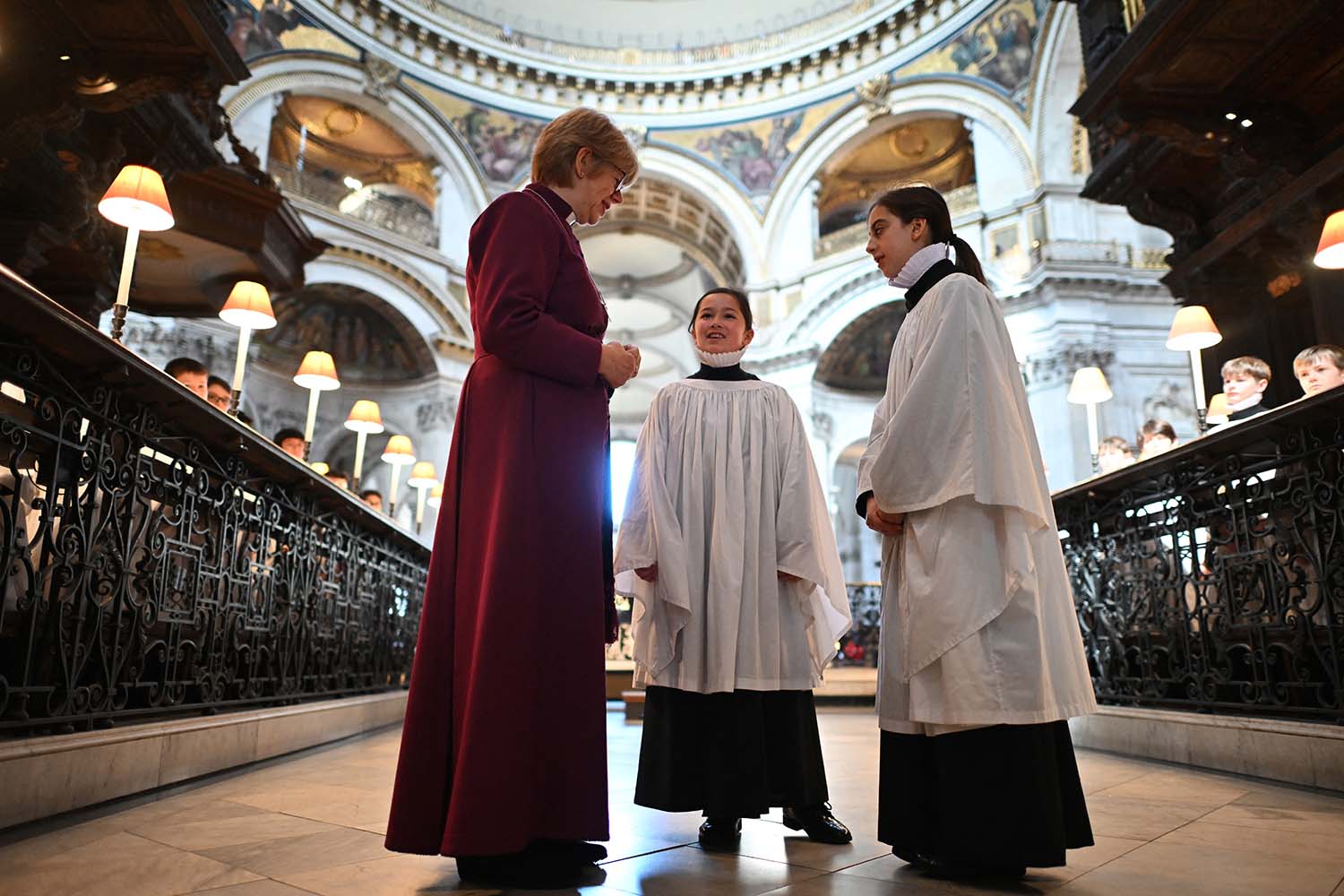
Girl choristers 10-year-old Lois, (C) and 11-year-old Lila, (R) speak to Bishop Sarah Mullally, the first female bishop of London, as they pose for photographers during a photocall at St Paul’s Cathedral in London on June 29, 2024. (Photo by JUSTIN TALLIS/AFP via Getty Images)
More evidence of Mohler’s increasing limitations for women may come from his reflection on the recent installation of Sarah Mullally as archbishop of Canterbury in the same podcast episode.
Speaking of the day the Church of England allowed women to be ordained as priests, he said: “No one back 50 years ago was ready for a female archbishop of Canterbury and said, ‘We’re just stopping at this.’ But you can’t just stop at that. It doesn’t stop. Once you get into a confusing pattern, the confusion doesn’t clarify itself.”
Mohler’s argument is that women in any kind of leadership is a slippery slope. He contends once women are allowed to have the title of “pastor,” even as children’s pastor or women’s pastor, that will lead to a confusing pattern that ends with women in the highest office of the denomination.
If Mohler’s slippery slope argument is correct, then the opposite also must be true.
When women are denied access to certain roles in leadership, they ultimately also will be denied a seat at any table and even lose their representation in the denomination.
But sliding down the hill even further, what’s next? Will women no longer even be allowed to attend church with men? Will women be refused religious access and identity at all?
By Mohler’s own logic, denying women leadership and representation will result in women losing all rights to participation in religious life among Baptists.
Despite his protest, that is an insult to women.
Speaking of insults to women, last week Turning Point USA held an event on the campus of Baylor University — a Baptist university that has departments that espouse support for women in ministry and women’s equality. This event and its sister event on Baylor’s campus have been reported extensively, so I will mention only this one detail.

Benny Johnson
Benny Johnson, a conservative podcaster, was among Turning Point’s speakers. According to student reporters for the Lariat, when a student audience member said they had experience raising cows and pigs, Johnson replied, “So you are very familiar with how to deal with liberal women.”
Another student challenged Johnson for making such a crude comment while claiming to be a person of faith, and Johnson rebuffed that it was only a joke.
Mohler may not have compared women to farm animals, but in arguing against women’s right to even have a voice in religious matters, he and Johnson have in common their willingness to unashamedly and publicly insult women.
Such degradation of women cannot be allowed. As an important aside, such degradation of any person cannot be allowed, but I will keep my focus on women for the sake of this article.
To all Baptists who espouse support for women in ministry and women’s equality, we must speak up and come together as a strong and united voice so we can fight the gravity of the slippery slope leading toward the disappearance of all women’s rights.
Our voice for the equality Christ modeled is weakened when we platform dehumanization and suppress liberation.
Our voice is subdued when we call women’s equality a secondary issue.
Our voice is muted when we conduct litmus tests that keep us from being able to come together and celebrate the image of God in women and in all people.
And when we are silent and have no voice at all, the loudest voices, however insulting and degrading they may be, will win.
So, whether it be in public discourse or also in quieter conversations and acts of support, let us not be ashamed to unite and use our voices so that love might win instead.
Meredith Stone serves as executive director of Baptist Women in Ministry.
Related articles:
Yes, there is a movement to take away women’s right to vote
Mohler and Pressley on women having a seat at pastoral table