

I have spent much of my life working at the intersection of faith and public life, often in rooms where people insist religion should stay out of politics.
I understand why. Faith has been used to divide, to dominate, to justify harm.
But what I am seeing now is something different and more dangerous. Faith is being weaponized to silence dissent and reshape reality itself.
The only way to respond is to reclaim it for liberation.
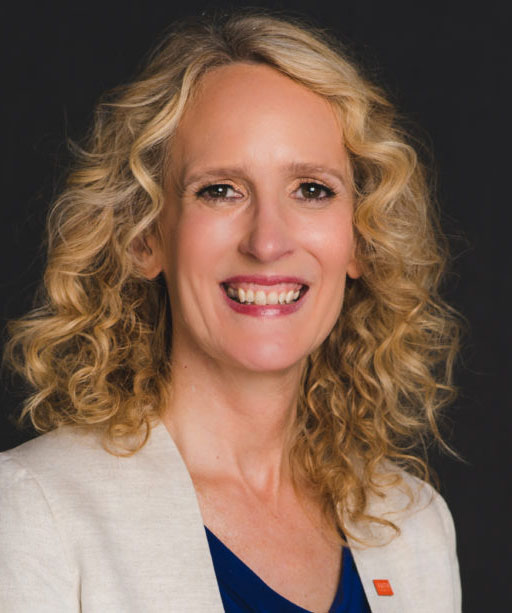
Jennifer Butler
In their quest for absolute power, autocrats demand absolute loyalty. They achieve it by silencing dissent.
Here’s how it works.
On one front, political leaders elevate a distorted Christianity — one that advocates violence, enforces exclusion and punishes dissent. Criticism becomes betrayal. Dissent becomes a crime. It is an attempt to redefine Christianity in narrower, more exclusionary and ultimately nationalist terms.
On another front, immigration enforcement becomes a theater of fear — communities destabilized, due process eroded, neighbors turned against one another. The goal is not just enforcement. It is intimidation — an attempt to redefine America in narrower, more exclusionary, and ultimately white terms.
And now, on yet another front, the administration attempts to dismantle the very organizations that expose violent extremism.
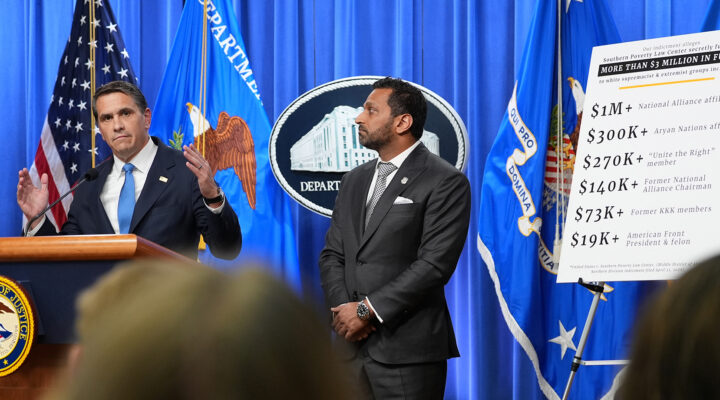
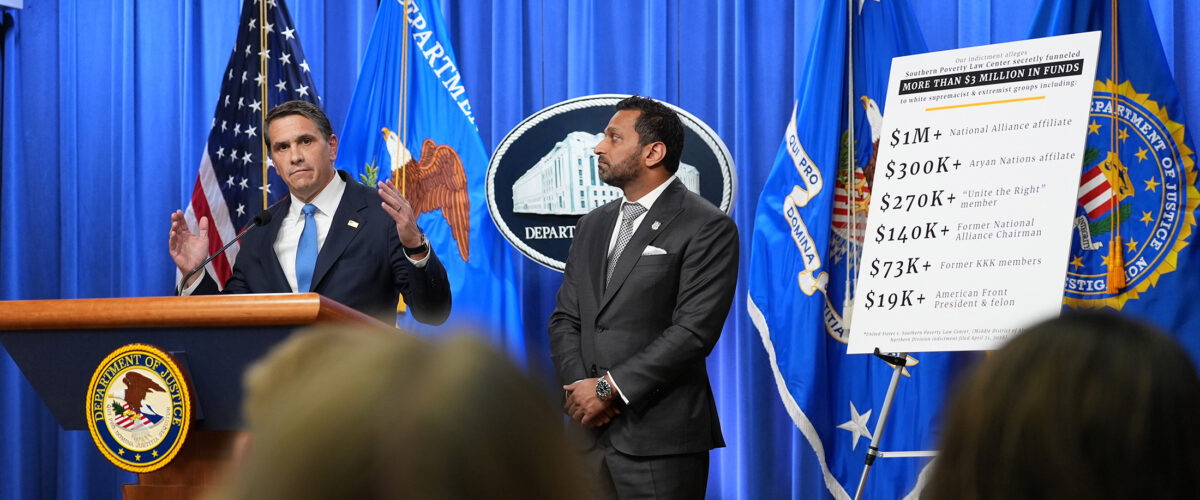
Last week, the Justice Department indicted the Southern Poverty Law Center, alleging fraud tied to its use of informants — informants who helped disrupt violent hate groups.
“The administration attempts to dismantle the very organizations that expose violent extremism.”
For more than 50 years, the SPLC has tracked the Ku Klux Klan, exposed white nationalist networks and documented the rise of Christian nationalism. The group rose to national fame in the 1980s by financially breaking the modern Klan through strategic lawsuits on behalf of its victims. Their offices have been firebombed. Their staff threatened. Their work has saved lives.
Now, that work is being reframed as criminal. This is not new. It is a pattern.
Historian Steven J. Ross documents how, before and after World War II, civil society stepped in when the government would not. While federal agencies were slow — or unwilling — to act, groups like the ADL and the Anti-Nazi League infiltrated violent extremist networks and helped stop attacks before they happened.
In one case, an undercover operative infiltrated a fascist group known as the Columbians, who were plotting to bomb a Black Baptist convention in Savannah, Ga. She gathered hundreds of pages of evidence, leading to the group’s arrest.
This is the tradition the SPLC stands in: Ordinary people taking extraordinary risks to defend democracy when institutions fall short.
And that is precisely why they are being targeted.
Authoritarian power depends on rewriting reality — deciding who is dangerous, who is legitimate, who belongs.
“This is not just about policy. It is about control over truth itself.”
January 6 insurrectionists become heroes. Civil rights laws become “discrimination.” And those who expose violence become criminals.
This is not just about policy. It is about control over truth itself.
To understand this moment, we have to go deeper.
The early Christians faced a similar test under the Roman Emperor Domitian, who demanded worship as a god. Refusal was not just dissent. It was treason.
It is in that moment that John of Patmos writes the Book of Revelation. Not as a prediction of the end of the world as Christian nationalists often believe, but as a guide for surviving empire.
Writing in code, John unmasks how domination works: Through fear, spectacle and the demand for total allegiance.
The “mark of the beast” is not a mystery. It is a metaphor of the pressure to conform, to give loyalty to a ruler or beast who claims what belongs to God.
And John offers a counter-command: Do not comply. Do not be deceived. Do not worship what is not God.
“Do not comply. Do not be deceived. Do not worship what is not God.”
He teaches his community how to see clearly — and how to endure.
We saw it in Minneapolis. Neighbors showed up for neighbors. They alerted them to danger. They took kids safely to school when parents could not for fear of being profiled. They delivered medical aid to houses. They gave money so families could pay rent.
After federal agents killed two U.S. citizens during aggressive immigration operations, community members refused to accept the official narrative. They documented what happened. They organized. They protested. They demanded accountability. And it mattered.
Public pressure forced a shift. Leadership changed. Agents were pulled back.
Not everything changed. But something did.
They disrupted the story. They refused the lie. They told and demonstrated the truth in thought, word and deed. And it changed what was possible.
That is the power authoritarianism fears most.
But for those of us shaped by the gospel, there is something even deeper. Jesus does not only call us to reject lies. He calls us to bear witness.
To bear witness that another reality already is breaking through. To bear witness to a kingdom not built on domination, but on dignity; not on fear, but on love; not on exclusion, but on belonging.
We resist not only through truth telling, but through loving action, by standing with the vulnerable, protecting our neighbors and refusing to participate in systems that deny their humanity.
This is not passive, nor is it naïve. It is how empires fall.
Clergy, your public theological voice matters. Continue to help your communities name what is happening — not in partisan terms, but in moral and theological ones. Create spaces where people can tell the truth without fear.
Have a plan. I recently visited an evangelical church where a retired national security official sat quietly by the door, keeping watch so his neighbors could worship in peace.
For all of us, refuse the lie. Find others who refuse and join them.
Pay attention to whose voices are being silenced and why. Support organizations that protect the vulnerable and expose violence. Stand with your neighbors when they are targeted. Tell the truth, even when it costs something. Use your faith voice to call people back to who they are.
And remember: We are not only resisting what is wrong. We are bearing witness to what is already breaking through.
Jennifer Butler founded Faith in Public Life, which she led from 2005 to 2022. She is the author of Born Again: The Christian Right Globalized and Who Stole My Bible? Reclaiming Scripture as a Handbook for Resisting Tyranny. She served as chair of the White House Council on Faith and Neighborhood Partnerships from 2015 to 2016 and spent 10 years working in the field of international human rights representing the Presbyterian Church (USA) at the United Nations.