

In a recent Atlantic article, David Brooks writes: “Many of us thought that the world would get more democratic as it modernized, but for the past quarter century, we have seen a reversion to authoritarian strongmen. Donald Trump, acting like some 16th-century European prince, has made the presidency his own personal fiefdom.”
I agree, with one small addition. President 47 not only behaves like “some 16th-century European prince,” but also like something of a 16th-century pontiff.
Newly sworn into his second presidential term, Trump AI-ed (A permissible postmodern term?) himself into full papal garb. In his recent kerfuffle with Pope Leo XIV, Trump seems strangely pontifical, claiming a kind of religio-secular infallibility, not simply ex cathedra, that seldom-used dogma of infallibility when popes declare they are speaking on specific matters of “faith and morals” for the entire Catholic Church, but on everything.
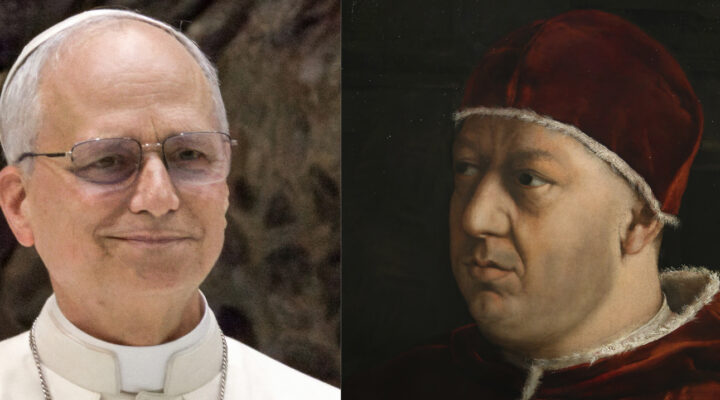
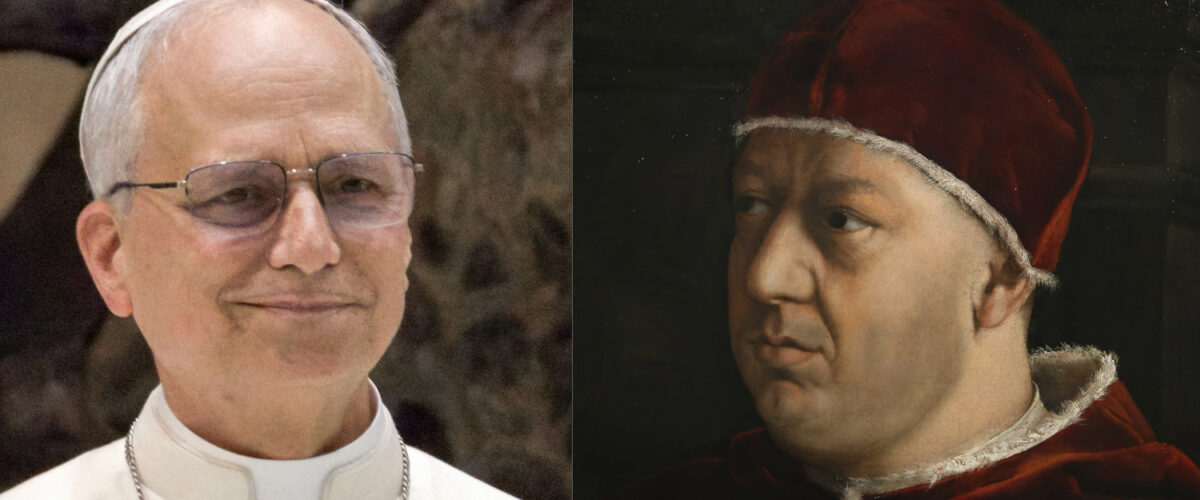
Such tensions suggest a tale of two Leos: Pope Leo X, whose 16th-century confrontation with Augustinian priest and university professor Martin Luther presaged the Protestant Reformation, and another Augustinian, Pope Leo XIV, whose 21st-century critiques of Trump and Co.’s attempt to turn the Prince of Peace into Jehovah, God of Battles, represent a reversal of roles between Catholic and Protestant protagonists.
In a twist of gospel irony, both Martin Luther and Leo XIV offer a prophetic challenge to two powerful monarchial leaders who, in their own times, utilize secular and religious means to solidify their particular autocratic ends.
Pope Leo X
Martin Luther opened the door to Protestantism on Oct. 31, 1517, with the circulation of his Ninety-five Theses challenging papal authority for selling documents that, when proper funding (and repentance?) was made, assured release of the purchaser or his/her relatives from purgatory.
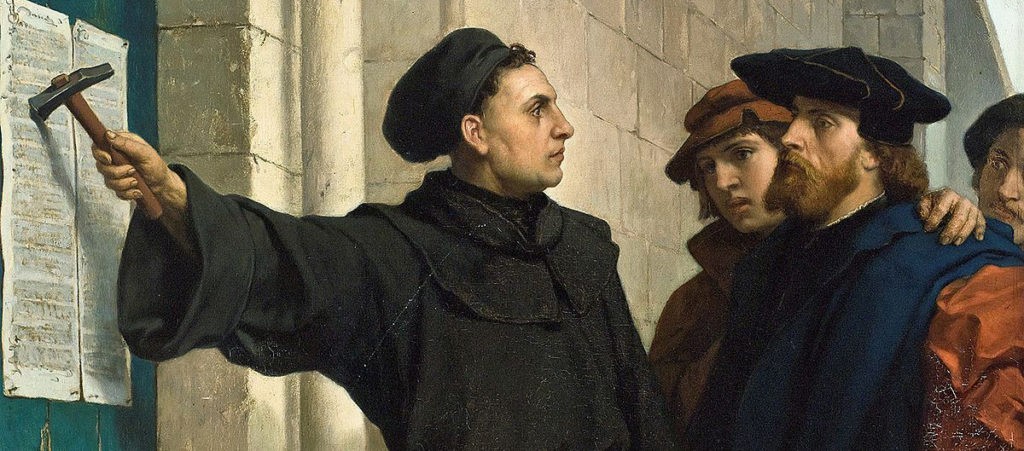
Martin Luther posting his 95 theses, by Ferdinand Pauwels, 1872.
Papally commissioned indulgence sellers promised, “When a coin in the coffer clings, a soul from purgatory springs.” Leo X used indulgence money for building St. Peter’s Basilica in Rome. Luther’s Theses take indulgences apart piece by piece. My personal favorite reads:
- To wit: — “Why does not the pope empty purgatory, for the sake of holy love and of the dire need of the souls that are there, if he redeems an infinite number of souls for the sake of miserable money with which to build a Church? The former reasons would be most just; the latter is most trivial.”
Circulation of the Theses reached Pope Leo X who, on June 15, 1520, issued a papal bulla, titled Exsurge Domine, and translated, “Arise, O Lord and judge thy cause. … A wild Boar is loose in thy vineyard.” In it, Leo X denounced 41 of Luther’s theses as outside the bounds of Catholic and papal orthodoxy. He warned Luther and his followers to recant or be excommunicated.
Leo concluded: “With mature deliberation on each and every one of the above theses, and by the authority of almighty God, the blessed Apostles Peter and Paul, and our own authority, we condemn, reprobate and reject completely each of these theses or errors as either heretical, scandalous, false, offensive to pious ears or seductive of simple minds, and against Catholic truth.
Luther’s response was equally direct:
You then, Leo, you cardinals and the rest of you at Rome, I tell you to our faces: “If this bull has come out in your name, then I will use the power which has been given me in baptism whereby I became a son of god and co-heir with Christ, established upon the rock against which the gates of hell cannot prevail I call upon you to renounce your diabolical blasphemy and audacious impiety, and if you will not, we shall all hold you and your seat as possessed and oppressed by Satan, the damned seat of the Antichrist, in the name of Jesus Christ, whom you persecute.”
Luther and his students burned Exsurge Domine in Wittenburg.
On Jan. 3, 1521, Leo X excommunicated Luther in a document titled Decet Romanum Pontificem, a phrase translated, “It is fitting for the pope,” casting him out of the Catholic Church and declaring him an “outlaw” to be captured and executed for heresy. Protected by his German prince, Frederick the Wise of Saxony, Luther escaped arrest and execution.
Pope Leo XIV
Some 505 years later, the 14th Pope Leo finds himself enveloped in controversy, not with a recalcitrant priest but with an intractable president who questions whether “it is fitting for the pope” to challenge certain national and global actions of the Trump administration.
The conflict appeared by September 2025, shortly after both men secured their respective offices and Leo XIV addressed the Trumpian response to immigrants: “Someone who says I’m against abortion but is in favor of the death penalty is not really pro-life. And someone who says I’m against abortion but I’m in agreement with the inhuman treatment of immigrants in the United States, I don’t know if that’s pro-life.”

Pope Leo XIV addresses the faithful gathered in Saint Peter’s Square for the Regina Caeli on April 12, 2026, in Vatican City, Vatican. “We have moral obligation to protect civilians from horrific effects of war,” Pope Leo said. (Photo by Elisabetta Trevisan – Vatican Media via Vatican Pool/Getty Images)
Without mentioning Trump, the pope questioned his mass deportation agenda as “extremely disrespectful” to immigrant communities. Later came remarks questioning American military actions, first in Venezuela, then in Iran.
On an April visit to Cameroon, Leo criticized leaders who use religion as a basis to justify war, insisting: “The masters of war pretend not to know that it takes only a moment to destroy, yet often a lifetime is not enough to rebuild. They turn a blind eye to the fact that billions of dollars are spent on killing and devastation, yet the resources needed for healing, education, and restoration are nowhere to be found.”
The Pope added on X: “Woe to those who manipulate religion and the very name of God for their own military, economic and political gain, dragging that which is sacred into darkness and filth.”
Trump answered back:
I don’t want a Pope who thinks it’s OK for Iran to have a Nuclear Weapon. I don’t want a Pope who thinks it’s terrible that America attacked Venezuela, a Country that was sending massive amounts of Drugs into the United States and, even worse, emptying their prisons, including murderers, drug dealers, and killers, into our Country. And I don’t want a Pope who criticizes the President of the United States because I’m doing exactly what I was elected, IN A LANDSLIDE, to do, setting Record Low Numbers in Crime, and creating the Greatest Stock Market in History.
Predictably, Trump attributed Leo’s election not to the Holy Spirit, but to himself:
Leo should be thankful because, as everyone knows, he was a shocking surprise. He wasn’t on any list to be Pope, and was only put there by the Church because he was an American, and they thought that would be the best way to deal with President Donald J. Trump. If I wasn’t in the White House, Leo wouldn’t be in the Vatican.
Then this “pastoral” advice:
Leo should get his act together as Pope, use Common Sense, stop catering to the Radical Left, and focus on being a Great Pope, not a Politician. It’s hurting him very badly and, more importantly, it’s hurting the Catholic Church! President DONALD J. TRUMP.
In defending the president’s comments, Vice President JD Vance opined: “I certainly think that in some cases, it would be best for the Vatican to stick to matters of morality, to stick to matters of … what’s going on in the Catholic Church and let the president of the United States stick to dictating American public policy.”
Dictating??
“I have no fear of either the Trump administration or speaking out loudly about the message of the gospel.”
Sounding somewhat Luther-like, Leo XVI retorted: “I have no fear of either the Trump administration or speaking out loudly about the message of the gospel. We’re not politicians. We’re not looking to make foreign policy, as he calls it, with the same perspective that he might understand it.”
He promised to “continue to speak out loudly against war, looking to promote peace, promoting dialogue and multilateral relationships among the states, to look for just solutions of the problems.
To compel countries to accept their policies, Medieval popes sometimes slammed them with “interdicts,” closing all churches to marriages, burials, baptisms and sacraments. The New York Times’ Maureen Dowd documents Trump’s similar action, writing: “In a puerile fit of apparent retribution, Trump canceled an $11 million federal contract with Catholic Charities in Miami to house and feed migrant children coming to America alone.”
MAGA religionists may need to study Medieval Christianity more closely.
Called to testify before the Diet of Worms (Germany) in 1521, Martin Luther refused to recant, asserting: “My conscience is captive to the word of God. I cannot and will not recant, for to go against conscience is neither safe nor right.”
He probably added: “God help me. Here I stand. Amen.”
Five centuries later, Catholic and Protestant alike had best cling to our consciences.
And all the gospel we can muster.
Bill Leonard is founding dean and the James and Marilyn Dunn professor of Baptist studies and church history emeritus at Wake Forest University School of Divinity in Winston-Salem, N.C. He is the author or editor of 25 books. A native Texan, he lives in Winston-Salem with his wife, Candyce.
Related articles:
In post full of lies, Trump lambastes Pope Leo
‘We need the moral courage to stand where Pope Leo stood this morning’