

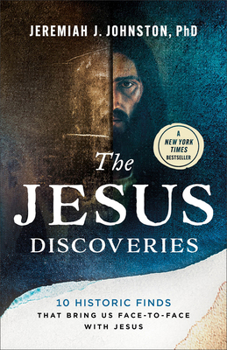
Popular evangelical biblical scholar Jeremiah Johnston’s latest book, The Jesus Discoveries: 10 Historical Finds that Bring Us Face-to-Face with Jesus, has become an unexpected publishing phenomenon. It currently ranks among the top titles on both the New York Times bestseller list and Amazon’s religion list, signaling a broad public appetite for bold claims about Christian antiquities.
The book’s central arguments are striking. Johnston contends the Shroud of Turin is the actual burial cloth of Jesus Christ. He goes further, asserting a “burst of energy” at the moment of the Resurrection caused the image to be imprinted on the linen. Most provocatively, he claims the blood of Jesus Christ is physically present on the Shroud, preserved for two millennia as empirical testimony to the Passion.

Lee Enochs
These are not modest proposals. They are maximal claims that collapse the traditional boundaries between historical inquiry, forensic science and theological conviction. And while Johnston’s visibility has brought renewed public interest to early Christian material culture, it also has reopened long-settled questions about evidence, method and scholarly responsibility.
Despite the book’s popularity, I remain unconvinced. The reasons are straightforward and have less to do with theological predisposition than with historical and scientific fact.
First, the radiocarbon dating. In 1988, three independent laboratories in Oxford, Zurich and Tucson dated samples from the Shroud to 1260 to 1390 AD with 95% confidence. That dating has been contested, but no subsequent peer-reviewed testing has overturned it. Until new, rigorously controlled samples are tested and published, the 14th-century date remains the best scientific anchor we have.
“It is theological conjecture dressed in the language of physics.”
Second, the “burst of energy” hypothesis is not a scientific explanation; it is theological conjecture dressed in the language of physics. No known mechanism in forensic science accounts for a full-body, photographic-negative image being seared into linen by a momentary release of undefined energy. The image formation remains debated, but invoking the Resurrection as a causal agent moves the discussion out of the realm of testable hypotheses.
Third, the blood claims require far more precision. AB-type blood has been reported on the Shroud, and the stains test positive for heme. Yet presence of blood does not prove identity. Without ancient DNA — and the Shroud’s contamination history makes that prospect nearly impossible — there is no scientific pathway to identify the blood as belonging to Jesus of Nazareth. To assert otherwise is to confuse possibility with demonstration.
 Finally, the historical record is stubborn. There is no unambiguous reference to the Shroud before its appearance in Lirey, France, in the 1350s. Bishop Pierre d’Arcis’ 1389 memorandum to the Avignon pope explicitly called it a painted cloth, with an artist who had confessed to the forgery. The canonical Gospels describe multiple burial wrappings, including a separate face cloth, not a single 14-foot sheet. These texts cannot be reconciled with the Shroud without special pleading.
Johnston’s expertise on the Dead Sea Scrolls is not in question. But authority in one subfield does not automatically transfer to another, especially when the latter involves radiocarbon physics, textile forensics and Medieval art history. The public, understandably, wants certainty about relics connected to Christ. Sensationalist claims fill that void, but scholarship advances by resisting it.
The Shroud of Turin is a remarkable artifact worthy of study. It is a masterpiece of Medieval devotion, a focal point of pilgrimage and a puzzle for image science. What it is not, based on the current weight of historical and scientific evidence, is the burial cloth of Jesus Christ bearing his literal blood and an energy signature of the Resurrection.
Despite Johnston’s sincere and zealous claims, I remain unconvinced about the veracity of his central arguments regarding the Shroud of Turin irrespective of the popularity of his recent books that make many fantastical claims.
Lee Enochs is a graduate of Princeton Theological Seminary, Southwestern Baptist Theological Seminary, Gateway Seminary and the University of North Texas. He also is a Ph.D. student in history and is currently forming a Shroud of Turin study group based in Princeton, N.J. Lee also hosts a weekly podcast on current events and religion for KNTU Radio.