



Last week, the Oklahoma legislation known as the “Cindy Clemishire Act” died after the state Senate adjourned early, without calling the bill to a floor vote. This came just one day after its unanimous passage out of the Senate Judiciary Committee.
The public safety bill would have eliminated the criminal statute of limitations for sex crimes committed against children. It also included “Trey’s Law” language, which aims to eliminate the weaponization of non-disclosure agreements in civil settlements related to child sexual abuse, sexual assault and sex trafficking.
As the session approached its closure without the bill’s passing, advocates spoke out in support of the bill, including Clemishire herself.

Cindy Clemishire
On Thursday, Clemishire said: “I am standing here at the Capitol today because we are down to the final hours, and the safety of Oklahoma’s children is hanging in the balance. For decades, predators have used these outdated laws to hide from justice. The House and the committees have done their part unanimously — now, it is entirely up to the Senate. Senate leadership must bring this to a vote today, and if they don’t, you have to ask, ‘Who are they protecting, and why?’”
Clemishire is a survivor of sexual abuse at the hands of Robert Morris, the former pastor of Gateway Church in Dallas, who pleaded guilty to five felony counts of lewd or indecent acts with a child. Clemishire’s abuse began when she at just 12 years old in the 1980s while Morris passed through Oklahoma as a traveling evangelist.
She was only able to pursue charges against him because of a frontier-era loophole in Oklahoma that allows prosecutors to pursue a case if the perpetrator committed a crime in the state while passing through. The case was otherwise barred by the current Oklahoma criminal statute of limitations. Additionally, Clemishire previously refused in earlier years to enter a settlement agreement with Morris that included an NDA.
This session’s bill, the Cindy Clemishire Act, originated in the House of Representatives as HB-4227 but was substituted by the Senate version SB-740 after the deadline to consider House bills passed. Advocates, including Elizabeth Carlock Phillips and Clemishire, testified in support of the bill until the final hours of the legislative session.
“Trey’s Law has passed unanimously in seven states and today before U.S. Congress in the Senate Judiciary Committee. We have come too far and fought too hard to see these protections stall at the finish line in Oklahoma. The legislative session ends today, and we cannot afford to wait another year to restore victims’ rights,” Phillips said on Friday.
“We have come too far and fought too hard to see these protections stall at the finish line in Oklahoma.”
“With a perfect 199-0 record of unanimous support across both chambers in this state so far, I hope Senate leadership hears this as a clear, bipartisan mandate to protect Oklahoma’s children. The people’s business isn’t finished until SB-740 is heard and voted to passage on the floor. Every day we delay, more children are left vulnerable and more predators escape justice. I urge Senate leadership: Do the right thing for children. This was supposed to be an easy ‘yes.’ for this body, and Oklahoma is a sad outlier in otherwise sweeping national momentum. Cindy and I stand together for kids today.”
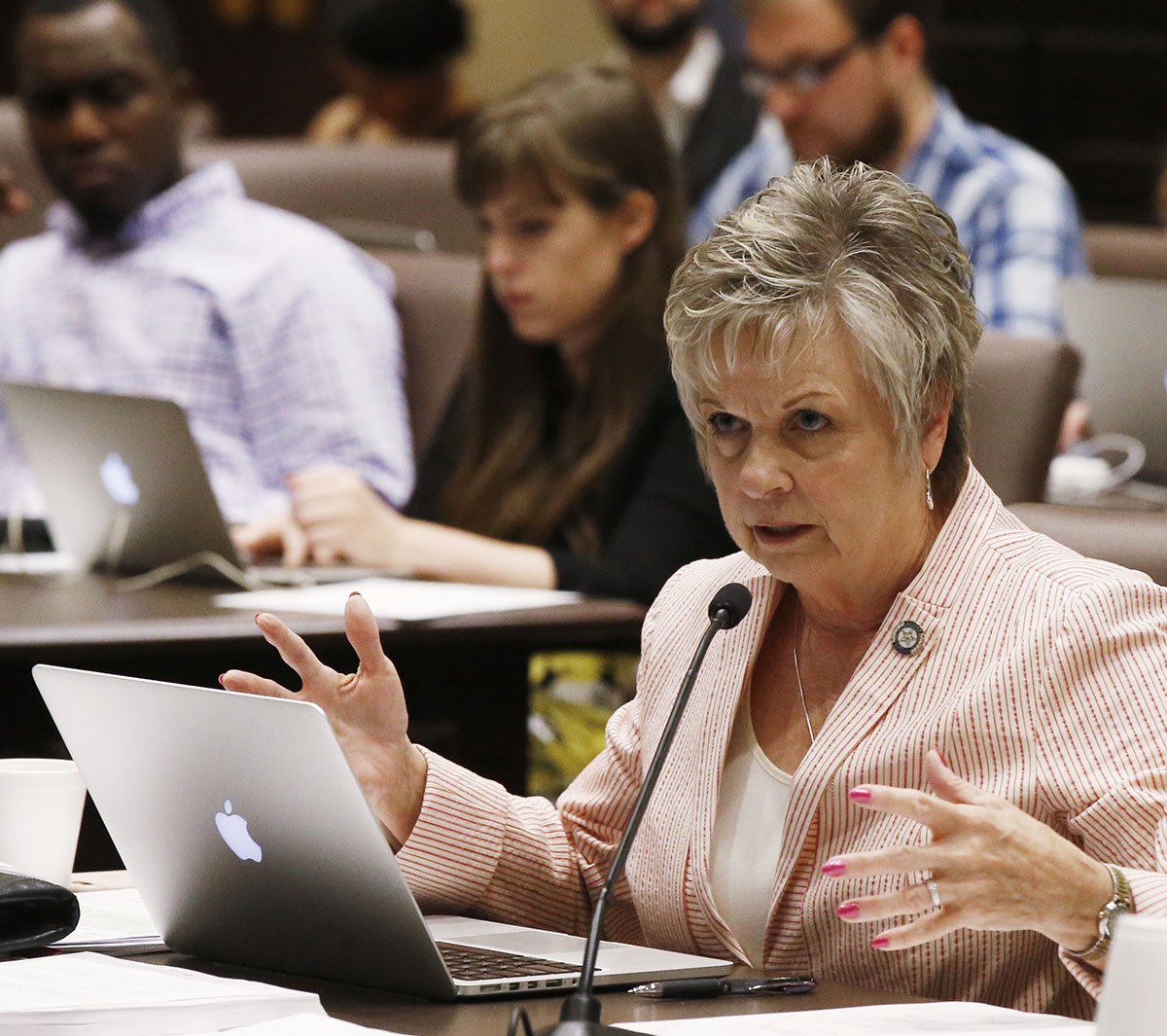
Oklahoma state Sen. Julie Daniels in a 2018 file photo. (AP Photo/Sue Ogrocki)
According to Religion Unplugged, the measures were blocked by Sen. Julie Daniels, R-Bartlesville, “leaving Oklahoma one of six states that have not fully eliminated criminal statutes of limitations for child sexual abuse and trafficking.”
On Friday, Daniels said a provision raising the age under which victims could come forward was “a deal breaker” that caused her to block the measure. The current cutoff age is 45; the measure would have raised the age limit to 54.
“The statute of limitations is there to protect the innocent, not to punish a victim, and the further you get away from the time in which a crime may have been committed or is alleged to have been committed, the more difficult it is for a defendant to mount a successful defense, and that is why you have a statute of limitations,” Daniels said. “To focus on simply one particular story, which was very traumatic, and one which I sympathize with greatly, I have to look at the balance of what does this also do on the defense side.”
“I just want to say ‘thank you’ to every single representative and to all the senators that did support out bill. We appreciate you and we look forward to working with you next session. To the survivors out there, to the victims, we aren’t going to give up. This is for you. Stay strong.