

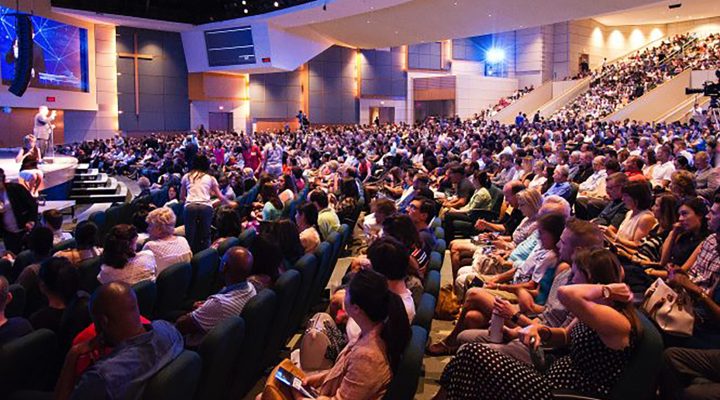
A long-running legal dispute between leadership of McLean Bible Church and members who have accused Pastor David Platt of attempting to take over the church got new life — yet again — May 19.
The Virginia Court of Appeals remanded the case to a circuit court for reconsideration, based on a request for additional discovery. Steve Gaskins et al vs. McLean Bible Church has been up and down and all around the Virginia court system, with rulings, appeals and bad blood between congregants and their pastor.

David Platt
Those disaffected members got new life to their case with the latest court of appeals ruling, which continues to explore whether the civil courts are eligible to rule on the matter or whether it is ecclesial in nature and therefore off limits.
Although McLean is a well-known nondenominational Bible church, Platt is a Southern Baptist who previously led the Southern Baptist Convention’s International Mission Board. Among the accusations made against him is fear that he has given church money to SBC causes and is leading the church to become “woke.”
The dispute stems from the election of elders in 2021, just as the church was coming out of the isolation required by the COVID-19 pandemic. That dispute is explained in an earlier BNG article.
Plaintiffs in the case also created a documentary film telling their story.
One of the legal issues in the case is whether secular courts should address an internal church dispute at all. The “ecclesial abstention doctrine” says courts must avoid interfering in matters that are ecclesial or theological.
Church leaders contend that principle should preclude adjudication of the charges against them in the civil courts. But a key finding of the latest ruling on appeal is that the McLean case is about operation of a state-recognized nonprofit entity that does not involve theological matters to decide.
“As MBC correctly points out, the First Amendment’s protections extend to one of the most fundamental religious matters of all: a church’s membership decisions — its ‘selection of those who will personify its beliefs,’” the ruling says.
“When the majority has spoken in a fairly conducted congregational meeting held after proper notice to the membership, then the governing body of the church has expressed its will and, as in the case of a hierarchical church, its decision is constitutionally immune from judicial review,” the ruling explains. “The situation is otherwise, however, when the members of a congregational church merely seek the protection of the court for the purpose of obtaining a fairly conducted meeting in the first place. Here the analogy to hierarchical churches breaks down because there is no body of ecclesiastical law to invoke, no internal tribunal to appeal to.
“The number eight is neutral.”
“Thus, although this case involves membership decisions, we — and the members of MBC — are bound not by the board’s decisions, but by ‘the will of the majority,’ as expressed in the MBC Constitution. And courts are free to interpret and apply the relevant provisions of that constitution just as long as they do so ‘in purely secular terms’ and do not ‘rely on religious precepts.’”
The McLean dispute, the court ruled, “hinges on neutral principles.”
“The number eight is neutral. That is the number of consecutive weeks of worship services a member must miss before the board may deem them inactive. If a member who has not missed eight consecutive weeks is declared inactive, the board has violated the MBC Constitution. And that is exactly what the dissenters allege happened here. This court, and all other courts in Virginia, are surely able to count to eight without entering a ‘religious thicket.’”
The church counters this is not a neutral judgment because the eight weeks must be missed “without reasonable excuse.” And defining what constitutes a reasonable excuse is a purely ecclesiastical question, they assert.
Part of what the plaintiffs seek in additional discovery is records that would show those removed from the board missed eight consecutive weeks of worship services — during the pandemic — and did so “without reasonable excuse.”
If that can be proved, there is no case for a secular court, the appeals ruling states. And figuring that out can be proved with “numerical principles,” not theology, the court explained.
The church says even if the ecclesiastical abstention doctrine does not apply, the “very process of inquiry” into these matters would infringe on the church’s First Amendment rights.
Here, the court cites another Southern Baptist case, McRaney v. North American Mission Board of the Southern Baptist Convention, and other cases to say the trial judge should have discretion to “control discovery and the flow of evidence” so that if ecclesiastical matters overtake the litigation, the case can be stopped.
The appeals court says it finds “nothing objectionable about allowing limited discovery to determine whether the ecclesiastical abstention doctrine applies.”
“We embrace the perhaps subtle — but meaningful — distinction between a religious institution being ‘above the law’ and being subject to the law while still wielding significant privileges and protections,” the ruling explains.
For these reasons, the circuit court was in error by finding the First Amendment’s religion clauses barred it from compelling any discovery, the appeals court ruling says. That means “appropriately limited discovery” should be undertaken “to determine whether the ecclesiastical abstention doctrine applies.”