

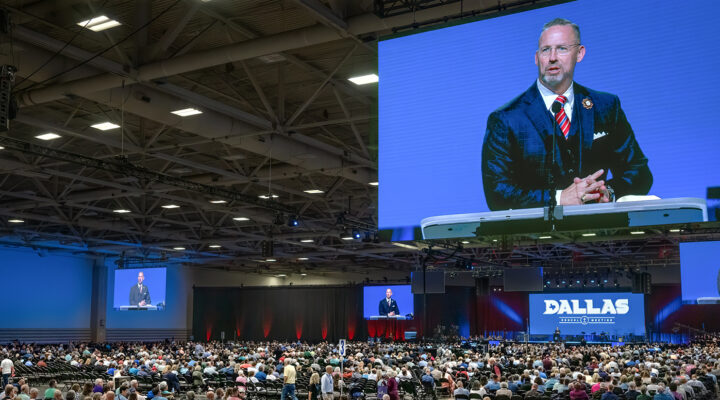
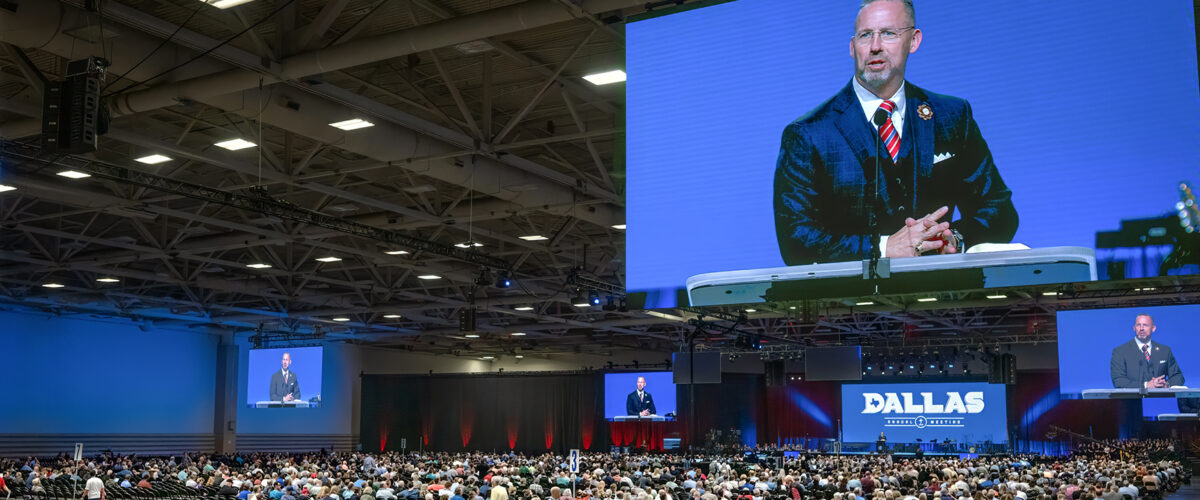
As Southern Baptists prepare to consider Al Mohler’s so called “Truth and Unity Amendment” at their annual meeting in Orlando next month, many Baptist women are becoming weary of Southern Baptist men defining “unity” as joining together to silence women.
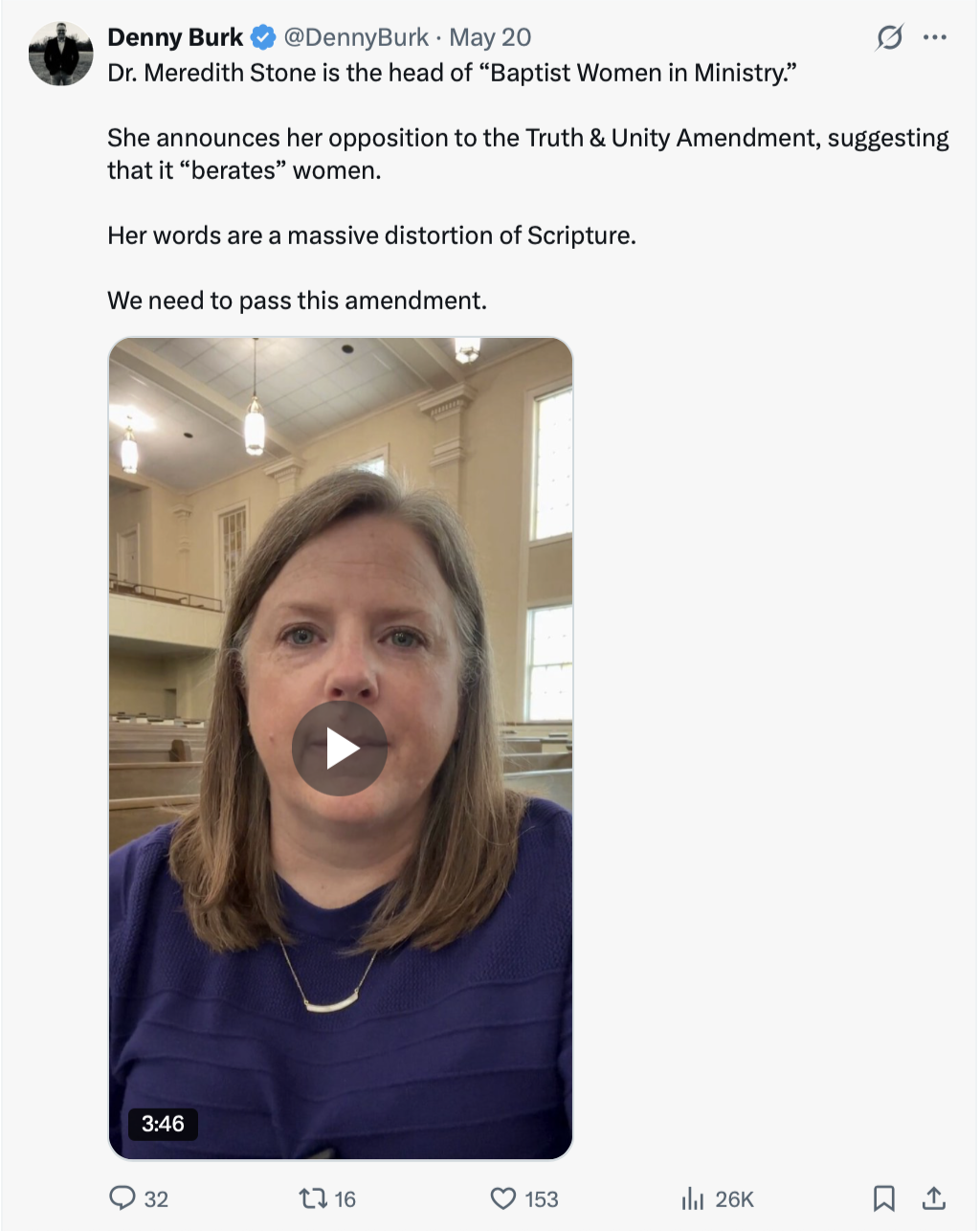
Meredith Stone, executive director of Baptist Women in Ministry, posted a video on social media last week to name how tired women are of these antics. Then Southern Baptist men had a meltdown, calling her a Jezebel, Satan, a serpent and a vicious wolf for committing the unpardonable sin of daring to question Mohler’s patriarchy, which includes not only prohibiting women from being called “pastor” or functioning as pastors, but also from discussing a male pastor’s sermons on podcasts.
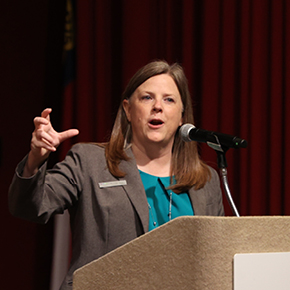
Meredith Stone (Photo by Marv Knox)
Stone appeared on BNG’s podcast “Highest Power: Church + State” this week for an interview about the controversy. Here is an edited version of my full interview with her.
Is there anything different in Mohler’s amendment than in previous proposals over the past few years?
This is an intensification of what has been said before. It says a Southern Baptist church does not affirm, endorse or employ a woman in the office or function of pastor, overseer, elder. And the “function” is new. A lot of churches had women serving as children’s pastors, women’s pastors, missions pastors. And just by saying the title of “pastor,” their church was going to be disfellowshipped or up for disfellowship. Some were saying, “Well, we’ll just change their title. We’ll call the, children’s director instead of a children’s pastor.”
What Mohler has been saying is because that has been viewed as a workaround for some churches, adding in “the function of pastor” clarifies. If she is speaking or teaching before the whole congregation, if she is doing anything in an authoritative role that would be equivalent to pastor, overseer, elder, then she is doing the thing that would get you disfellowshipped.
He’s also highlighting any kind of preaching that happens. We had the big controversy in 2021 over Beth Moore preaching on Mother’s Day at a church. And this is a way in which they’re trying to find even more clarification.
What I’ve seen from some Southern Baptist pastors here in the last week is they’ve said, “OK, if we’re going to say women can’t preach before the assembled congregation, what about the children’s sermon? She’s expositing Scripture to the children, but it’s in front of the whole church. Can women not give children’s sermons anymore if this passes?”
“Can women not give children’s sermons anymore if this passes?”
Another thing I saw come up was a church has a podcast, where all their ministers are part of the podcast, and sometimes people ask questions. If a woman were to somehow speak about Scripture or give any kind of authoritative teaching on a podcast, does that count as the function of pastor? And Mohler says, well, that would be a problem.
So not even just having the title, no preaching before everyone, no podcasting before everyone. I imagine questions will come up about, can she even write in the newsletter? Because it will be read by the whole church.
It almost feels like he’s taking away women’s ability to disciple others.
 It definitely feels that way. They try to make the case in all these instances that, “This doesn’t mean that we don’t value women. We value women in the church and what they do in the church. We think women have full value to God. They just can’t do these things.”
And I don’t know if they realize what they are saying. Whenever you put limitations on someone, you have immediately limited their value to the whole. They have said, “You’re not valuable to the whole church. You’re only valuable to these children or these women.”
And thus, it kind of falls down that slippery slope. If women are not valuable to the whole church, then women begin to question, “Am I even as valuable to God as men are if God wants men doing all of these big things, but we have to stay in our corner and be quiet?”
It makes women even question, Do I have equal status as a member of God’s family?
A lot of the conversations here end up going toward biblical interpretation. How does this word translate here and how does this concept translate there. And I understand why that’s important to people to think about what the Bible says. But there’s a deeply human element going on here. How does it affect women when they’re constantly told they shouldn’t be seen or heard?
It’s not a conflict that’s theoretical. It is a conflict that is about their bodies and how they exist in the church. And so these women have been struggling quite a bit for the last few years.
You can only take it for so long. You can only hear so long, “You’re the problem. If you weren’t our youth pastor, we wouldn’t have a problem with the Southern Baptist Convention.”
You can only hear so long from Al Mohler and whoever else, “We don’t value you and your gifts as much in the church as we do men.”
Recent statistics reported by The New York Times are showing that in evangelical churches, there’s a rise of young men who say they are religious and value religious experiences. There’s a decline in young women in evangelical churches, which is the first time in the church’s history that women’s commitment and involvement and viewing the importance of church is lower than men.
I can’t imagine how these two things are not connected to one another — an increase in the enforcement of patriarchal ideas with women walking away from the church.
Mohler and the men of the SBC seem to be treating this as an issue of utmost importance. It’s always at the top of their minds, they’re constantly talking about it, prioritizing it. And then there’s this group of Baptists that want to lower the temperature. And so they’ll say this is a secondary or a tertiary issue that good people can disagree on. But women are being told they can’t be seen, they can’t be heard, they can’t be equipped, they can’t be affirmed. That’s about the dignity and value of women, which should be of utmost importance.
I would say it’s a gospel issue, not a secondary or tertiary issue. When we say, “Jesus came so that all might have abundant life,” we can’t add, “except for women who feel called to do ministry.”
We can’t add, “Except the women who we want to call Jezebel and Satan and serpent and obstacle to the gospel,” all of which I’ve been called in the last week, just for suggesting maybe there are women who this hurts.
I don’t know how that is a representation of the abundant life Jesus came to offer all people. So, I feel strongly that this is more than a secondary or tertiary issue. It is a representation of who we are as the embodiment of Christ, as the church. That feels like something of the utmost importance.
Some of the conversation here needs to be about how you awaken people to the value of women. Because a lot of the conversation is about how to correctly interpret a verse, which is a different conversation than how to value women as humans.
Scripture, scriptural inerrancy, interpretation of Scripture, as well as the submission of women are used as props to maintain power. Because at the end of the day, what this is really about is a certain group of people maintaining power.
“At the end of the day, what this is really about is a certain group of people maintaining power.”
Earlier this week, I said, “If you could see the ministry these women are having, sharing the love of Jesus Christ, why would we want to stop that from happening?”
And people said, “It doesn’t matter if you’re sharing Jesus Christ. It doesn’t matter if people are finding Jesus because of it. It’s still wrong.”
I am dumbfounded that anyone would want to stop the gospel of Jesus from reaching more people. And I think the reason that doesn’t make sense to my mind is because I see it is an act of wanting to maintain one group’s power rather than a true desire to see the ministry of Jesus happen throughout the church, throughout society.
If somehow the conversation could be moved to see the value of women, it would absolutely make a difference. But I don’t think from some people’s perspective it will ever get there, because the conversation for them is always about power, and everything else is secondary to how they can use that to maintain their power.
They’ll often accuse women like you of changing the definitions of words in the Bible. But in your video, you said Paul’s use of the word “prophesying” meant preaching. And a bunch of men said that’s not what prophesying was. Yet, in a totally separate conversation about cessationism and spiritual gifts, they’ll say “prophesying” is about preaching. But suddenly a woman uses the word prophesying, and it’s not about preaching. These guys are just picking and choosing their own definitions of whatever suits their own authority.
Absolutely. And it is a picking and choosing of which verses they decide are universally applicable to folks and which are not.
I have been to the last couple of Southern Baptist Conventions. Whenever they are praying, I do not see every single man’s holy hands up in prayer. As Paul says just five verses earlier from the whole First Timothy thing about how women should not preach or have authority over the assembly. Just a few verses earlier, Paul says, men should raise holy hands in prayer. But they’re not doing that one. That’s not universally applicable.
It’s literally their decision as to what they want to enforce versus what they’re not enforcing.
I don’t see them kissing one another, as Paul says, “Greet one another with a holy kiss.” Oh, that’s contextual.
It is all about who has the power to make those decisions. They are trying to maintain their power to do that.
One thing that’s especially frustrating about Mohler’s amendment is the title, “Truth and Unity.” Because patriarchy bears the image of empire, and the cross by definition doesn’t have unity with the empire. What would a truth and unity amendment that was shaped more by the Communion table than by the empire look like for you?
I don’t even know if an amendment to the SBC Constitution that would look like that could exist because I do think there’s so much embedded within the SBC bureaucracy and its connections, even to the current administration, the Christian nationalism that is connected. I don’t know that an amendment that might be shaped by the Communion table would exist. But gosh, I hope it could at some point.
And we have seen it, right? There are representations of the church today in society that say, this church is not going to be about the power of some over others. This church is going to be about the power of the Holy Spirit in all of us, as you and I are talking the day after Pentecost.
It is what I preached about yesterday before my assembled Baptist congregation. The Holy Spirit is the place where power comes in. Literally Paul’s lists of all those gifts of the Spirit was for the purpose of saying, “None is better than the other. All are for the purpose of building the church, of building the body of Christ, of making space for all.”
I do think we have seen visions of who Baptists can be who value that. I don’t know if the SBC could ever get there. But what a force for the beloved community of God they would be if they did.
Listen to the entire conversation here.
Rick Pidcock is a 2004 graduate of Bob Jones University, with a bachelor of arts degree in Bible. He’s a freelance writer based in South Carolina and a former Clemons Fellow with BNG. He completed a master of arts degree in worship from Northern Seminary. He is a stay-at-home father of five children and is the author of a forthcoming book, Weapons of Worship: How the Songs of Evangelicalism Form the Soundtrack of Extremism. Follow his blog at www.rickpidcock.com.