

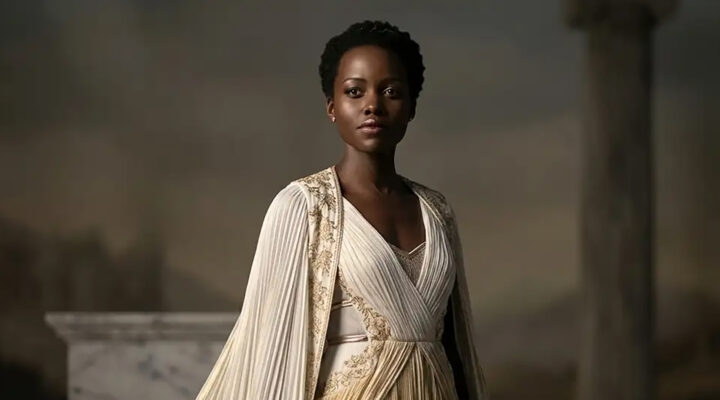

Lupita Nyong’o has been cast as Helen of Troy in Christopher Nolan’s upcoming historical retelling of Homer’s The Odyssey, and conservative white men are irate.
Elon Musk tweeted that Nolan “desecrated The Odyssey” and claimed newly implemented representation and inclusion standards for Oscars® eligibility was driving Nolan’s casting decisions.

Lupita Nyong’o (Photo by Jordan Strauss/Invision/AP)
Never mind that The Odyssey would meet said standards without Nyong’o’s casting.
Matt Walsh chimed in that “not one person on the planet actually thinks that Lupita Nyong’o is ‘the most beautiful woman in the world.’ But Christopher Nolan knows that we would be called racist if he gave ‘the most beautiful woman’ role to a white woman.”
Never mind that Nyong’o was People magazine’s World’s Most Beautiful Woman in 2014.
This was just the tip of the iceberg of racist commentary on the casting.
NewsMax’s Rob Finnerty, speaking above a chyron titled “Holly-woke delivers movie adaptation to appeal to Left,” went on a long tirade about the film and casting, calling it a “rewriting of history.”
Never mind that The Odyssey is a fictional mythological epic and Helen is portrayed elsewhere in Greek literature as having hatched from an egg laid by her human mother after she was raped by the Greek god Zeus in the form of a swan.
Whatever the justification, whatever the euphemism, the conservative backlash to Nyongo’s casting rests on a simple assumption: Helen of Troy is supposed to be white. Not historically white, because Helen never was historical. Not textually white, because Homer never describes her in modern racial terms. But culturally White — capital W, the product of centuries of European art, Western classicism and racialized white supremist ideas of beauty.
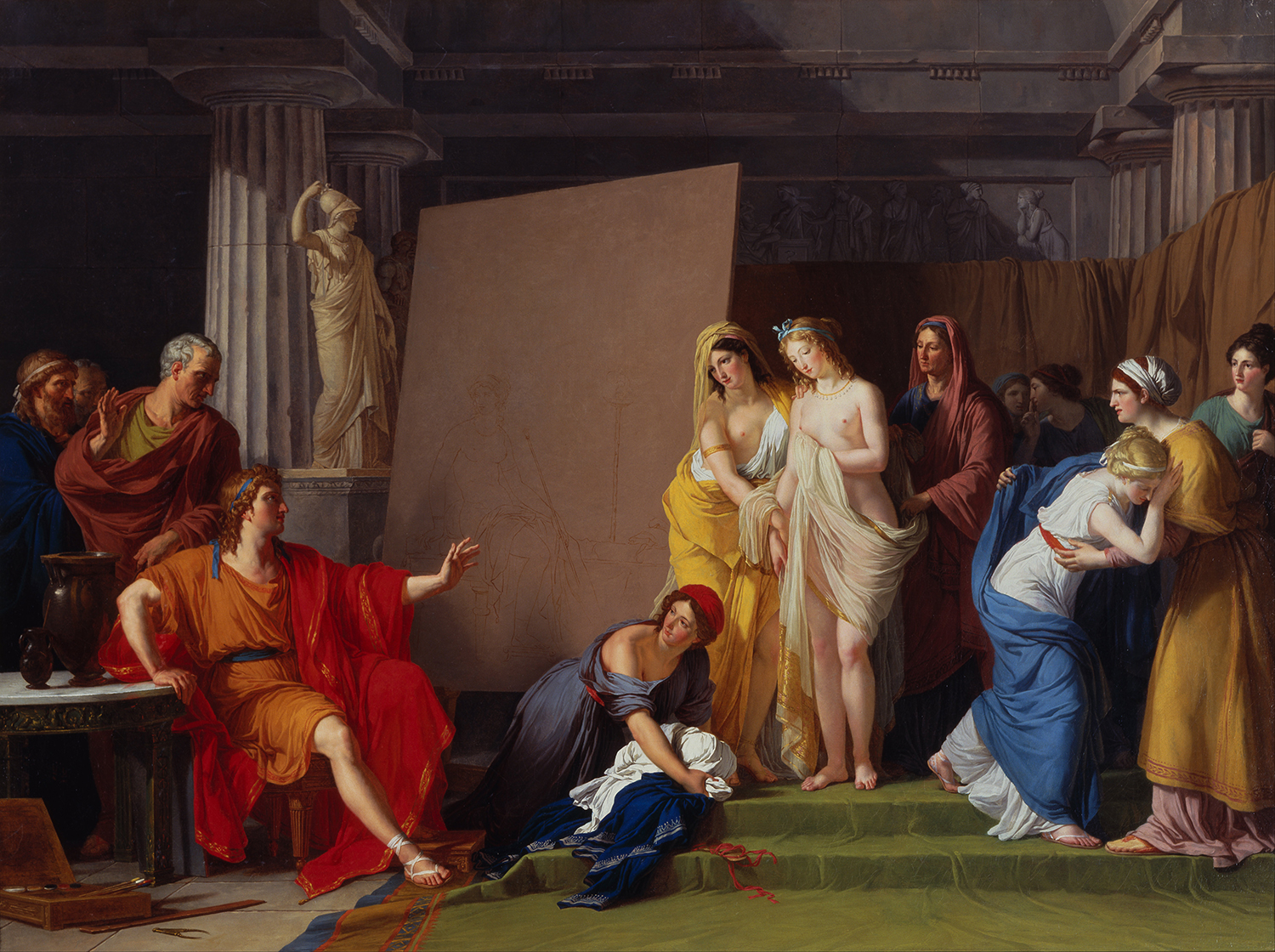
” Zeuxis Choosing his Models for the Image of Helen from among the Girls of Croton,” 1791, Vincent François-André
How Helen became white
The modern visual imagination of Helen of Troy does not come from ancient Greek literature but the European Renaissance, which remade Helen in its cultural image. Greek texts from Homer or Euripides speak of Helen and her beauty with broad strokes, focusing on her charisma and presence as partially divine. She was a prototypical beauty, described in poetic and symbolical language precisely so that every reader or listener — each with their own predilections of beauty — could render a Helen of their own imagination.
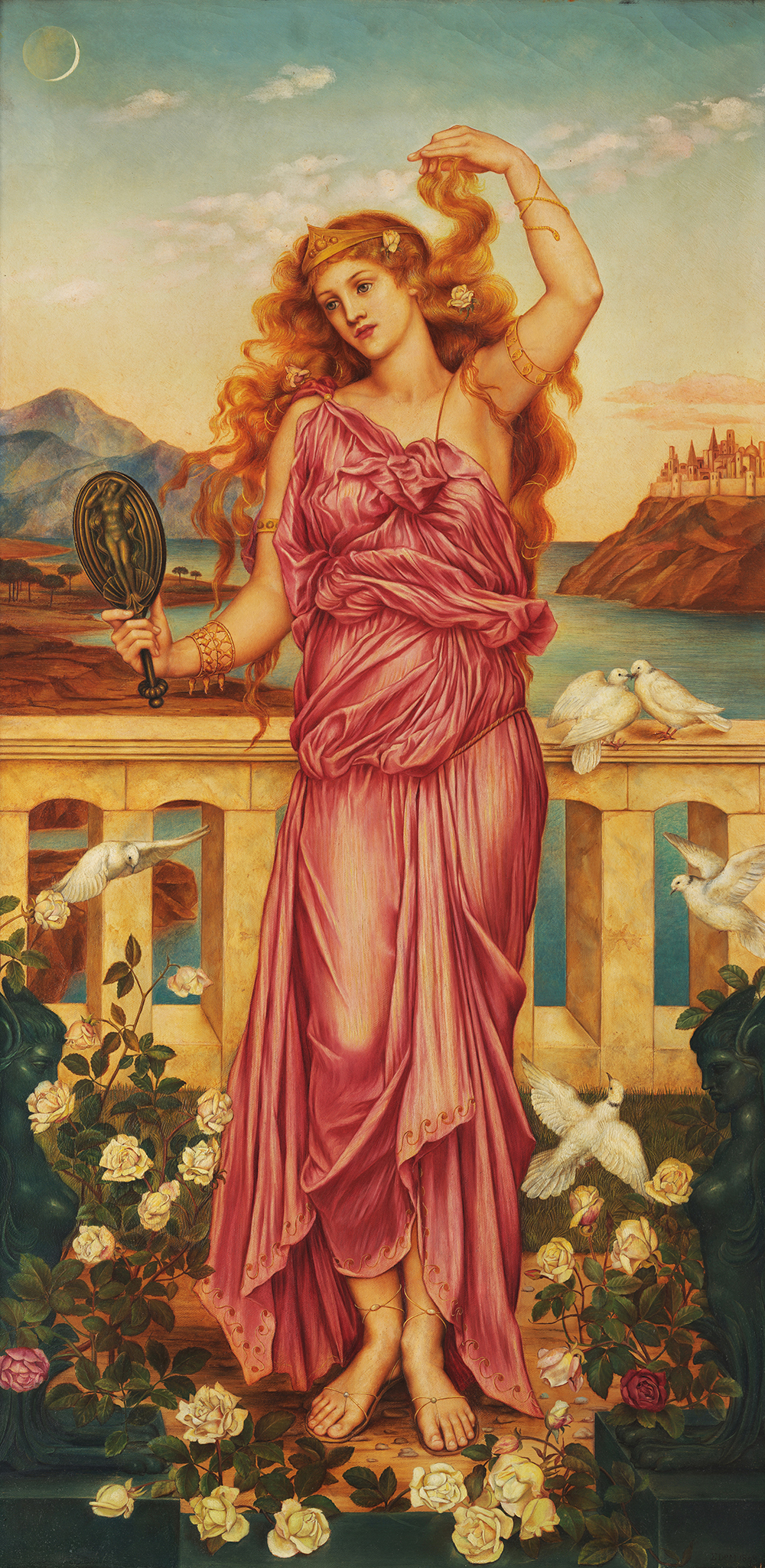
“Helen of Troy” by Evelyn De Morgan (1898, London); (wikipedia)
In the Louvre, there is a painting called Zeuxis Choosing His Models for the Image of Helen from Among the Girls of Croton. Painted by François-André Vincent, it details the story of the fifth-century B.C. painter Zeuxis of Heraclea who, according to Cicero, was commissioned by the people of Croton to produce a painting for their local temple of Juno. Zeuxis chose to portray Helen of Troy, but soon realized no single model could ever possess Helen’s beauty. Therefore, he chose the five most beautiful women from the region and combined their best features into a composite.

In this painting, Vincent shows Zeuxis observing the women, but his canvas — the central theme of the painting — is blank. It is up to the viewer to decide what Helen’s beauty means. Helen of Troy is a timeless stand-in for the idealized lust of the male gaze.
The genesis of Helen of Troy as white begins in Medieval times, where her reception and representation were part of a larger process of reinterpreting classical figures into European literary and visual frameworks, reshaping her identity according to the cultural assumptions of the period. The Trojan War, in particular, was portrayed in the dress and location of Medieval and Renaissance Europe and interpreted through the lens of Christianity and the Crusades.
One 15th-century illuminated manuscript of Histories of Troy portrays knights, castles and Medieval dress, indicative of the artists seeing history through a contemporary lens. The Baroque and Neoclassical periods that followed in the 18th and 19th centuries further cemented this transformation. This would continue into the film era, with Helen being portrayed by actors such as Rossana Podestà, Elizabeth Taylor, Sienna Guillory and Diane Kruger — all examples of white, Eurocentric beauty.
What whiteness means
Helen’s whiteness, then, is not about skin color or historical accuracy — it’s about cultural representation. The culture choosing to depict a character purposefully written to reflect a timeless, idealized beauty for any culture will, naturally, choose to reflect something that looks like them.
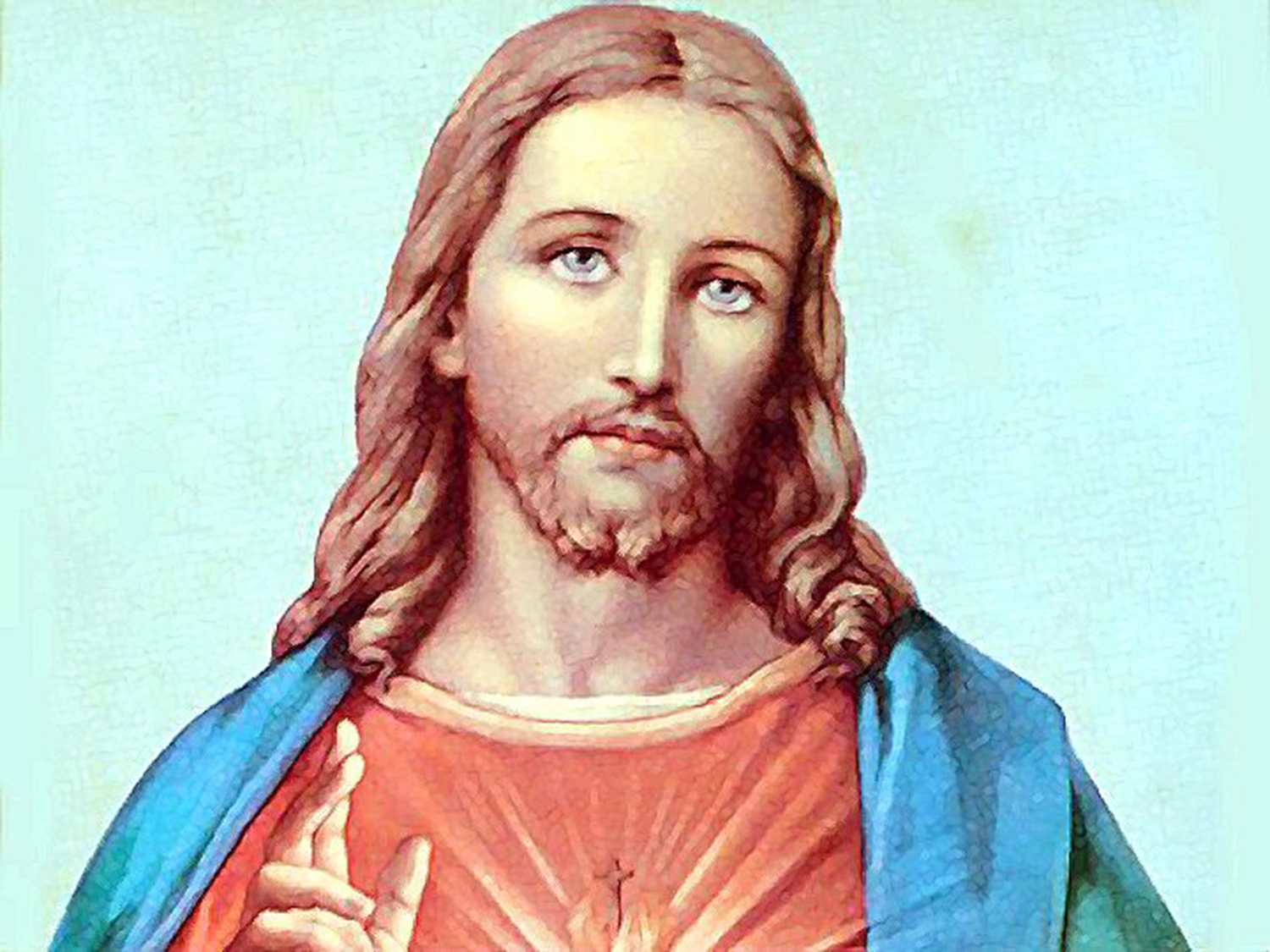 Helen becomes white in the same way Jesus became white. This is not inherently wrong. We want to be able to see ourselves in art, literature and, yes, religion.
The problem comes when there is an insistence on continued whiteness amid cultural changes. Helen of Troy as a literary and artistic figure is meant to be an idealized beauty for her intended audience. If the intended audience for Christopher Nolan’s The Odyssey is multi-cultural, multi-ethnic and global, then Lupita Nyong’o — born in Mexico, raised in Kenya, educated in the United States — is an excellent casting choice. She is culturally representative of the global audience Nolan envisions.
The backlash to her casting is not that it isn’t culturally representative or that she isn’t beautiful, it’s that her Blackness stands in stark contrast to hundreds of years of mostly unchallenged whiteness. That a Black woman could be Helen of Troy for a global audience means white folk don’t hold the cultural power or supremacy they once did. In her body, Lupita Nyong’o as Helen of Troy challenges the visual language of whiteness at a foundational level.
Whiteness isn’t about culture or skin color. It’s a way of being in the world. Willie James Jennings defines whiteness as “a way of perceiving the world and organizing and ordering the world by the perception of one’s distorted place within it” along with “the power to place that perception on other people and to sustain it.”
In other words, whiteness is when folks place themselves at the center of the universe and utilize that centrality to decide who has access to power and who does not. It is called “whiteness” because it is most commonly reflected in the colonial and dominionist political, social and theological tendencies of the Western world. A white Helen of Troy is not just symbolic of Western beauty aesthetics but a symbol of whiteness.
A Helen for all people
Central to Helen of Troy’s identity is that she once was Helen of Sparta. That is the whole reason for the Trojan War, after all. Helen has been queen consort to King Menelaus of Sparta but is seduced/abducted by Paris, prince of Troy, to become his wife. The Spartans’ expedition to retrieve Helen is what launches the war — and comprises the central conflict within The Iliad and The Odyssey. Helen, the embodiment of beauty, is ripped away from Sparta and given to the Trojans.
There is some significance, then, that Sparta has long been a symbolic shorthand for militarism, hypermasculinity, racial purity and authoritarian social order. Going back to the Civil War, post-war white Southerners memorialized Confederate soldiers using Spartan analogies. In recent history, during the attempted insurrection on January 6, 2021, some insurrectionists wore Spartan helmets while others flew a flag bearing a quote from Spartan king Leonidas.
“White supremacists will gladly draw a direct line from Sparta to their own views.”
White supremacists will gladly draw a direct line from Sparta to their own views.
Jared Taylor, author of White Identity — in which he argues for segregation — has said white Americans face “extermination” and called on them to “choose to be like the countless white heroes” such as the Spartans.
David Lane, a white supremacist best known for his formulation of the so-called 14 words, once wrote in an essay that Spartans were “a model of heroism for white people everywhere.”
In his book, The White Pedestal: How White Nationalists Use Ancient Greece and Rome to Justify Hate, Curtis Dozier writes that Sparta has become symbolic of white nationalism because it is understood “as a model of masculine resistance to the threat of foreign invasion.” It is not too far a leap, then, to say that Helen of Sparta is understood as a model of feminine beauty that is threatened by the foreign invasion of nonwhite beauty.
It is this mindset driving Musk, Walsh and others to react against a Black Helen. Like the Spartans, the cultural symbol of beauty is no longer theirs. Helen of Sparta has become Helen of Troy. And so they’ll tweet their outrage.
What Lupita Nyong’o represents is a world that is more than white, a future that is multi-colored and multi-cultural, where power and beauty shine in a vibrant display of skin tones, ethnic backgrounds and lived experiences. She is a challenge to a system that inherently privileges and empowers whiteness.
White nationalists are right that Nyong’o’s depiction of Helen of Troy is significant. But what unsettles them is not that her casting betrays the myth of Helen, but that it exposes the myth of whiteness beneath it.

Josh Olds
Josh Olds is a public theologian and pastor for those disillusioned with institutional church. He is the creator of the small-group video series “Year on the Mountaintop” and a featured contributor to Fostering Hope: A Prayerbook for Fostering and Adoptive Parents. Follow his work on Facebook or at JoshOlds.com.