

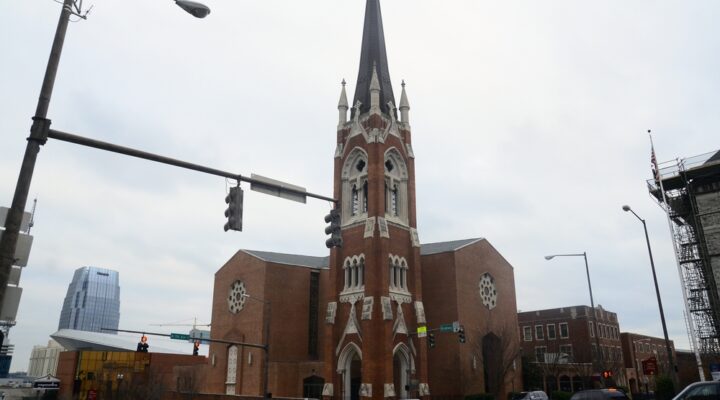
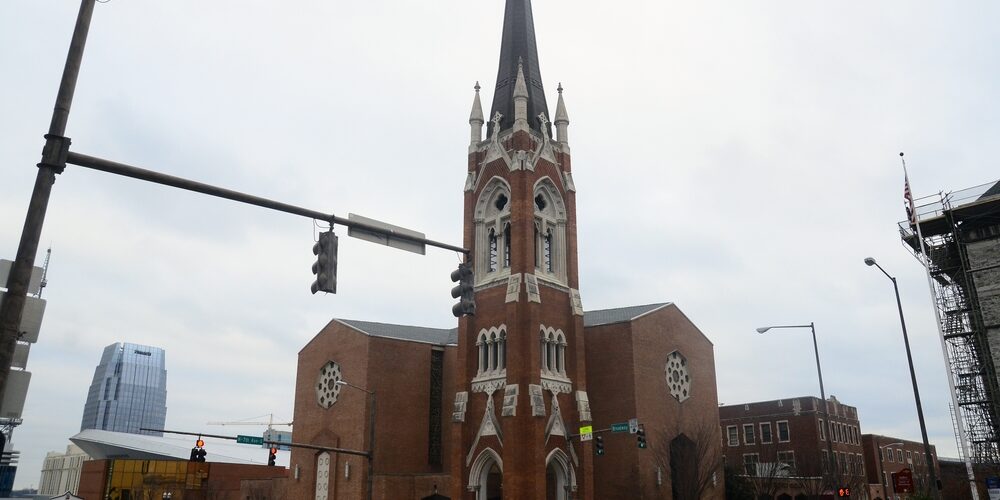
In March 1886, members of Nashville’s First Baptist Church gathered for what would be their final prayer meeting inside a synagogue on South Vine Street.
For nearly a year, the congregation had worshipped there while its new church building was under construction nearby at Broad and Vine. At the close of the meeting, the pastor, C. H. Strickland, called the church into conference. A resolution had been prepared.
“The pastor, deacons, trustees and other members of the First Baptist Church of Nashville desire to return grateful and sincere thanks to Rabbi J. S. Goldammer” and to the Jewish congregation “for the free use of their spacious and comfortable house of worship.”
The Baptists thanked the synagogue not only for opening its doors, but for doing so repeatedly and at inconvenience to itself. The resolution noted that Jewish services and meetings had at times been rearranged to accommodate the Christian congregation while it was without a permanent home.
“We wish our Israelitish friends to know,” the Baptists declared, “that we feel deeply our obligations to them for affording us a place of worship.”
The resolution was adopted by a standing vote.
One church member described the hospitality as “a signal favor … that ought to be held in grateful remembrance.”
Another remarked that “the highest type of kindness was for a man to anticipate the wants of a fellow-man and tender the aid before being asked to do so. This our Hebrew friends had done.”
Capt. M.B. Pilcher recalled that Jews in Nashville had urged the Baptists again and again to use the synagogue before the church had even left its former building.
“It would have been painful to them if we had declined to accept the proffered favor,” Pilcher said.
The pastor himself spoke of the synagogue’s “signal kindness,” recalling the rabbi had even altered festival observances rather than ask the Baptists to surrender meeting time.
Shutterstock.com
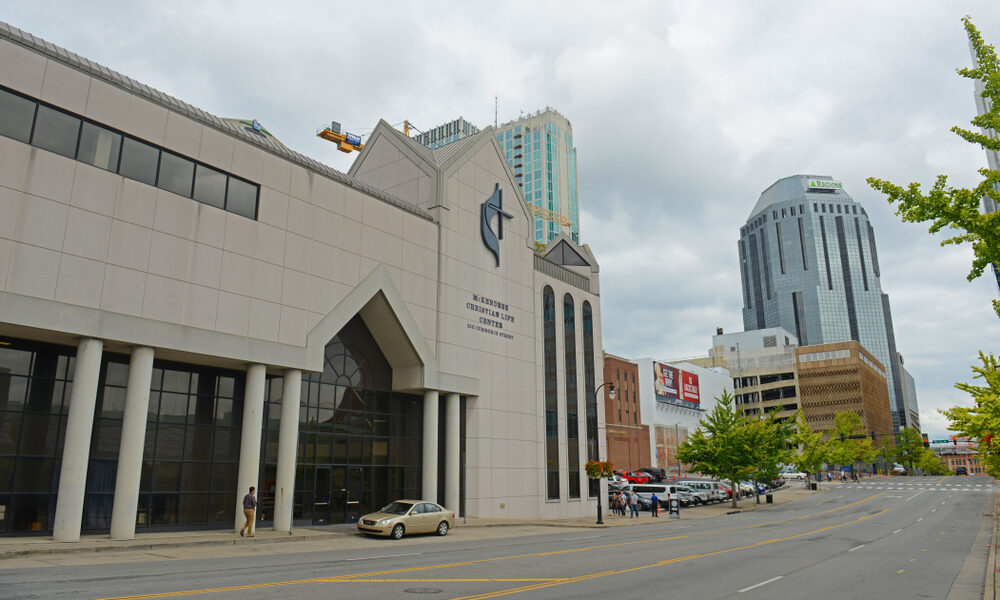
The synagogue still exists in Nashville today. So do First Baptist and McKendree United Methodist Church, which also benefited from the synagogue’s hospitality.
Seven years earlier, after a fire destroyed McKendree Methodist Church, the same synagogue had opened its doors to that congregation.
“The singular spectacle of a Christian congregation worshipping in a Jewish synagogue will be witnessed today in Nashville,” one Tennessee newspaper reported in November 1879.
The writer lingered on what the arrangement represented: “No people have been more rigid in their opinions or adhere now with more tenacity to their convictions than the Jews. The Methodists have been marked by an equally tenacious adherence.”
Yet the paper insisted the arrangement did not require surrender from either side.
“You have your opinions, I have mine,” the article summarized the spirit of the moment, “but we are both men and can perform toward each other friendly human offices, without yielding or obtruding on each other our opinions.”
The relationship between Nashville’s Baptists and Jewish congregation eventually produced something beyond shared space.
In May 1886, after the Baptists had moved into their new church building, members of the Vine Street Temple invited Pastor Strickland back to deliver a lecture. The sanctuary was reportedly “lighted up brilliantly” and filled with both congregations.
“I take it is somewhat remarkable,” Strickland began, “that I should stand in this place and speak to you, the descendants of Jacob, the speaker himself a Christian.”
The minister spoke at length about Jewish endurance, Jewish history and the antiquity of Israel.
“No nation on the face of the earth can boast of such a galaxy of illustrious names as Israel,” he declared. “The illustrious Nazarene himself was a Jew.”
He praised Jewish perseverance across centuries of exile and persecution. He marveled that empires had risen and decayed while Israel endured.
But the lecture did not dissolve theological difference into sentimentality. Strickland ultimately spoke as a Baptist minister convinced of Christianity’s truth.
“I have profound respect for your convictions,” he told the congregation, “but in justice to myself I have been compelled to say that at some time the favored nation of God will come to bow with me at the Cross.”
The Jews who welcomed him into the synagogue possessed convictions no less deeply held.
When the synagogue itself had been dedicated in 1876, one local paper reported that Jews and Christians filled the sanctuary in nearly equal numbers.
The dedicatory address by Rabbi Alexander Rosenspitz described Judaism as a faith grounded in the unity of God, human dignity and the commandment: “Thou shall love thy neighbor as thyself.”
“The prayers and hymns which will here be offered,” the speaker declared, “are invocations to our Heavenly Father to grant his blessings not only to us, but to all his children.”
The sermon also spoke in confident universal terms of its own. Judaism’s truths, Rabbi Rosenspitz declared, “will one day be universally acknowledged, and form the basis of a universal religion.”
The congregation called itself Ohabai Sholom — Lovers of Peace.
These stories come from the 19th century, from a period we too easily imagine as incapable of such interfaith partnership. The people gathered in Nashville’s synagogue in 1876 and again in 1886 did not believe the same things. They did not need to pretend otherwise.
What they shared was a willingness to make room for one another while allowing real differences to remain visible and speakable.
In a divided national moment, that may be part of what these records still offer — not a sentimental story of agreement, but an older example of disagreeing without being disagreeable. The sources preserve free expression of conviction alongside gestures of practical kindness. Thanks offered publicly, doors opened for guests.
Such kindness did not erase differences.
It simply refused to make conviction an obstacle to hospitality.

Austin Albanese
Austin Albanese is a historian and writer focused on overlooked stories, especially those rooted in Jewish life, civic memory and small-town American experience.